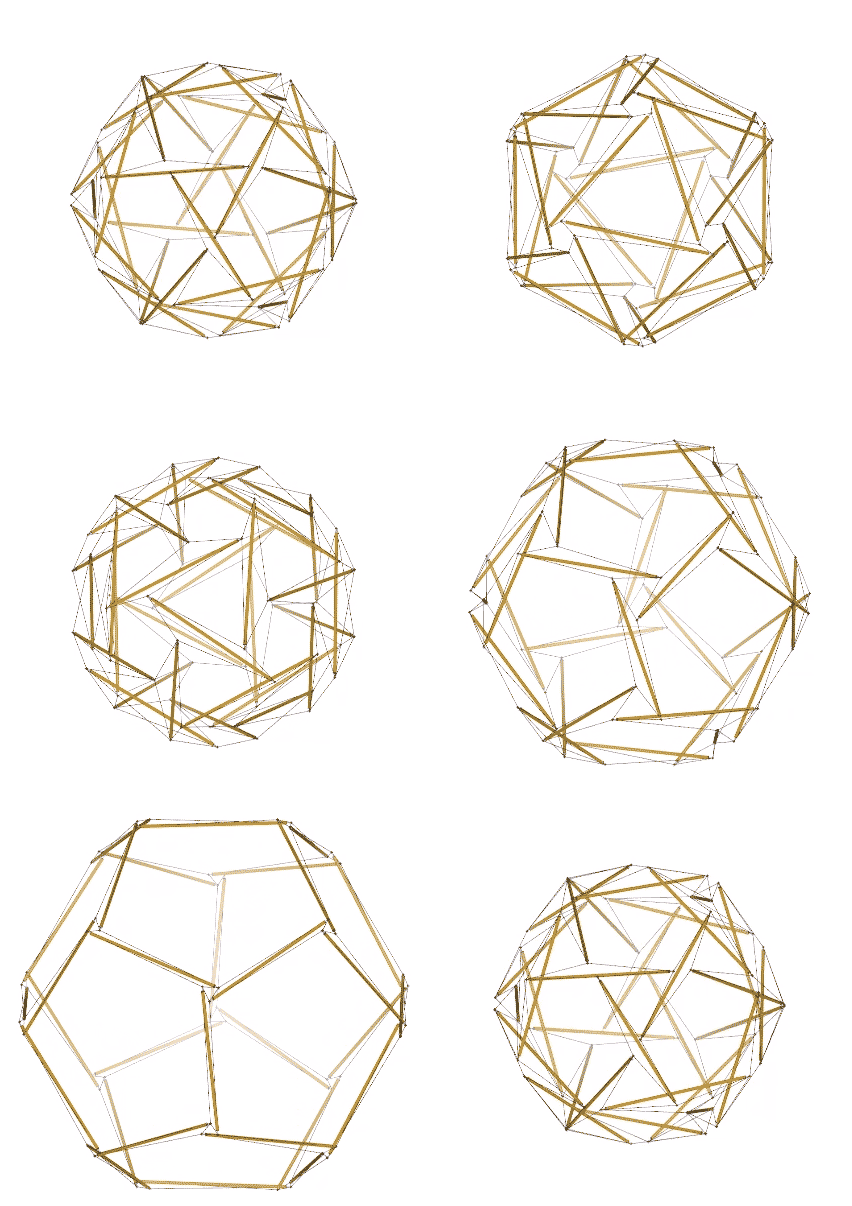
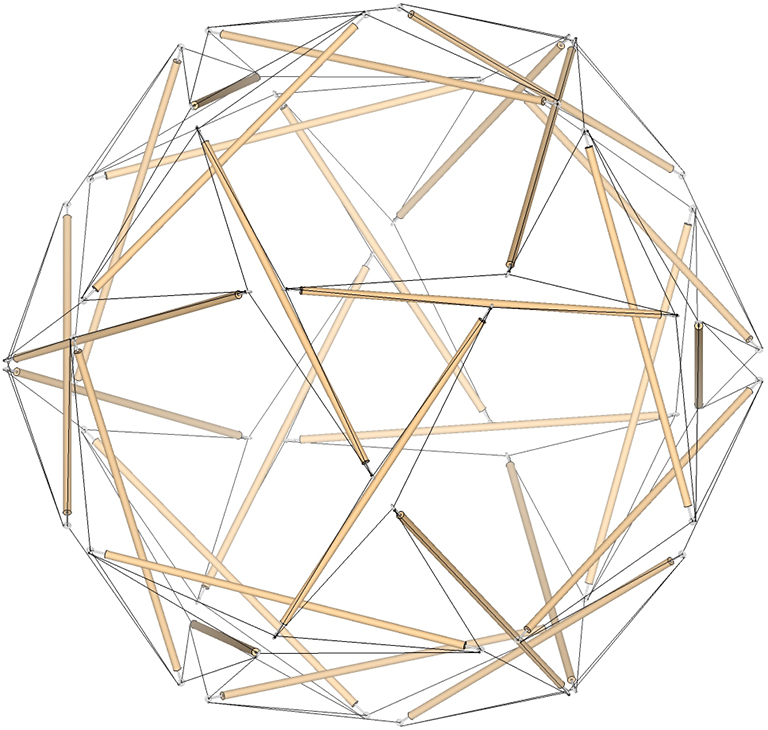
The 30-strut tensegrity sphere is the spherical, or tensor equilibrium phase of the regular icosahedron and its dual, the pentagonal dodecahedron.
The pentagonal dodecahedron is the dual of the icosahedron.
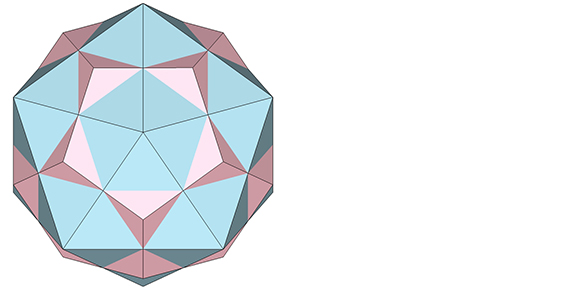
Rectification of either (or the intersection of both) produces the icosidodecahedron.
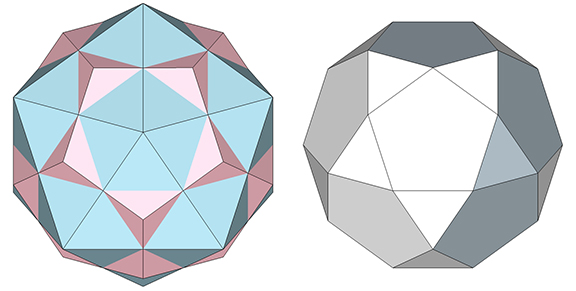
The 60 edges of a icosidodecahedron consist of six intersecting decagons (10-sided polygons). Connecting alternate vertices of the six decagons produces six pentagons whose edges align with the distribution of the struts in the 30-strut tensegrity sphere.
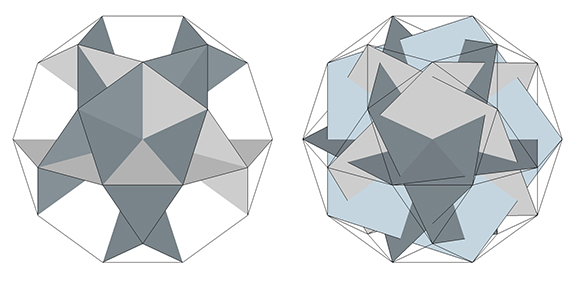
Each of the six intersecting pentagons of the 30-strut tensegrity sphere consists of five struts and the triangular cross section of the valley formed by the tendons connecting each strut-pair to its dangler. The dimensions of this triangular cross-section are illustrated below.
- n (number of sides of the polygon) = 5
- δ = 180°/n = 36°
- S = strut length
- d (vertical distance from polygon’s edge to strut) = S×tan(δ/2)/4
- d’ (height of the triangle formed by the strut ends and the polygon’s vertex) = d×cos(δ)
- h (height of the triangle formed by the strut ends and the midpoint of their dangler strut) = d+d’
- gap (distance between strut ends) = S×sin²(δ/2)/2
- dip (distance from strut end to midpoint of dangler strut) = S×sin(δ/2)/2
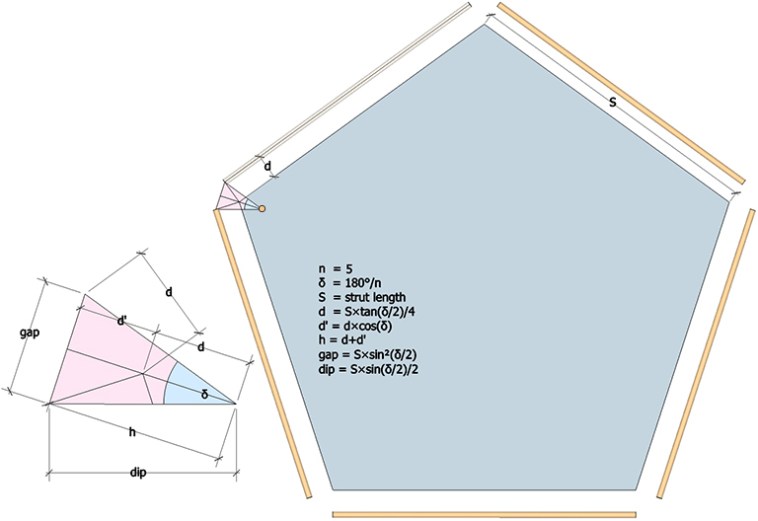
In its spherical, or equilibrium phase, the dimensions of the cross section of the tension valley created by the tendons reach their maximum. In its polyhedral phases (described below), δ approaches 0°, and both the gap and dip approach zero (0).
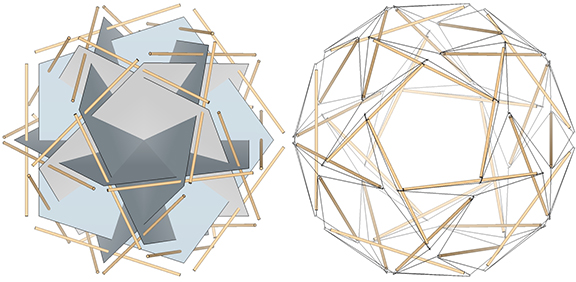
Transformation of the 30-Strut Tensegrity Sphere to the Tensegrity Icosahedron and the Tensegrity Pentagonal Dodecahedron
From the spherical phase, the 30-strut tensegrity sphere is reduced to the tensegrity icosahedron by moving each strut along the short tendon toward the end of its dangler, as illustrated below.
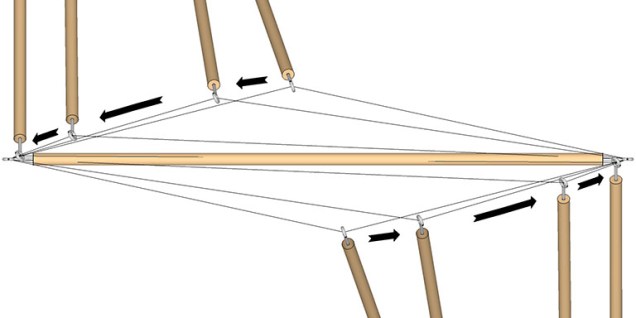
The sphere is reduced to the tensegrity pentagonal dodecahedron by moving each strut along the long tendon toward the end of its dangler, as illustrated below.
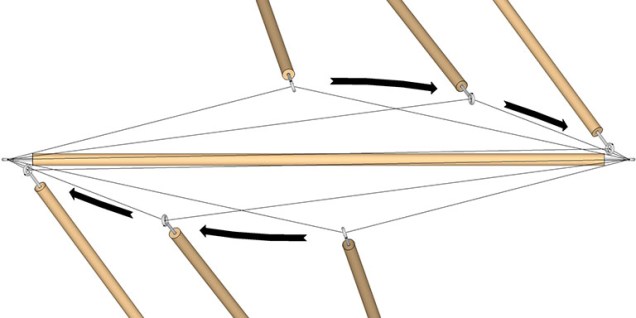
The surface of the 30-strut tensegrity sphere describes twenty triangular tendon-loops, and twelve pentagonal tendon-loops. In the transition to the icosahedron, the twenty triangular tendon loops transform into the icosahedron’s twenty faces, and the twelve pentagonal loops transform into its twelve vertices. In the transition to the pentagonal dodecahedron, the roles are reversed: the twenty triangular loops become its vertices, and the twelve pentagonal loops become its faces.
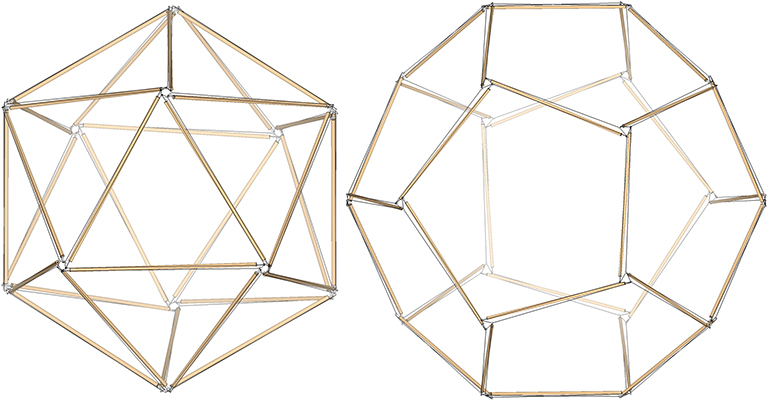
The oscillation from the tensor equilibrium (spherical) phase, to the extremes of the icosahedron and pentagonal dodecahedron phases, may be stopped at any point and the model will hold its shape. As long as the elasticity and tautness of the tendons is maintained, the models do not show a preference for one state over another.