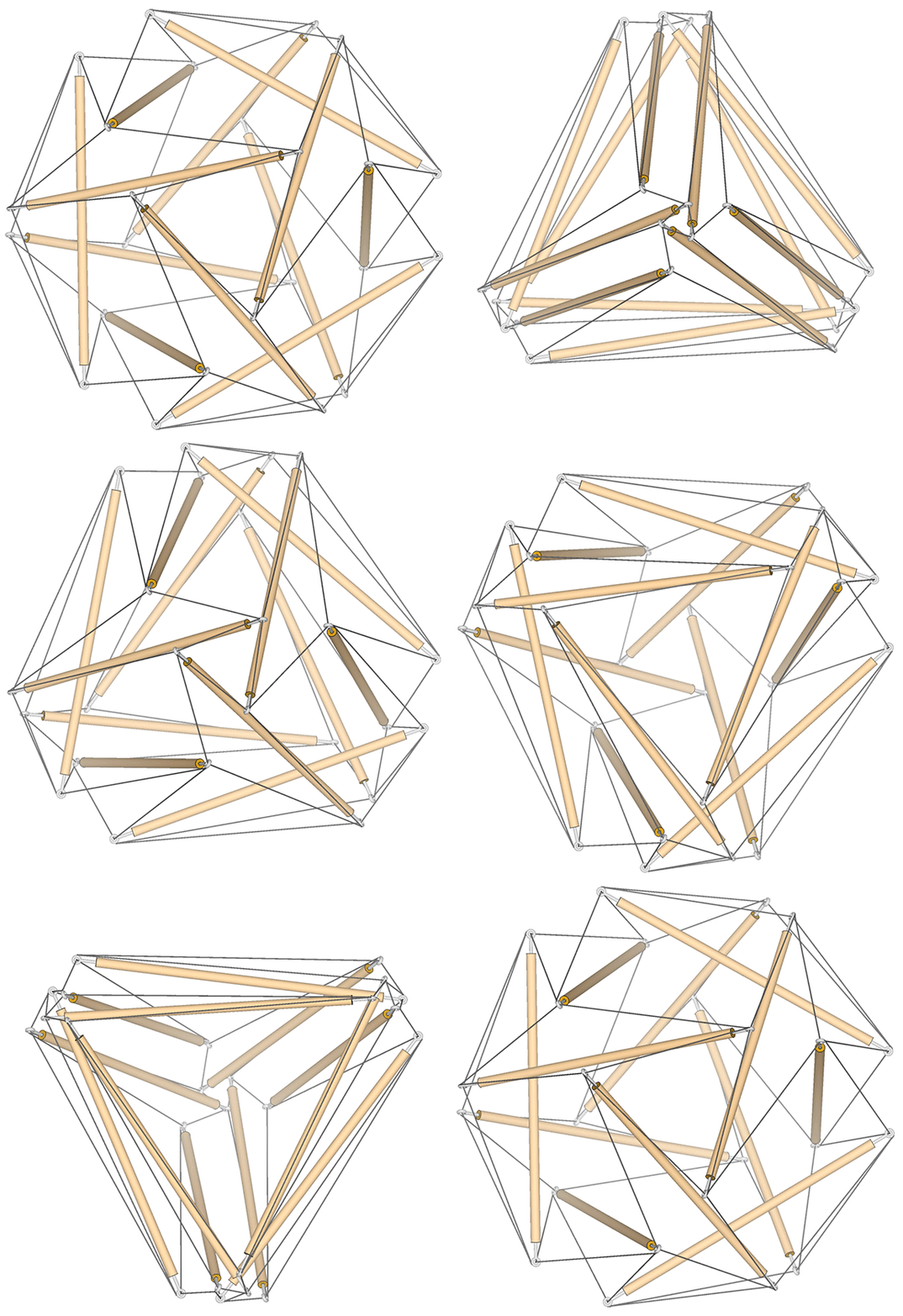
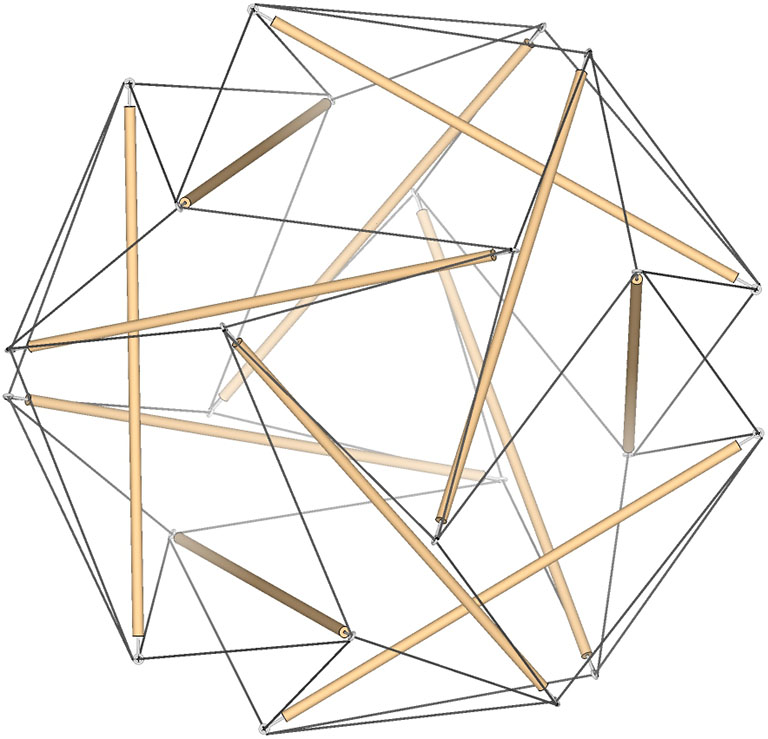
The 12-strut tensegrity sphere is the spherical, or tensor equilibrium phase of the tensegrity cube and its dual, the tensegrity octahedron. It also reduces to the double-edge tensegrity tetrahedron and its dual, which is the same polyhedron but with the vertices and faces transposed.
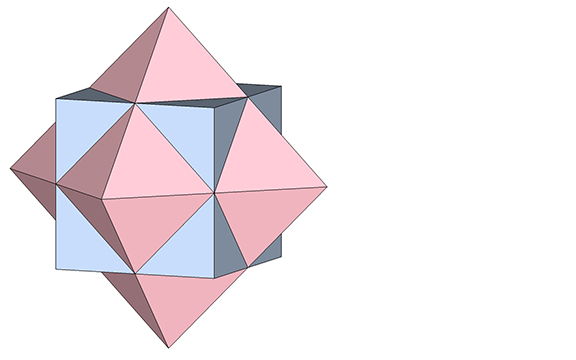
The cube is the dual the regular octahedron.
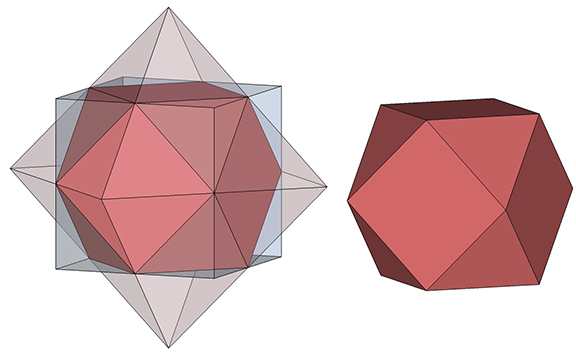
Rectification of either produces the cuboctahedron, i.e, the vector equilibrium or VE.
The 24 edges of the VE describe four intersecting hexagons. Connecting alternate vertices of these hexagons describes four equilateral triangles whose edges align with the distribution of the struts in the 12-strut tensegrity sphere.
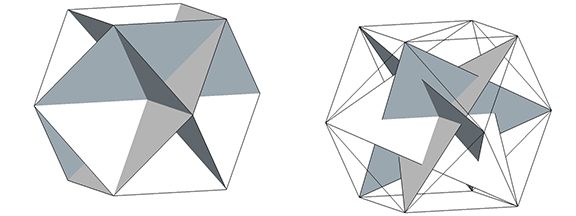
Each of the four intersecting triangles of the 12-strut tensegrity sphere consists of three struts and the triangular cross section of the valley formed by the tendons connecting each strut-pair to its dangler. The dimensions of this triangular cross-section are illustrated below.
- n (number of sides of the polygon) = 3
- δ = 180°/n = 60°
- S = strut length
- d (vertical distance from polygon’s edge to strut) = S×tan(δ/2)/4
- d’ (height of the triangle formed by the strut ends and the polygon’s vertex) = d×cos(δ)
- h (height of the triangle formed by the strut ends and the midpoint of their dangler strut) = d+d’
- gap (distance between strut ends) = S×sin²(δ/2)/2
- dip (distance from strut end to midpoint of dangler strut) = S×sin(δ/2)/2
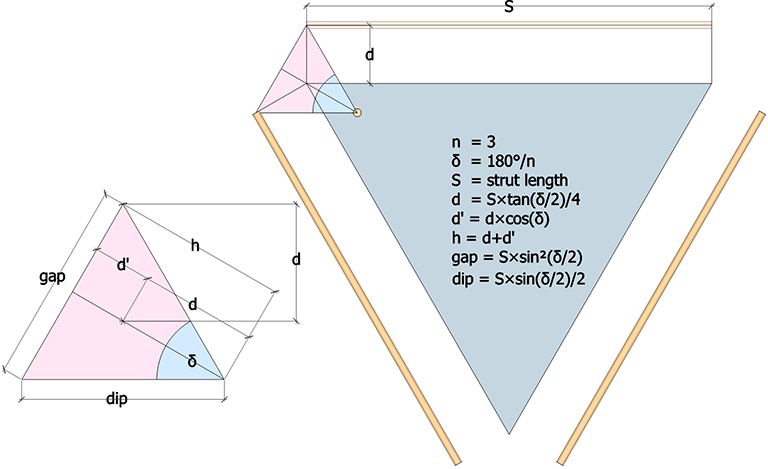
In its spherical, or equilibrium phase, the dimensions of the cross section of the tension valley created by the tendons reach their maximum. In the polyhedral phases described below, δ approaches to 0°, and both the gap and dip go to zero (0).
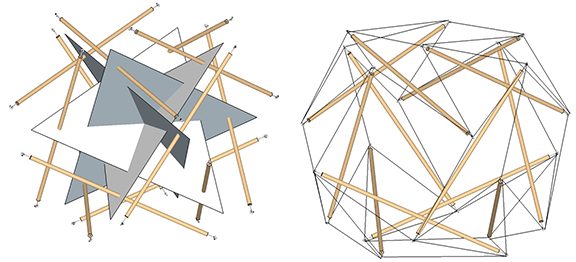
Transformation of the 12-Strut Tensegrity Sphere to the Tensegrity Cube
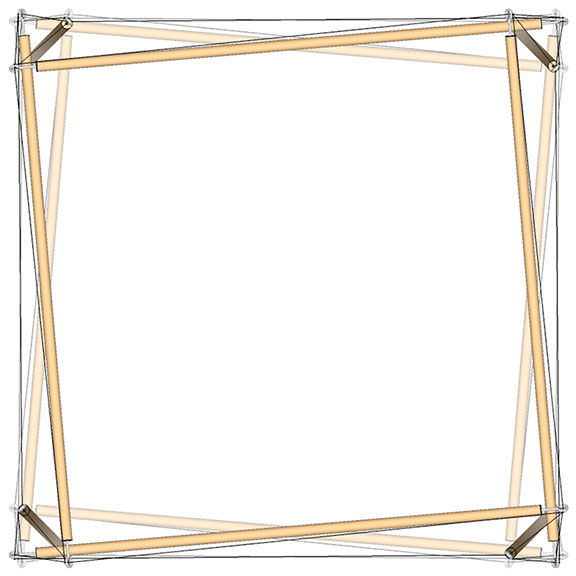
From the spherical phase, the 12-strut tensegrity sphere is reduced to the tensegrity cube by moving each strut along the short tendon toward the end of its dangler, as illustrated below.
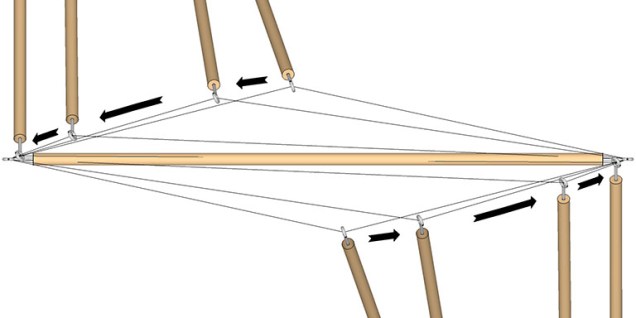
The surface of the 12-strut tensegrity sphere describes eight triangular tendon-loops and six square tendon-loops. A face-on view of one of the square tendon loops is illustrated below.
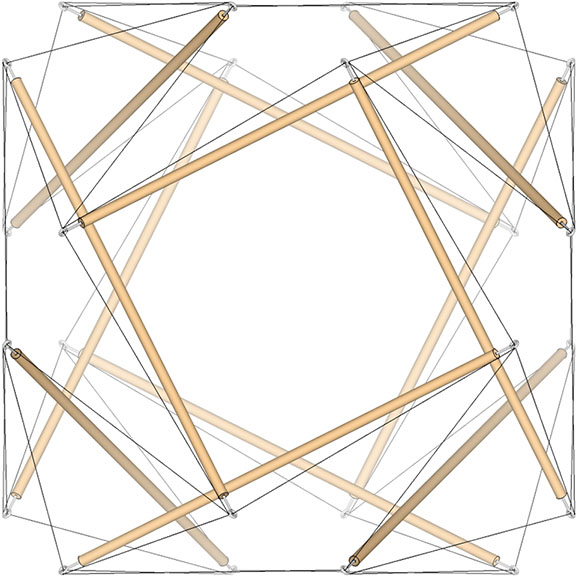
In the transition to the cube, the six square tendon loops transform into the cube’s six faces, while the eight triangular loops transform into the cube’s eight vertices.
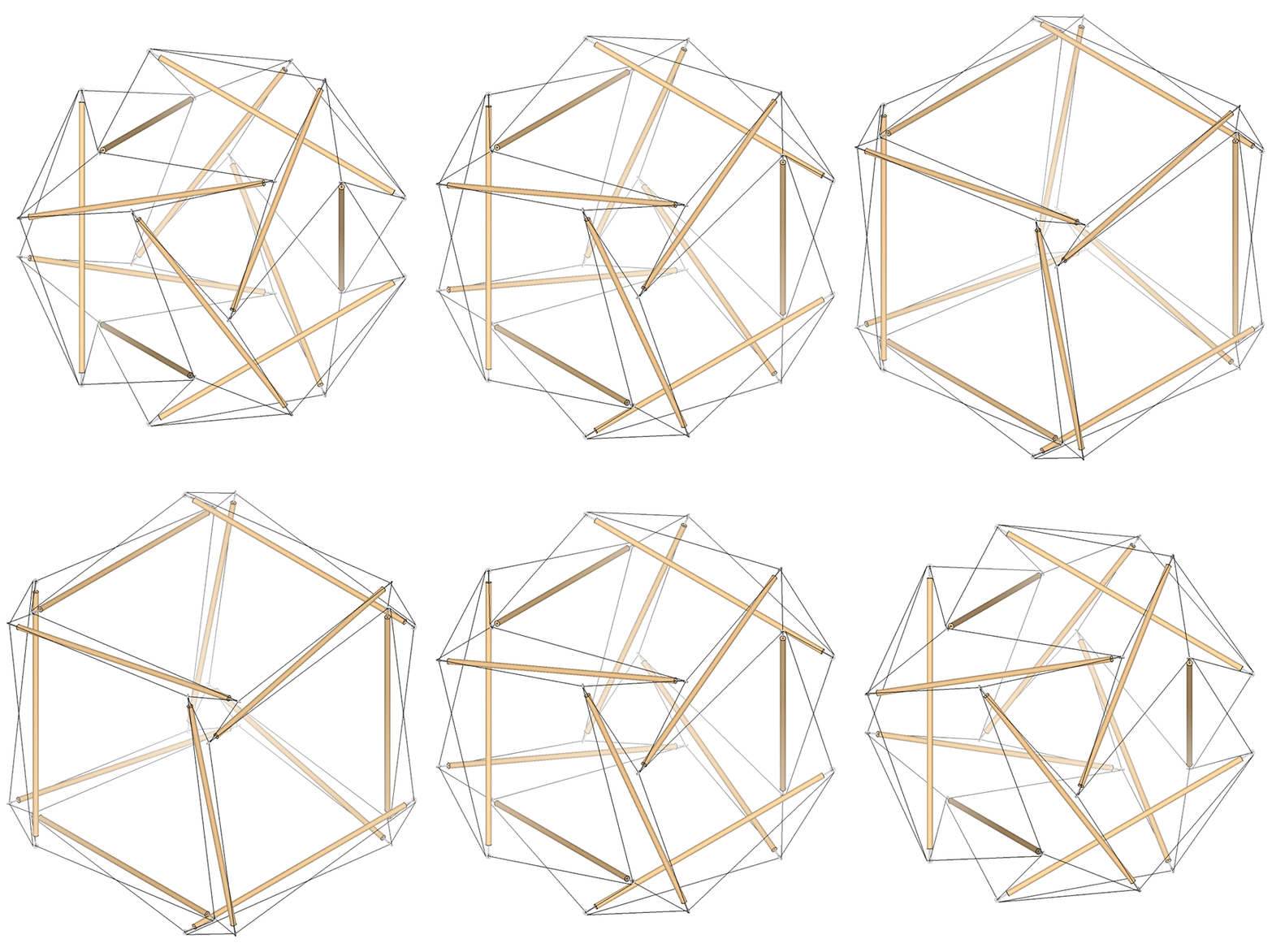
Transformation of the 12-Strut Tensegrity Sphere to the Tensegrity Octahedron
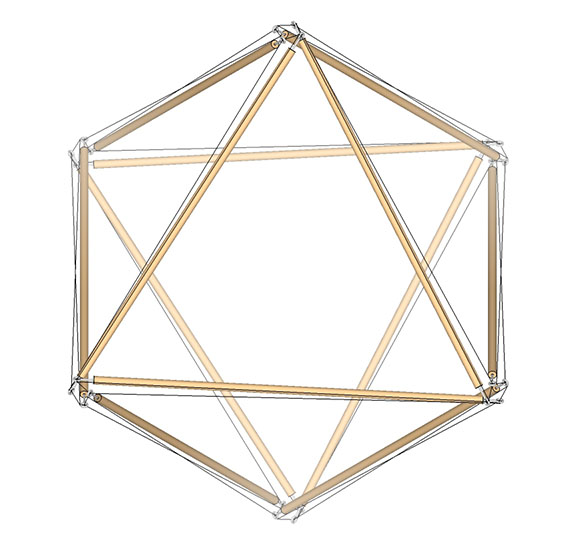
From the spherical phase, the 12-strut tensegrity sphere is reduced to the tensegrity octahedron by moving each strut along the long tendon toward the end of its dangler, as illustrated below.
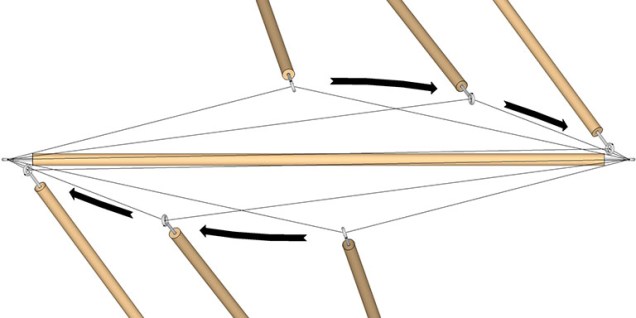
The surface of the 12-strut tensegrity sphere describes eight triangular tendon-loops and six square tendon-loops. A face-on view of one of the triangular tendon loops is illustrated below.
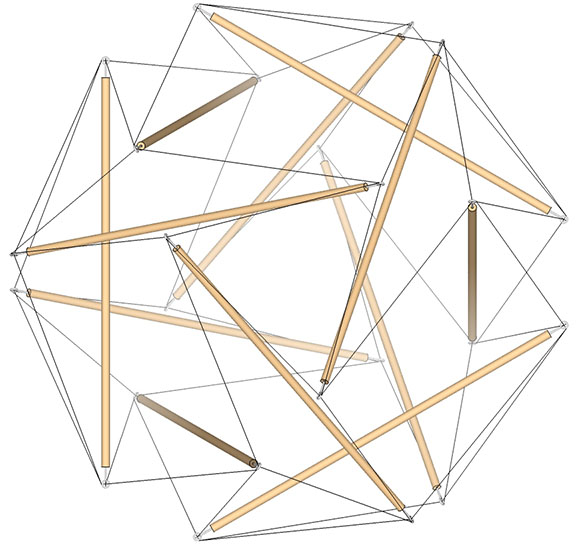
The six square loops of the 12-strut tensegrity sphere reduce to form the six vertices of the tensegrity octahedron, while the eight triangular loops expand of form its eight faces.
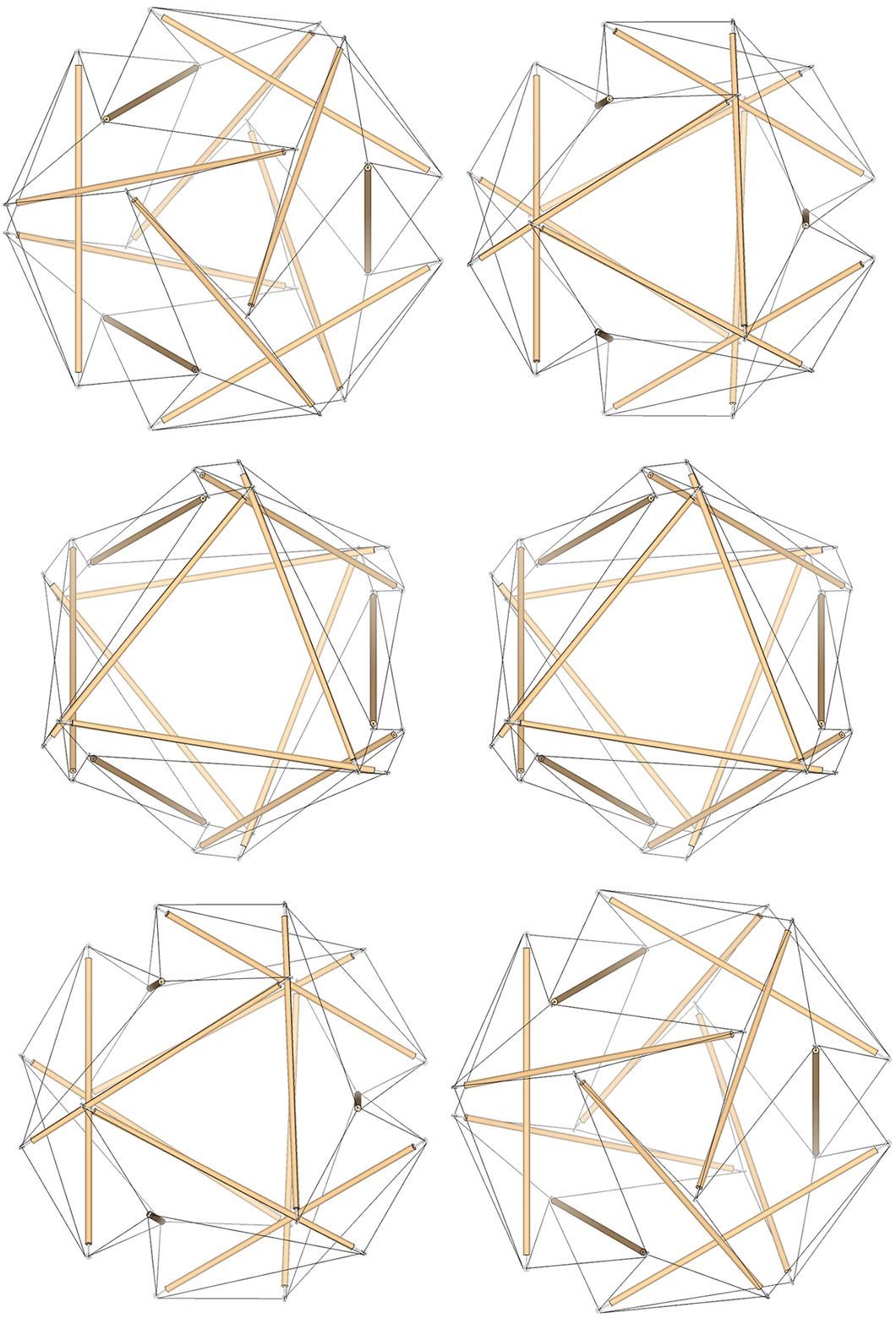
The oscillation from the tensor equilibrium (spherical) phase, to the extremes of the cube and octahedron phases, may be stopped at any point and the model will hold its shape. As long as the elasticity and tautness of the tendons is maintained, the models do not show a preference for one state over another.
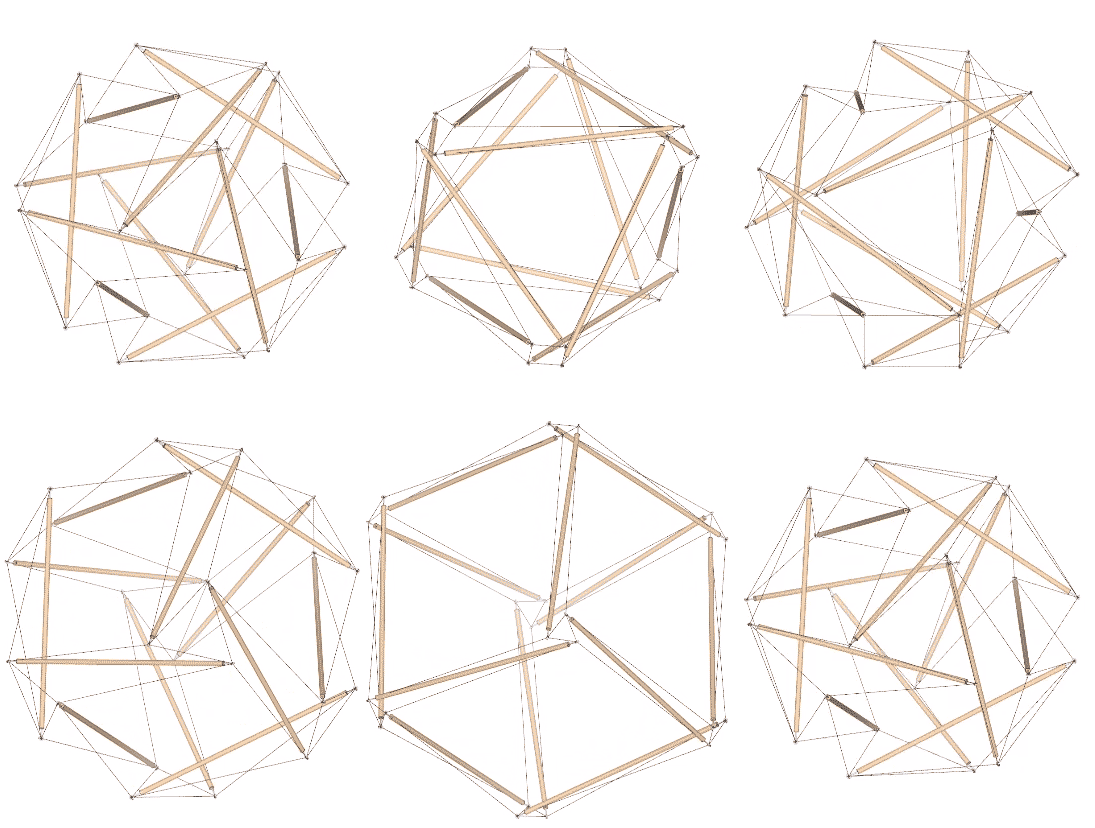
Note that the orientations (clockwise or counter-clockwise) of the triangular and square loops are mutually opposed. That is, if one is oriented clockwise, then the other will necessarily be counter-clockwise. That is, each polyhedron will always be counter the orientation of its dual at the other extreme of the transformation. This, however, does not seem to be the case for double-edged tetrahedron described below.
Transformation of the 12-Strut Sphere to the Double-Edged Tetrahedron
From its spherical phase, the 12-strut tensegrity can be transformed into a double-edged tetrahedron by moving the strut pairs together to either the left or right end of their danglers. That is, one strut moves along the short tendon, while the other moves along the long tendon toward the same end of their dangler.
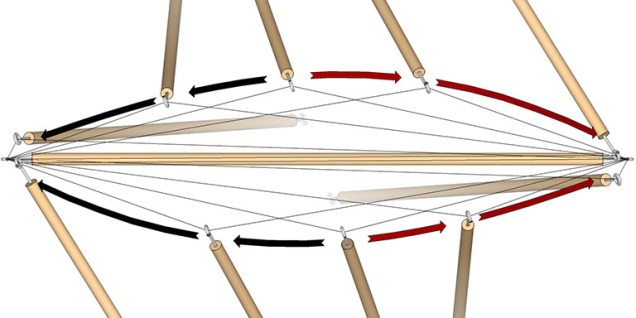
The surface of the 12-strut tensegrity sphere describes eight triangular tendon-loops and six square tendon-loops. A face-on view of one of the triangular tendon loops is illustrated below. On the left, the triangular loop is contracting to a vertex, while on the right, the triangular loop is expanding to a face. In both cases, the six square tendon loops are transformed into the six edges of the double-edge tetrahedron.
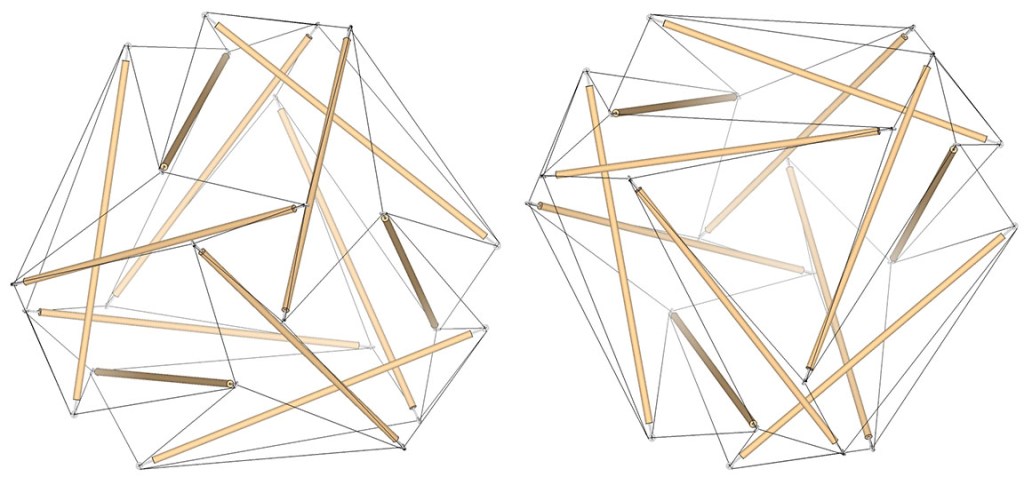
Note that both transformations (moving the strut pairs to either end of their danglers) produce the same double-edge tetrahedron. This is consistent with the fact that the tetrahedron is its own dual; the number of faces (4) is the same as the number of vertices (4), so transposing the two has no effect. However, with the other duals, if one’s vertices are oriented clockwise, the other’s are oriented counter-clockwise. With the double-edge tensegrity tetrahedron, the vertices are neither and both: three struts converge at the vertex oriented in one direction, and the other three come together oriented in the opposite direction, one effectively neutralizing the other.
The double-edge tetrahedron and, presumably, all the double-edge tensegrity polyhedra are, by the above reasoning, neutral counterparts to their polarized, single-edge counterparts. This may have intriguing implications for their relevance as models of quantum, chemical, and other physical interactions and open doors for theoretical exploration and research.
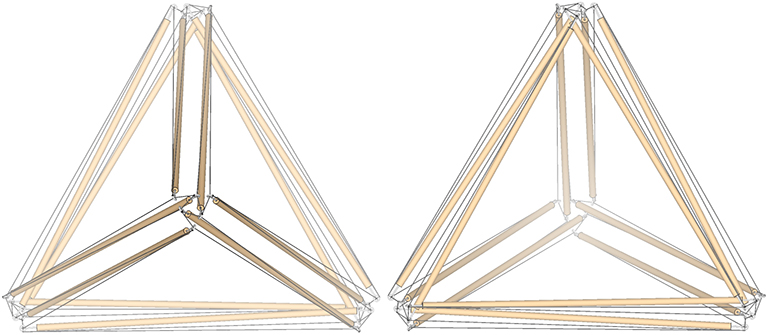
As with the transformations described above, the oscillations between the two double-edged tetrahedra may be stopped at any point in the process. The models do not some seem to prefer any one state over another, and will hold their shape in the transitional stages as well as at the extremes.