This is an ongoing journal of my personal explorations into the geometry of Richard Buckminster Fuller.
The following articles are arranged chronologically. An alphabetical list may be found in the sidebar. An index to the articles may be found here.
-
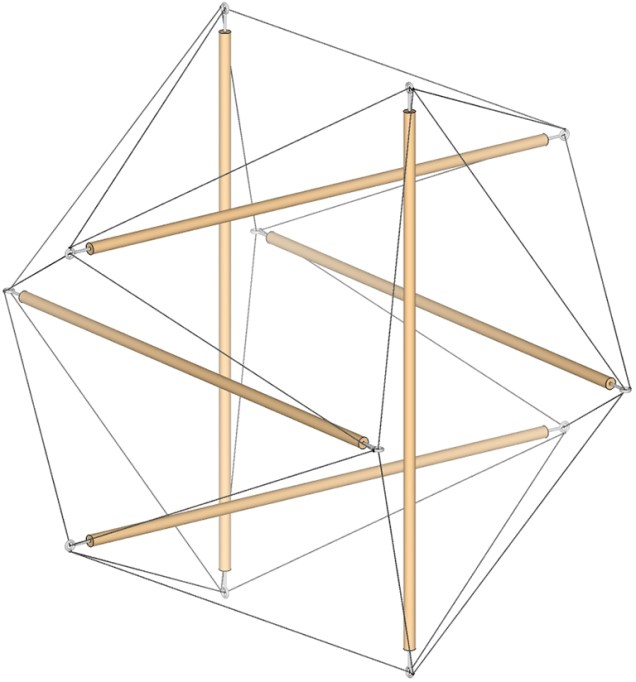
6-Strut Tensegrity Sphere and its Transformations
The 6-strut tensegrity sphere is the spherical, or tensor equilibrium phase of the the positive tensegrity tetrahedron and its dual, the negative tensegrity tetrahedron. Rectifications of either produce the regular octahedron which serves as the template for the spherical phase. The sphere is transformed into the two tetrahedra by sliding the struts along the the… Read more
-
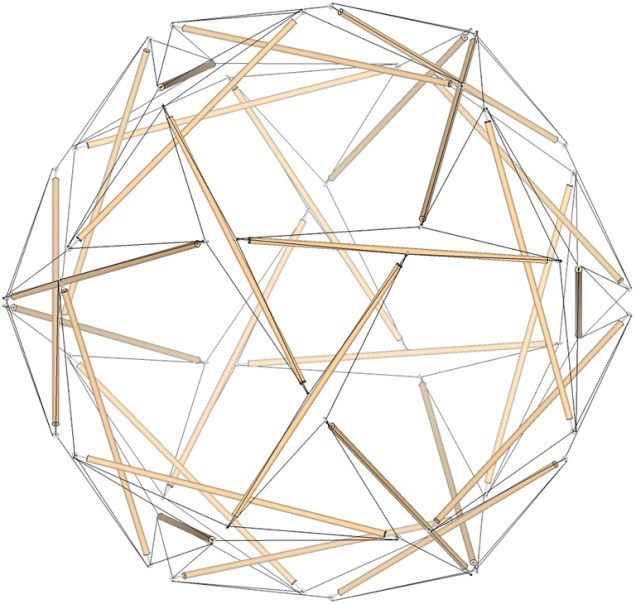
30-Strut Tensegrity Sphere and its Transformations
The 30-strut tensegrity sphere is the spherical, or tensor equilibrium phase of the the tensegrity icosahedron and its dual, the tensegrity pentagonal dodecahedron. Rectifications of either produce the icosidodecahedron which serves as the template for the spherical phase. The sphere is transformed into the icosahedron or pentagonal dodecahedron by sliding the strut pairs along the… Read more
-
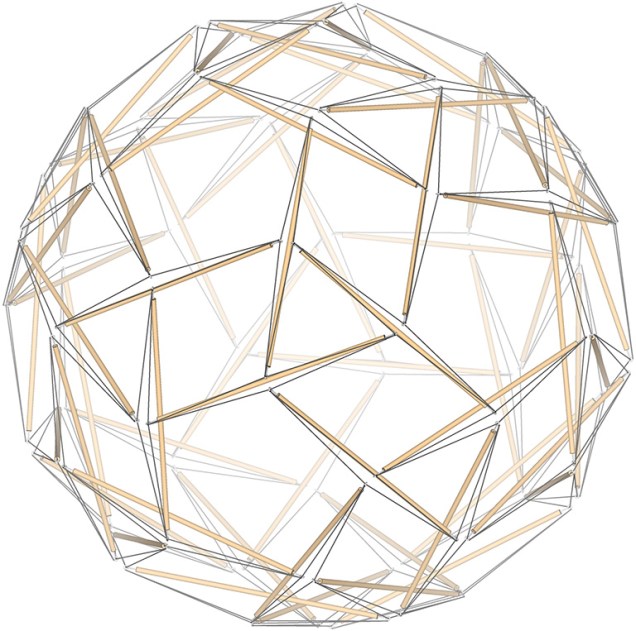
60-Strut Tensegrity Sphere and its Transformations
The 60-strut tensegrity sphere is the spherical, or tensor equilibrium phase of the the rhombic triacontahedron and its dual, the icosidodecahedron. Rectifications of either and the intersection of both produce a non-uniform rhombicosidodecahedron. The regular rhombicosidodecahedron serves as the template for the spherical phase of the 60-strut tensegrity. The sphere is transformed into the rhombic… Read more
-
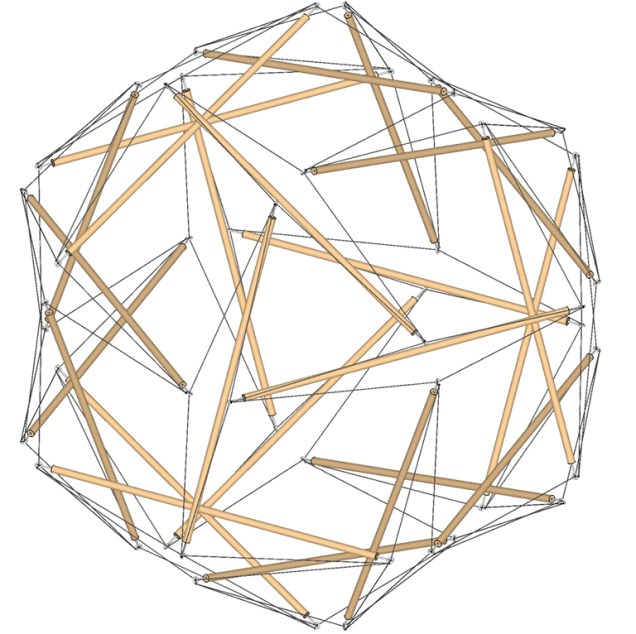
24-Strut Tensegrity Sphere and its Transformations
The 24-strut tensegrity sphere is the spherical, or tensor equilibrium phase of the the rhombic dodecahedron and its dual, the cuboctahedron, aka vector equilibrium or “VE.” Rectifications of either and the intersection of both produce a non-uniform rhombicuboctahedron. The regular rhombicuboctahedron serves as the template for the spherical phase of the 24-strut tensegrity. The sphere… Read more
-
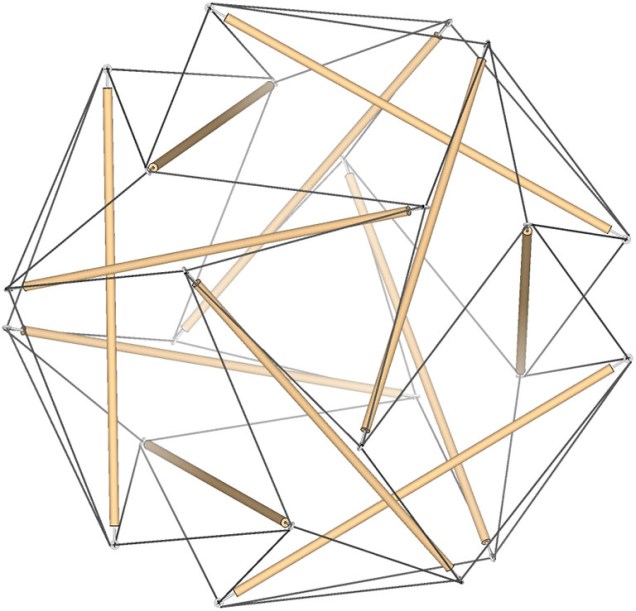
12-Strut Tensegrity Sphere and its Transformations
The 12-strut tensegrity sphere is the spherical, or tensor equilibrium phase of the the tensegrity octahedron and its dual, the tensegrity cube. Rectifications of either produce the cuboctahedron, i.e., vector equilibrium (VE) which serves as the template for the spherical phase. The sphere is transformed into the cube or octahedron by sliding the strut pairs… Read more
-
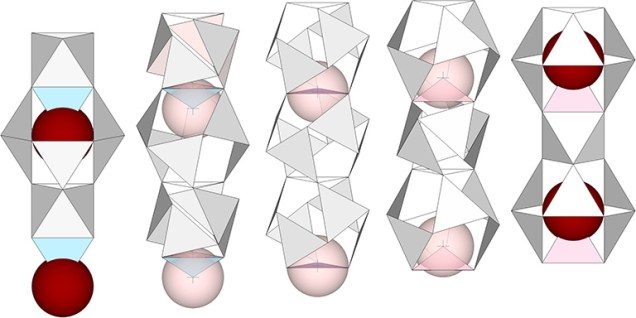
The Polar Pump Model of the Jitterbug
The polar pump model shows how the the jitterbug transformation might be conceived as the shuttling of nuclei along the primary axis of the 4 great circles via the octahedra they straddle. This is the same space-to-sphere, sphere-to-space oscillation as in all other models of the jitterbug, but allows us to visualize the transformation on… Read more
 The Geometry of Thinking