This is an ongoing journal of my personal explorations into the geometry of Richard Buckminster Fuller.
The following articles are arranged chronologically. An alphabetical list may be found in the sidebar. An index to the articles may be found here.
-

General Unit Conversions
In Fuller’s geometry, areas and volumes are measured in unit triangles and tetrahedron, rather than unit squares and cubes (see Areas and Volumes in Triangles and Tetrahedra). Fuller seems to have made unit conversions between his 60° coordinate system and the conventional 90° coordinate system unnecessarily complicated with the synergetics power constants (see Pi and… Read more
-

Topological Abundance Formulas
What Fuller called the “topological abundance formula” distills a very complex branch of mathematics down to a simplification or special case of Euler’s polyhedron formula which states that for any spherical polyhedron, the number of edges (E) plus the number of faces (F) subtracted from the number of vertices (V) always equals two (2). The… Read more
-

Basic Disequilibrium LCD Triangle
The 15 great circles that define the basic disequilibrium LCD triangle are constructed by spinning the icosahedron on its 15 edge-to-edge axes. It can be shown by spherical trigonometry that further subdividing of the surface would only result in dissimilar triangles. The Basic Disequilibrium LCD Triangle constitutes the lowest common denominator (LCD) of the sphere’s… Read more
-
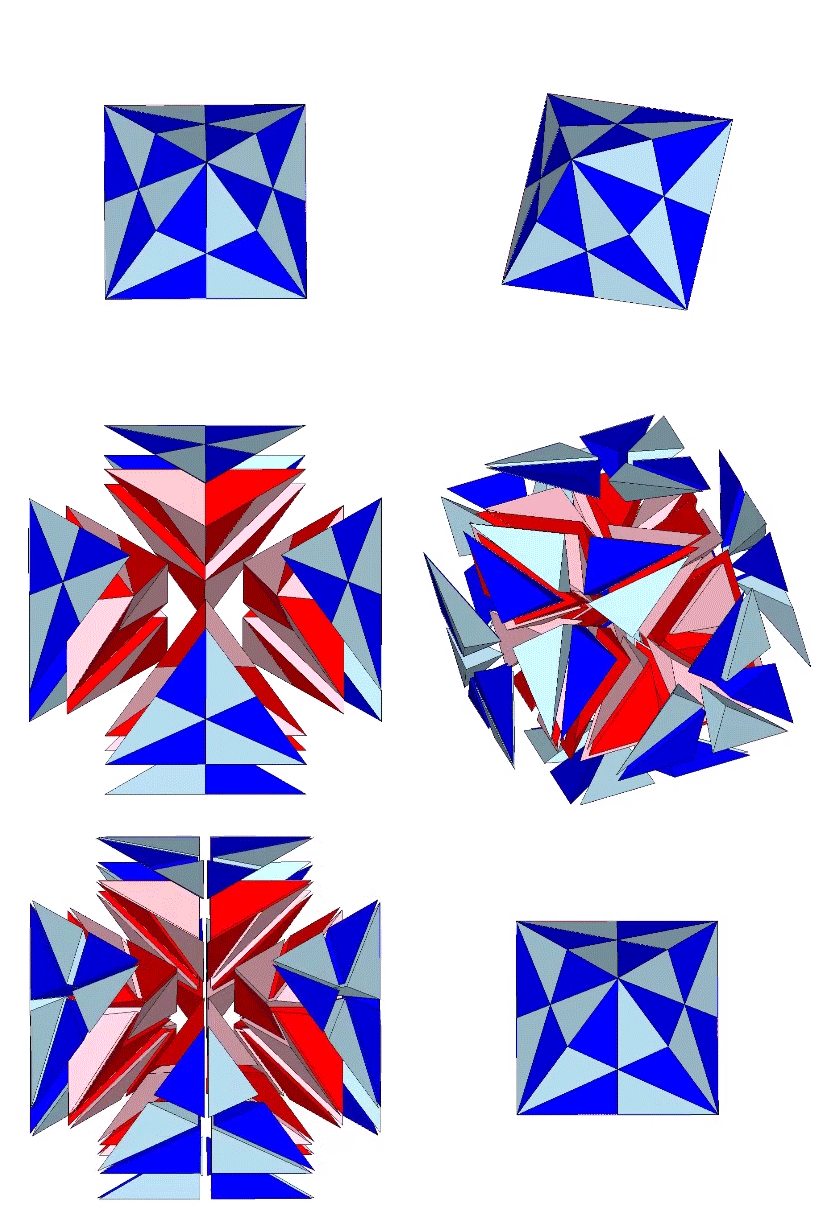
A and B Quanta Modules
The A and B quanta modules constitute the lowest common denominator of polyhedral systems, just as the Basic Disequilibrium LCD Triangle constitutes the lowest common denominator (LCD) of the sphere’s surface.… Continue reading → Read more
-

Rhombic Dodecahedron
Rhombic dodecahedra close pack to fill all space in exactly the same way that unit-radius spheres close pack around a central nucleus, as vector equilibria (VEs) of increasing frequency. That is, the polyhedral domain of each sphere in a close-packed nuclear array is in the shape of rhombic dodecahedron whose in-sphere radius is the radius… Read more
-
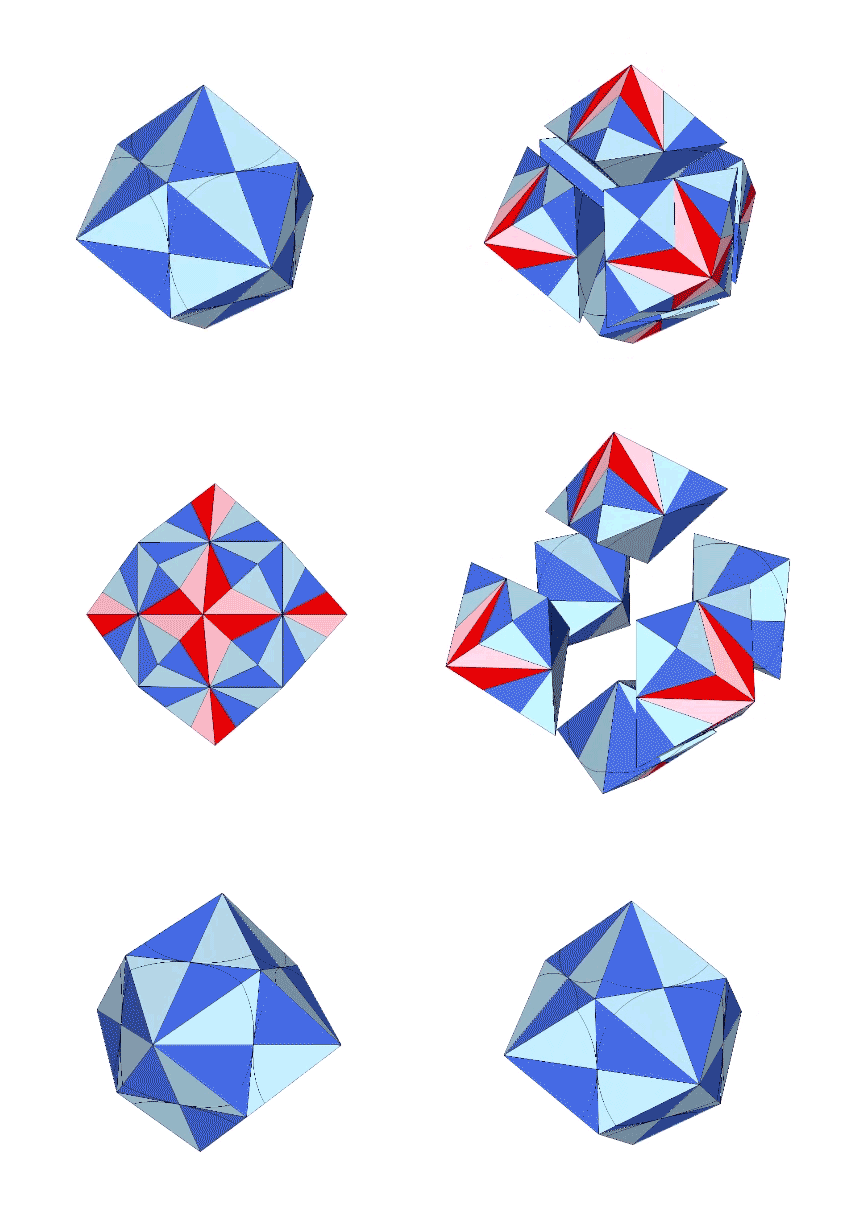
Quanta Module Constructions of the Rhombic Dodecahedron
The quanta module construction of the isotropic vector matrix discloses two rhombic dodecahedra, one occupying the positions of the spheres, and the other the space between the spheres. The two constructions can be shown to exchange places during the jitterbug transformation.… Continue reading → Read more
 The Geometry of Thinking