Categories of Spheres in the Isotropic Vector Matrix: Nuclei, F1 Shells, and “Nuclear Voids”

When modeling the distribution of nuclei in the isostropic vector matrix, I distinguish between the nuclei and the 12-sphere shells that isolate and define them. These nuclear domains, each consisting of one nuclear sphere and a 12-sphere shell, defines the vector equilibrium, or VE.
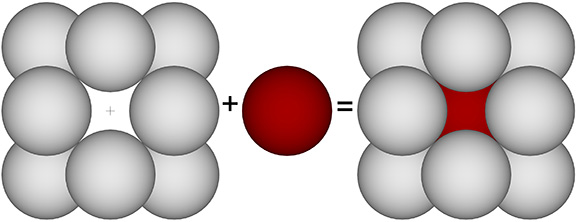
The nuclear domain (right) reduced to its nucleus (center) and its 12-sphere shell (left).
The nuclear domain (right) consists of a 12-sphere shell (left) and the nucleus (center).

Nuclei are distributed throughout the isotropic vector matrix at the centers and vertices of close-packed rhombic dodecahedra whose edges align with the primary axes of of the vector equilibrium’s 4 great circles. See: Formation and Distribution of Nuclei in Radial Close-Packing of Spheres; and Great Circles: The 25 Great Circles of the Vector Equilibrium (VE); The 25 Great Circles of the VE (new illustrations); and Distribution of Radially Close-Packed Spheres on the 25 Axes and Great Circle Planes of the Vector Equilibrium.
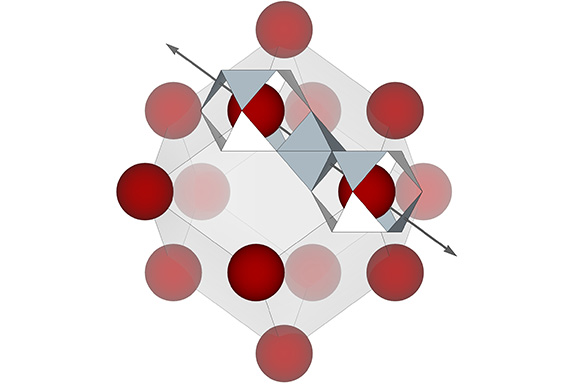
Fourteen nuclei distributed at the vertices of a rhombic dodecahedron with an edge length of four sphere-diameters. One edge is shown to coincide with an axis running through the the centers of opposing triangular faces of VEs enclosing the nuclei at each vertex with an octahedron between them.
Nuclei are distributed in the isotropic vector matrix along the edges and at the centers of rhombic dodecahedra with edge lengths of √6 times the sphere diameter. The edges align with the primary axis of VE’s set of 4 great circles.

Nuclei and their shells do not close-pack to fill all-space. Between these nuclear clusters are gaps which combine for form holes that run laterally through the isotropic vector matrix.
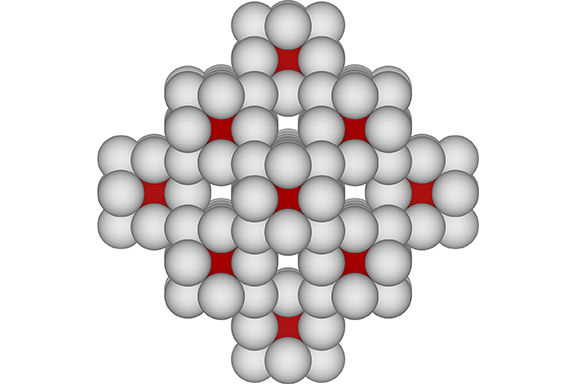
Fourteen nuclear domains, each containing a nucleus and its 12-sphere shell, close packed around a central nuclear domain. The arrangement leaves holes that run laterally through the isotropic vector matrix.
Nuclear domains (the nuclei and their 12-sphere shells) do not close-pack to fill all space. The vacancies form holes that run laterally through the isotropic vector matrix.

The spheres that fill these voids can be isolated to show that they all lie on a cubic grid which follows the square-face diagonals of close-packed F2 VEs.
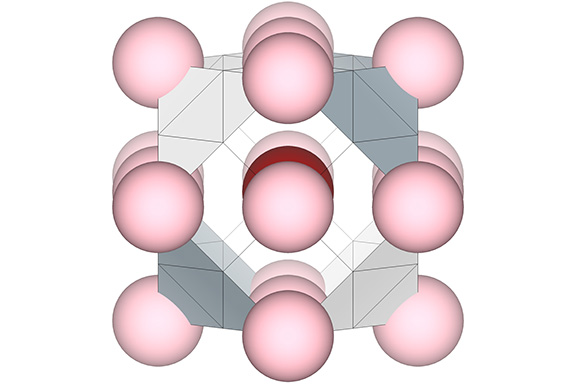
The voids left close packed nuclear domains represented by pink spheres arranged along the square-face diagonals of a 2F VE.
The voids left in the isotropic vector matrix by close-packed nuclear domains are filled by spheres distributed around each nucleus on the diagonals of a VE with an edge-length of 2 sphere diameters.

I refer to these as “nuclear voids” because, like the nuclei, each occupies the center of a VE, but unlike the nuclei, they do not have their own 12-sphere shells. Rather, every sphere in direct contact with a “nuclear void” is uniquely identified with the shell of one of its neighboring nuclei.
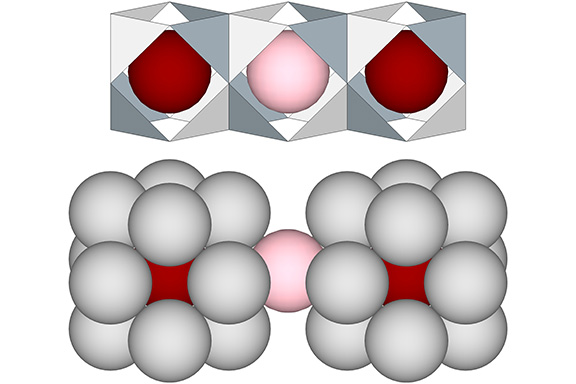
Two illustrations of a "nuclear void." Top: two nuclear domains (red spheres) on either side of a nuclear void (pink sphere), each at the centers of a VE bonded to the next by its square face. Bottom: two nuclear domains, represented by a nucleus (red sphere) and its 12-sphere shell (grey spheres), with a single pink sphere nested between them and representing the nuclear void.
The nuclear void (pink) occupies the center of VE whose vertices are all occupied by the spheres from the shells of neighboring nuclei.

Leave a comment