Rhombic Triacontahedron

The rhombic triacontahedron has 30 faces, 60 edges, and 32 vertices. Each of its 30 faces is a golden rhombus, i.e., the length of its long diagonal is related to the length of its short diagonal by φ, the golden ratio: (√5+1)/2 ≈ 1.61803398875

If the long diagonal is taken as d, the length of its short diagonal is d/φ. Its face angles are atan(2) ≈ 63.434948823°, and 2atan(φ) ≈ 116.565051177°. Its dihedral angle is 144°.
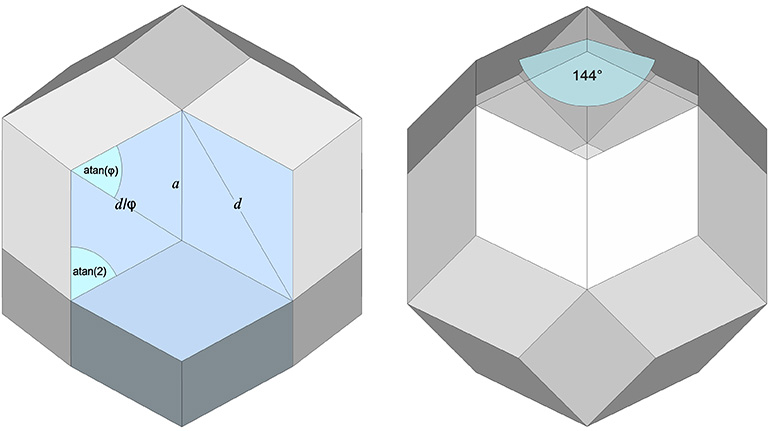
Rhombic Triacontahedron showing surface angles (left) and dihedral angle (right)
Surface angles (left) and dihedral angle (right) of the rhombic triacontahedron.

The central angle of its long diagonal, d, is atan(2) ≈ 63.434948823°. The central angle of its short diagonal, d/φ, is atan(2/√5) ≈ 41.810314896°. The central angle of its edge, a, is atan(2/φ²) ≈ 37.377368141°.
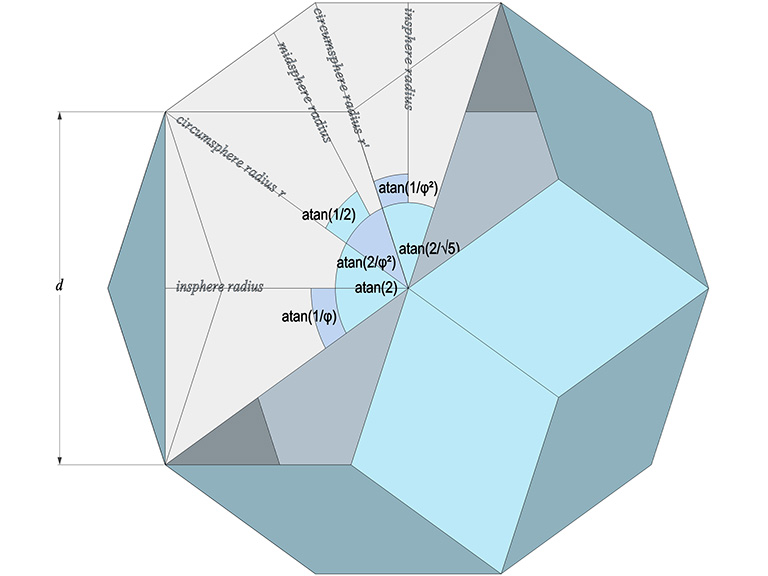
Rhombic triacontahedron showing central angles.
Central angles of the rhombic triacontahedron.

The in-sphere diameter is dφ. The mid-sphere diameter is 2dφ/√(φ+2). The circum-sphere diameter, i.e., the diameter measured by connecting opposite vertices bounded by four rhomboid faces, is d√(φ+2). The diameter measured by connecting opposite vertices bounded by three rhomboid faces, is d√3.
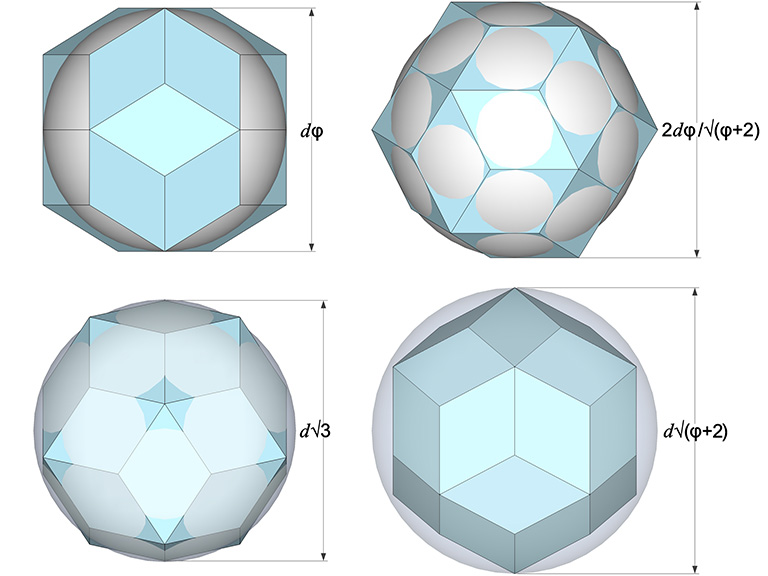
Illustration of radii of rhombic triacontahedron with reference to long diagonal, d.
Rhombic triacontahedron in-sphere diameter (top left), mid-sphere diameter (top right), circum-sphere, r’, diameter (lower left), and circum-sphere diameter, r, (lower right).

φ = Golden Ratio = (√5+1)/2

Dimensions in units of edge length, a:

  • a = edge length
  • Volume (cubic) = a³ × 4√(5+2√5)
  • Volume (tetrahedral) = a³ × 4√(5+2√5) × 6√2
  • In-sphere radius = a × φ²/√(1+φ²) = φ/√(3-φ)
  • Circumsphere radius r = a × φ
  • Circumsphere radius r‘ = a × φ√(3/(φ+2))
  • Mid-sphere radius = a × 2φ/√5

Dimensions in units of the long diagonal, d:

  • d = long diagonal
  • Volume (cubic) = d³ × 5/2
  • Volume (tetrahedral) = d³ × 15√2
  • In-sphere radius = d × φ/2
  • Circumsphere radius r = d × √(φ+2)/2
  • Circumsphere radius r’ = d × √3/2
  • Mid-sphere radius = d × 1/√(φ+2)

Identities:

  • a = d × √(3-φ)/2
  • d = a × 2/√(3-φ)
  • d/φ = short diagonal

Truncating the rhombic triacontahedron on the long diagonal of its rhomboid face describes the regular icosahedron.
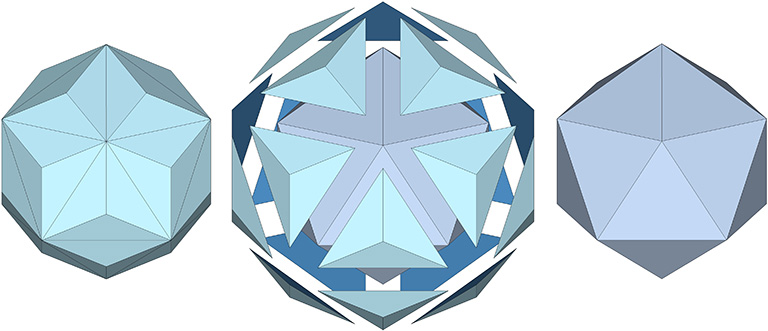
Rhombic triacontahedron scribed on the long diagonal of each face (left), and truncated along these lines (center), to describe the regular icosahedron (right).
The regular icosahedron (right) is disclosed by truncating the rhombic triacontahedron (left) by the long diagonals that bisect its rhomboid face.

Truncating the rhombic triacontahedron on the short diagonal of its rhomboid face describes the pentagonal dodecahedron.
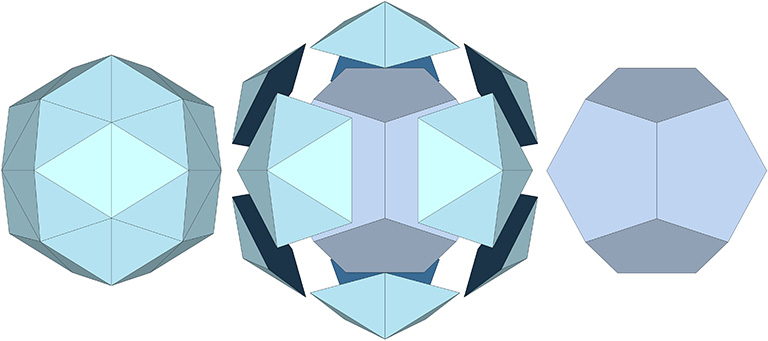
Rhombic triacontahedron scribed on the short diagonal of each face (left), and truncated along these lines (center), to describe the pentagonal dodecahedron (right).
The pentagonal dodecahedron (right) is disclosed by truncating the rhombic dodecahedron (left) by the short diagonals that bisect its rhomboid face.

Connecting the face centers describes the icosidodecahedron.
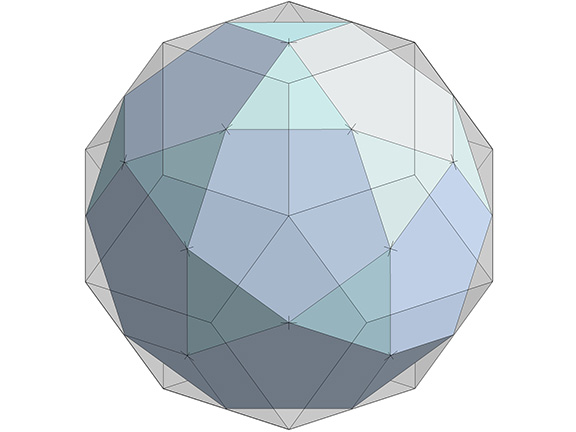
Face centers of rhombic triacontahedron connected to describe the icosidodecahedron.
The icosidodecahedron is disclosed by connecting the centers of the rhombic triacontahedron’s 30 rhomboid faces.

When a concentrated load is applied radially (toward the center) to any vertex of a polyhedral system, it tends to cause a dimpling effect. As the frequency or complexity of the system increases, the dimpling becomes progressively more localized, and proportionately less force is required to bring it about.
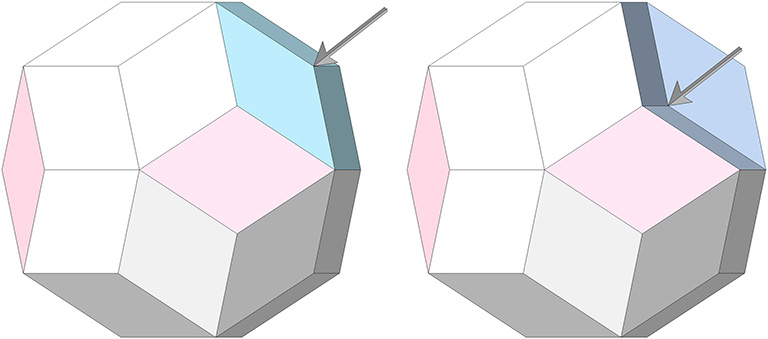
Rhombic triacontahedron (left), and dimpled on one of the eight three-member vertices (right).
Applying radial pressure on a three-member vertex of the rhombic triacontahedron (left) results in a concave dimpling of its convex surface (right).

The rhombic triacontahedron may be a limit case in which the dimpling of its eight three-vector vertices produces a concave rhombic triacontahedron that close-packs with the convex triacontahedron to fill all-space.
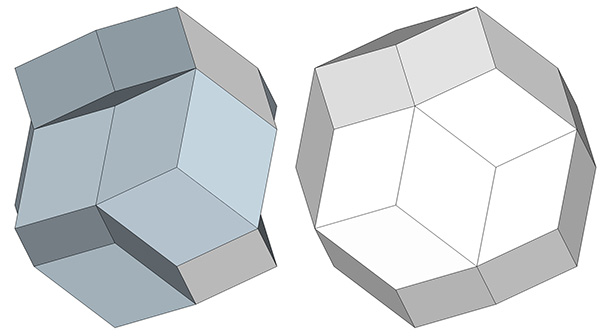
The concave rhombic triacontahedron (left) close packs with the convex rhombic triacontahedron (right) to fill all-space.
The dimpled (or concave) rhombic triacontahedron will close-pack with the convex rhombic triacontahedron to fill all-space.

The convex and concave rhombic triacontahedra close-pack radially around a common center as rhombic dodecahedra, a pattern which is identical to the distribution of unique nuclei in the isotropic vector matrix. (See Formation and Distribution of Nuclei in Radial Close-Packing of Spheres.)
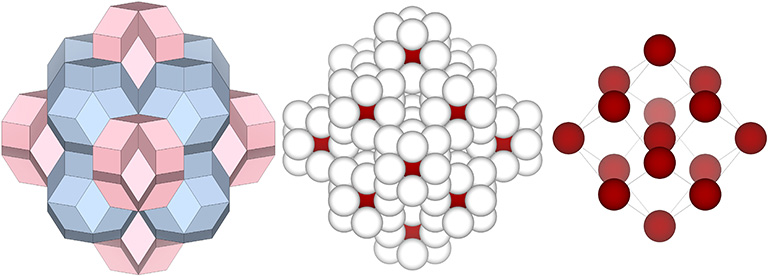
Eight convex and six concave rhombic triacontahedra close-packed around a central concave rhombic triacontahedron (left), in the pattern radially close-packed F1 vector equilibria (center), with their nuclei occupying the vertices of a rhombic dodecahedron (right).
The concave and convex rhombic triacontahedra close-pack around a common center (left) in a pattern identical to the distribution of unique nuclei in the isotropic vector matrix. Nuclei isolated by their 12-sphere shells (center) define the 14 vertices of the rhombic dodecahedron (right).

If the edge length is preserved, i.e., if we imagine the rhombic triacontahedron constructed of rigid struts and flexible connectors, it will undergo a jitterbug-like transformation into the all-space-filling Kelvin truncated octahedron at the halfway point in the transition between its convex and concave forms.
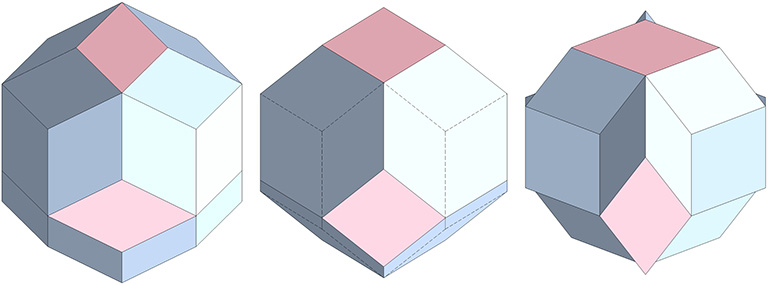
Rhombic triacontahedron (left), Kelvin truncated octahedron (middle, and concave rhombic triacontahedron (right).
If the edge length is held constant, the rhombic triacontahedron (left) transforms into the all-space-filling Kelvin truncated octahedron (center) at the halfway point in the transition to its concave form (right).

The in-sphere diameter of the rhombic triacontahedron with a tetrahedral volume of 5 is approximately 0.000517 less than the prime unit vector. This is an exquisitely small difference, and Fuller initially believed it to be due to the low resolution of the trigonometry tables he was using. The rhombic triacontahedron can be divided into 120 identical tetrahedra, and with a tetrahedral volume of five, each of the these 120 tetrahedra would have precisely the same volume as the A and B quanta modules, i.e., 1/24th of a unit tetrahedron. These he called the T quanta modules (‘T’ for ‘Triacontahedon’).

Subsequent calculations proved that the rhombic triacontahedron with a unit in-sphere diameter would have a tetrahedral volume of slightly more than 5. So, though his T quanta modules had a rational volume of 1/24th of the unit tetrahedron, the dimension corresponding to the in-sphere radius was awkward and irrational. The quanta module derived from the rhombic dodecahedron with a unit in-sphere diameter was subsequently named the E quanta module (‘E’ for ‘Einstein’). See T and E Quanta Modules.
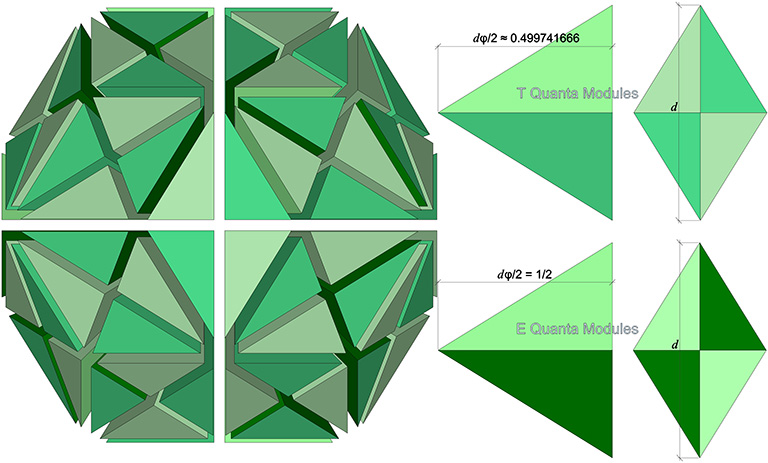
Rhombic triacontahedron divided into 120 equal-volume irregular tetrahedra (left). Schematic of T and E quanta modules (right) with the insphere radius, dφ/2 ≈ 0.4998 for the T module, and 1/2 for the E module.
The rhombic triacontahedron constructed of 120 T quanta modules had a tetrahedral volume of 5. The rhombic triacontahedron with a unit in-sphere diameter is constructed of 120 E quanta modules, and has a tetrahedral volume of slightly more than 5.

For a rhombic triacontahedron with a tetrahedral volume of 5:

  • 120 T quanta modules
  • d = ³√(√2/6)
  • In-sphere diameter = dφ ≈ 0.999483332262

For a rhombic triacontahedron with an in-sphere diameter of 1:

  • 120 E quanta modules
  • d = φ-1
  • Volume (tetrahedral) = d³ ×15√2 = (φ-1)³ × 15√2 ≈ 5.007758031333.

The rhombic triacontahedron may be unspooled into a continuous chain of rhombuses.
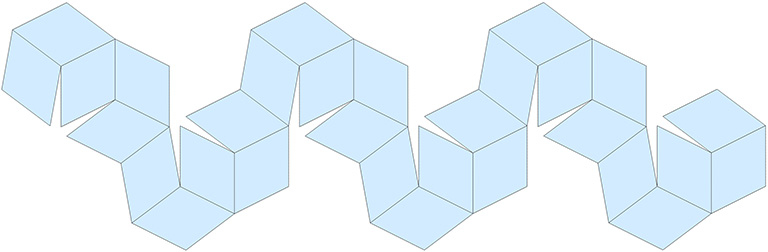
Net diagram of the rhombic triacontahedron.
Rhombic tricontahedron net diagram.

The construction is accomplished by 29 sequential folds of 36°.
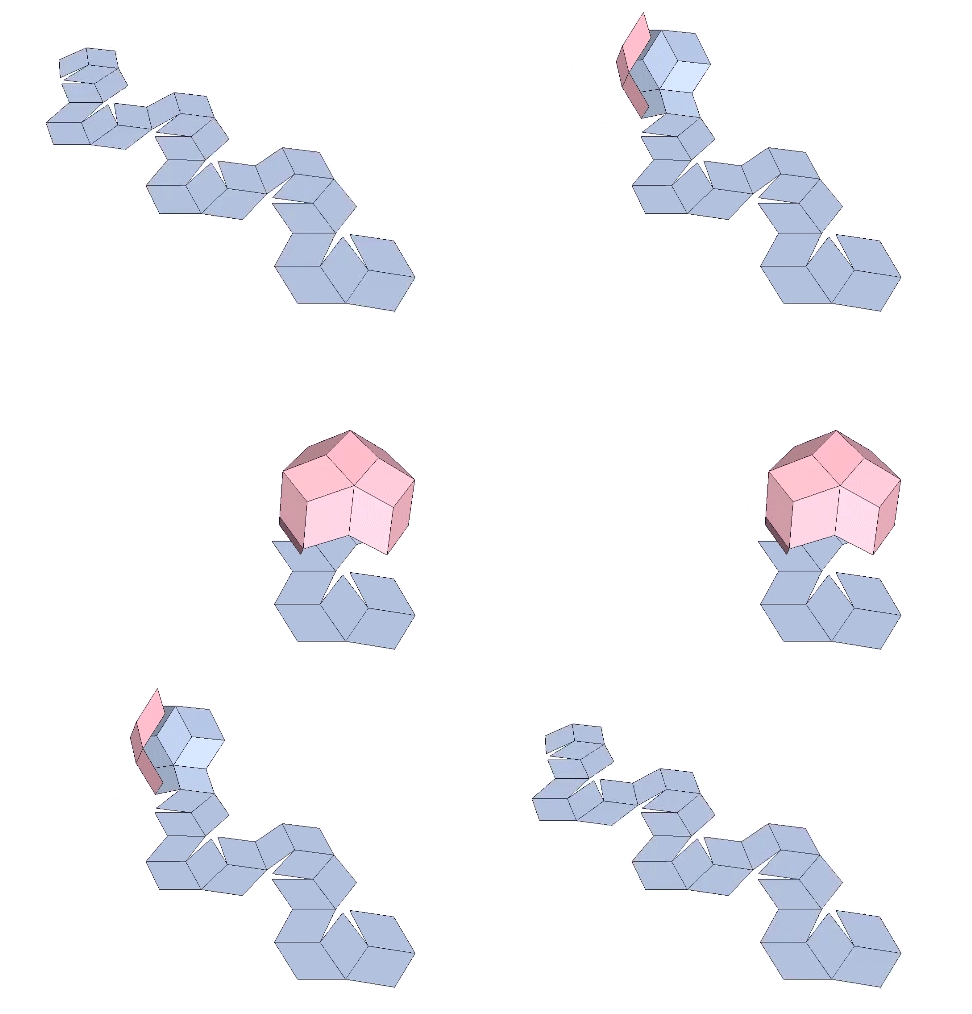
Rhombic triacontahedron constructed with 29 sequential folds from a single paper strip.
Rhombic tricontahedron constructed from a single paper strip with 19 sequential folds of 36° each.

Tetrakaidecahedron Dimensions and Whole Number Volume

The tetrakaidecahedron of the Weaire-Phelan structure complements the pyritohedron to fill all-space. Together, they constitute what is presently determined to be the best solution to the Kelvin Problem: How can space be partitioned into cells of equal volume with the least area of surface between them?

In previous articles, I demonstrated that the pyritohedra of the Weaire-Phelan structure align perfectly with the distribution of unique nuclei in the radial close-packing of spheres of the isotropic vector matrix. See: Formation and Distribution of Nuclei in Radial Close-Packing of Spheres; Tetrakaidecahedron and Pyritohedron; and Kelvin Truncated Octahedron. I was able to relate the two matrices and rationalize their volumes with reference to the variable, d, the diameter of the unit spheres of the isotropic vector matrix, and the constant α = ³√(√2/2), the length of the pyritohedron’s long edge when d is taken as unity. See: Pyritohedron Dimensions and Whole-Number Volume.

The Weaire-Phelan structure: the tetrakaidecahedron with height of tall pentagonal face (d) and the pyritohedron in with base of pentagonal face (a) in relation to the distribution of unique (red) and non-unique (pink) nuclei of the isotropic vector matrix.
The pyritohedron (right) and the tetrakaidecahedron (left) combine to form the Weaire-Phelan structure (or matrix) and, when dimensioned appropriately, align with the distribution of unique nuclei (red) and shared nuclei (pink) in the isotropic vector matrix.

To summarize my conclusions:

  • If the sphere diameter, d, is taken as unity, the tetrahedral volumes of both the pyritohedron and the tetrakaidecahedron of the Weaire-Phelan structure work out to be precisely 24d³.
  • If its longest edge, a, is taken as unity, then d = 1/α, and the cubic volumes of both the pyritohedron and the tetrakaidecahedron of the Weaire-Phelan structure work out to be precisely 4a³.

To satisfy the Kelvin problem, the volumes of the two shapes, i.e., the pyritohedron and its complementary tetrakaidecahedron, must be identical. This tetrakaidecahedron has three unique faces: two hexagonal faces; four large pentagonal faces; and eight smaller pentagonal faces, for a total of 14 faces — tetra (four), kai (+), deca (ten), hedron (face). To determine its volume, we’ll need the areas and in-sphere radii for each of its faces.

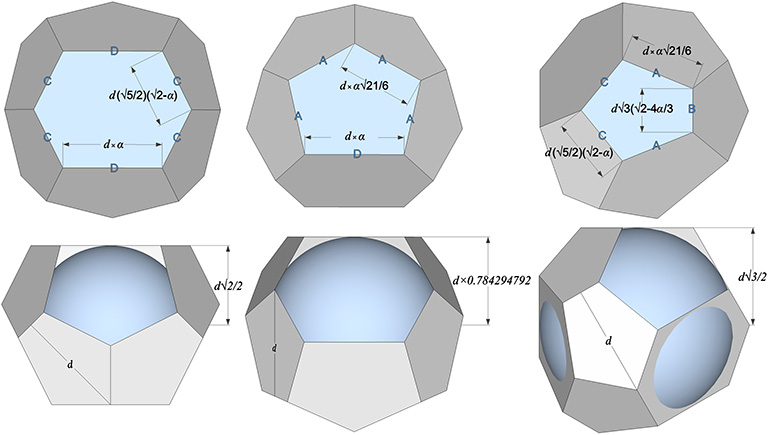
  • in-sphere radius to hexagonal face: d × √2/2
  • in-sphere radius to larger pentagonal face: d × ≈ 0.784294792 *
  • in-sphere radius to smaller pentagonal face: d × √3/2

* Though it should be possible to work out its precise value algebraically, I have so far been unsuccessful in resolving the in-sphere radius for the larger of the two pentagonal faces into whole number radicals and ratios.

The insphere radii of the tetrakaidecahedron of the Weaire-Phelan structure to the hexagonal face (left), the larger pentagonal face (center), and smaller pentagonal face (right).
Edge lengths and insphere radii of the Weiare-Phelan structure’s tetrakaidecahdron. All measurements are in reference to the height, d, of the smaller pentagonal face, and the constant, α = ³√(√2/2), or the length of the long edge when d = 1.

In addition to the in-sphere radii as shown above, we must calculate the surface area for each of the faces. This is most easily accomplished by dividing each face into right triangles.

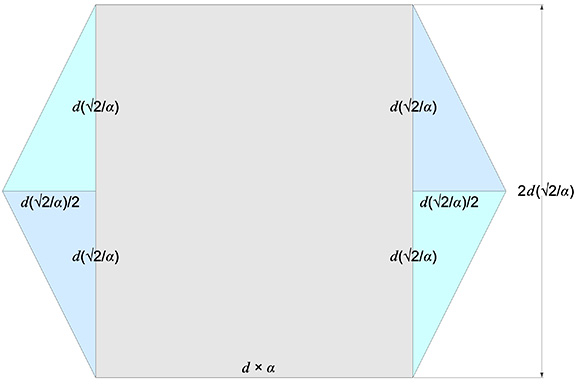
The hexagonal face is divided into four right triangles and one rectangle as follows:

  • Four right triangles of atan(1/2), with legs measuring d(√2/α) and d(√2/α)/2.
  • One rectangle measuring 2d(√2/α) by (d × α).

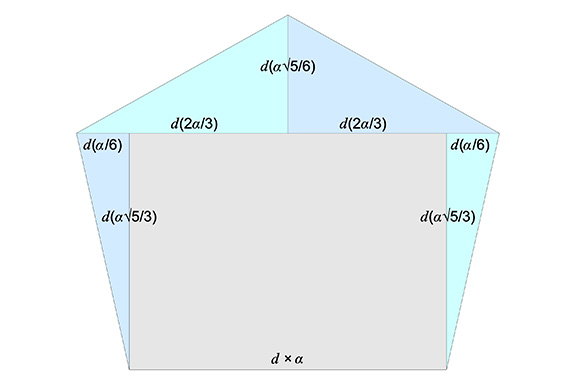
The larger of the two pentagonal faces is divided into four right triangles and one rectangle as follows:

  • Two right triangles of atan(√5/4) with legs measuring d(α√5/6) and d(2α/3).
  • Two right triangles of atan(√5/10) with legs measuring d(α/6) and d(α√5/3).
  • One rectangle measuring d(α√5/3) by (d × α).

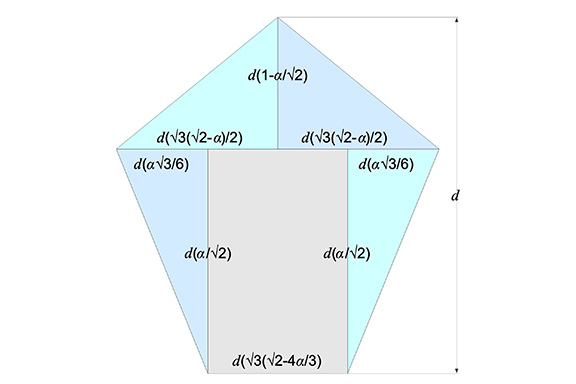
The smaller of the two pentagonal faces is divided into four right triangles and one rectangle as follows:

  • Two right triangles of atan(√6/3) with legs measuring d(α√5/6) and d(2α/3).
  • Two right triangles of atan(√6/6) with legs measuring d(α/√2) and d(α√3/6).
  • One rectangle measuring d√3(√2-4α/3) by d(α/√2).

If d is taken as unity (d = 1), then a = d × α = ³√(√2/2), and

  • The hexagonal face has a square area of ≈ 1.20629947402.
  • The cubic volume of its polyhedral cone is area/3 × √2/2 ≈ 0.28432751274
  • Multiplying by 2 (for the two hexagonal faces) ≈ 0.56865502548
  • Converting from cubic to tetrahedral units, multiply the above volume by 6√2 ≈ 4.825197896
  • Applying the same calculations to the large pentagonal faces, gives a total tetrahedral volume of 7.874010518.
  • And, applied to the small pentagonal faces, gives a total tetrahedral volume of 11.30079158.
  • 4.825197896 + 7.874010518 + 11.30079158 = 24, and it therefore follows that its tetrahedral volume is 24d³.

If the long edge (the base of the larger pentagonal face) is taken as unity, the d in our equations = 1/α, then a = α/α = 1. The cubic volumes then are, respectively, 0.804199649, 1.312335086, and 1.883465264, and

  • 0.804199649 + 1.312335086 + 1.883465264 = 4, and it therefore follows that its cubic volume is 4a³.