This construction produces the rational-volume tetrakaidecahedron and pyritohedron that align with the distribution of nuclei in the radially close-packed spheres of the isotropic vector matrix. See also: Formation and Distribution of Nuclei in Radial Close-Packing of Spheres.
Tetrakaidecahedron
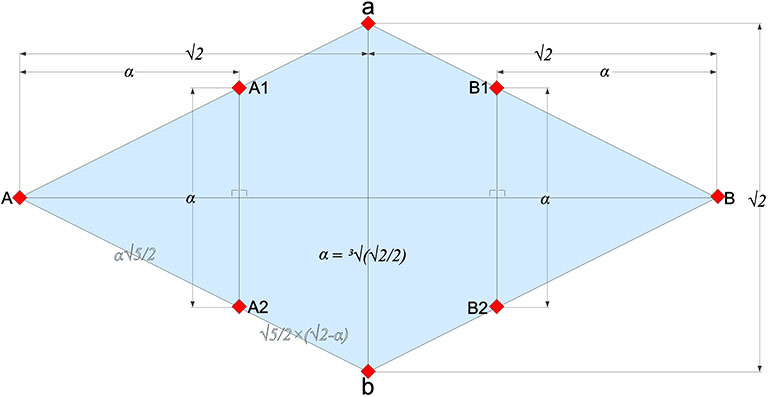
Begin with a 2√2 by √2 rhombus. Mark the vertices of the long diagonal A and B, and the vertices of the short diagonal a and b. On AB, mark points ³√(√2/2), about 0.8908987, in from each end. Lines perpendicular to AB and passing through these points bisect the edges of the rhombus at A1, A2, B1, and B2. (See illustration.)
Replicate the rhombus, rotate 90°, and separate (along the center face normal vector) by √2. Mark points as above, substituting C c for A a, and D d for B b.
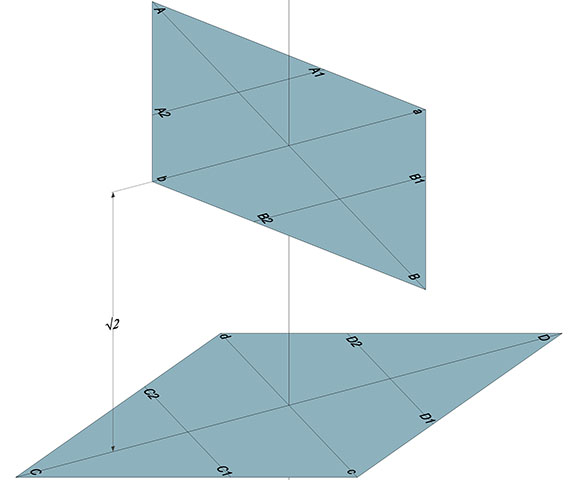
Connect the vertices to and create faces: BCcB; BDcB; bCBb; aDBa; ACdA; ADdA; aDAa, and; bCAa. Measure the distance, r, from A to either A1 or A2, and, using this length as the radius, scribe arcs from A on each of its adjacent faces. Repeat for B, C, and D.
The precise value of r is ³√(√2/2)×√5/2, or about 0.996055.
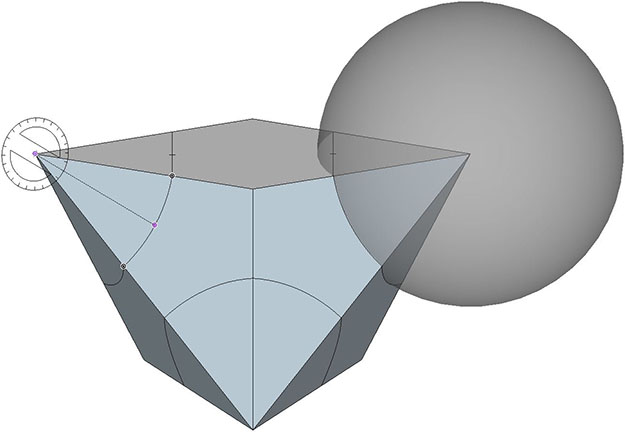
The scribed arcs locate the peaks of the tetrakaidecahedron’s four larger pentagonal faces at A3, B3, C3 and D3 (see illustration).
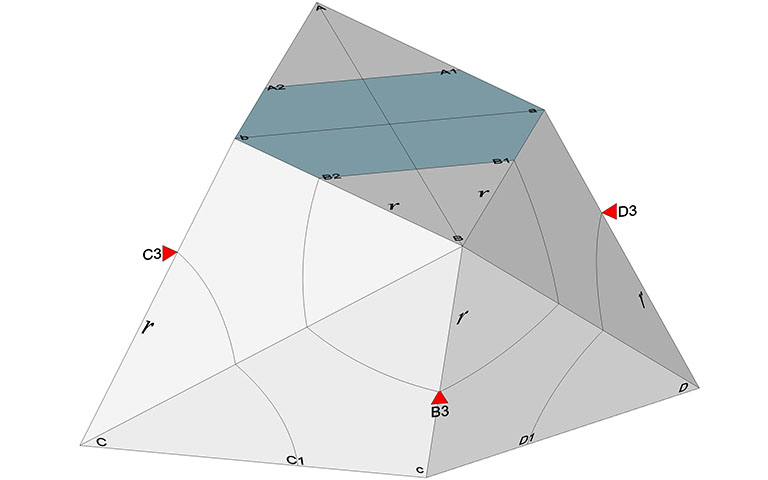
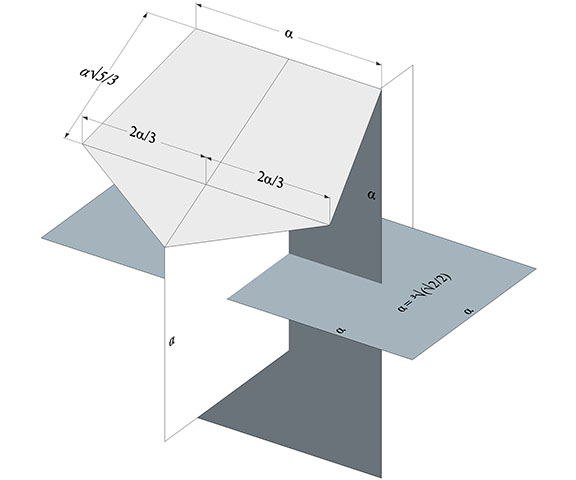
Each of the tetrakaidecahedron’s four larger pentagonal faces occupy a plane defined by the three vertices identified so far. At corner B, the plane (the blue disk in the illustration below) is defined by B1, B2, and B3. To locate the remaining two vertices, draw a line from the midpoint between B1–B2 to B3, and mark a point on this line ³√(√2/2)×√5/3 from the midpoint, or ³√(√2/2)×√5/6 from B3. A perpendicular through this point parallel to B1–B2 intersects BC and BD at B4 and B5, completing the pentagonal face (see illustration).
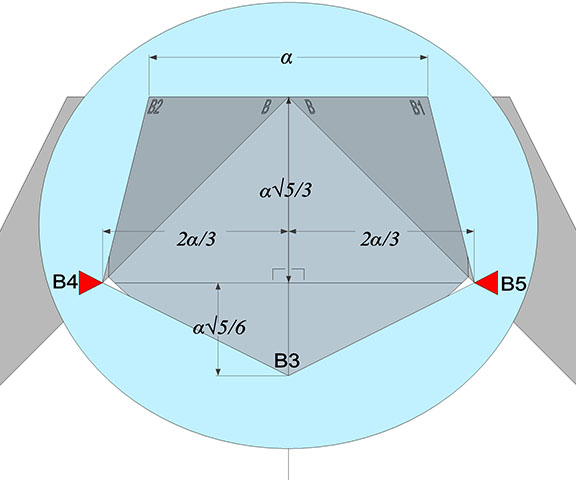
Repeating the steps for each corner A, B, C and D, produces four pentagonal faces in addition to the two hexagonal faces defined in the first step.
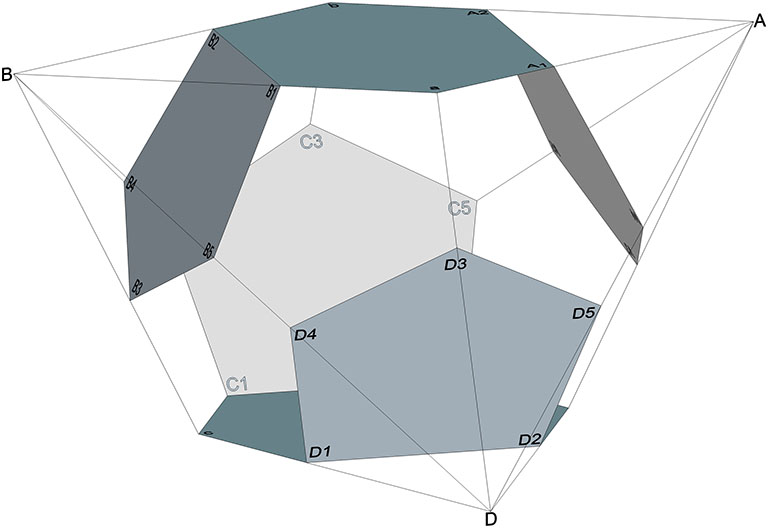
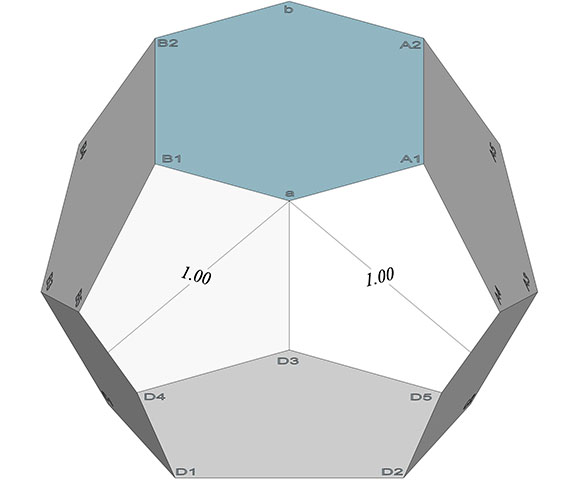
The points surrounding the remaining empty space should all lie on the same plane and define the eight smaller pentagonal faces of the Weaire-Phelan tetrakaidecahedron. A line bisecting their faces from the peak to mid-base should be of unit length, or, in terms of the isotropic vector matrix, one sphere diameter.
Pyritohedron
Begin with three, intersecting and mutually perpendicular 1 x 2 rectangles all sharing a common center. To construct a pyritohedron that will complement the Weaire-Phelan tetrakaidecahedron to fill all-space, the rectangle’s short edge will be ³√(√2/2) and the long edge will be twice that length (see illustration).
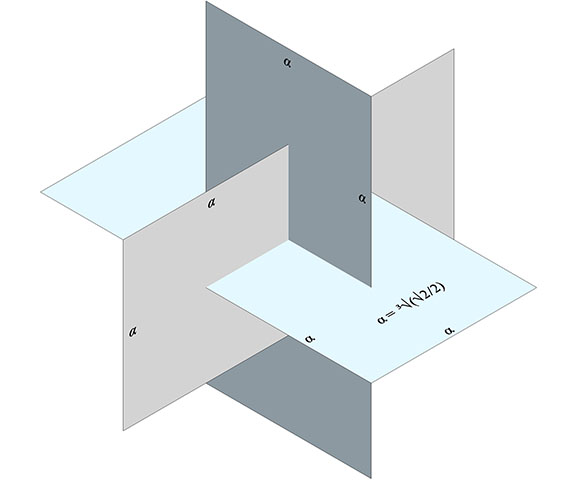
The twelve pentagonal faces of the pyritohedron are identical with the four larger pentagonal faces of the tetrakaidecahedron, and they are constructed using a method nearly identical with the procedure for the four larger pentagonal faces of the tetrakaidecahedron described above. Each face plane is defined by the the short edge of one rectangle, and the nearest corners of the rectangle perpendicular to that edge.
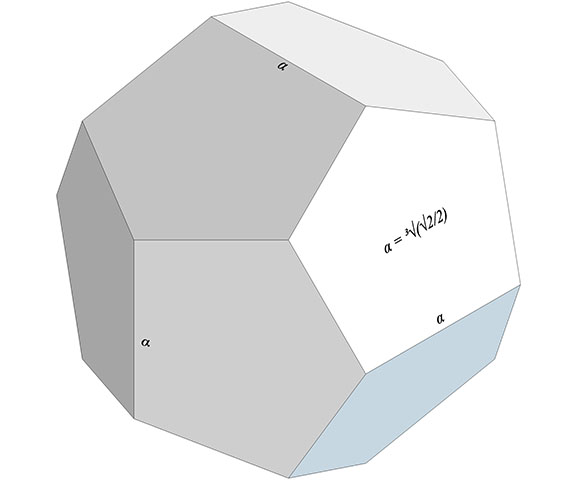
This pyritohedron has a rational volume of 24d³ in unit tetrahedra, where d is is the diameter of the unit sphere in the isotropic vector matrix or the height of the tetrakaidecahedron’s smaller pentagonal face. Its cubic volume of 4α³, where α is the length of the pyritohedron’s long edge. This volume should be identical with that of its companion tetrakaidecahedron. See Pyritohedron Dimensions and Whole-Number Volume, and Tetrakaidecahedron Dimensions and Whole Number Volume.
 The Geometry of Thinking