This is a supplement to a previous article, Great Circles: The 25 Great Circles of the Vector Equilibrium (VE), with new illustrations which I think add some clarity to the topic.
The figure below illustrates the full set of great circles in the context of the vector equilibrium (VE), both the planar VE (top), and spherical VE (bottom). Note that twelve great circles converge, cross, or are deflected at each of the twelve vertices, and at the centers of each triangular face.
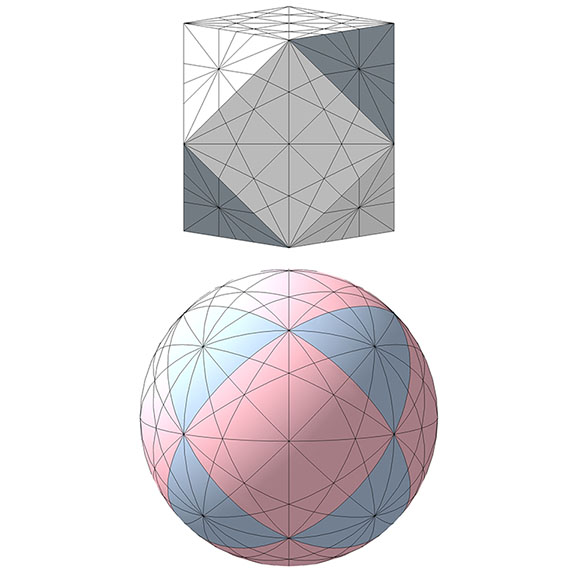
The 25 great circles are divided into four sets according to their spin axes. Axes running through opposite square faces generate the set of 3 great circles. Axes running through the centers of opposite triangular faces generate the set of 4 great circles. Axes running through diametrically opposing vertices generate the set of 6 great circles. And axes running through the midpoints of diametrically opposing edges generate the set of 12 great circles.
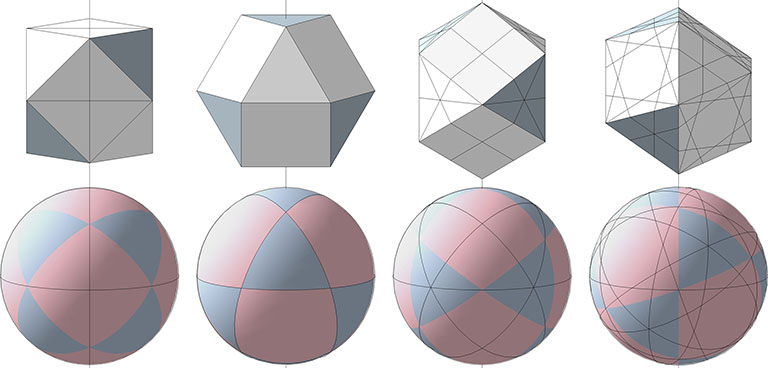
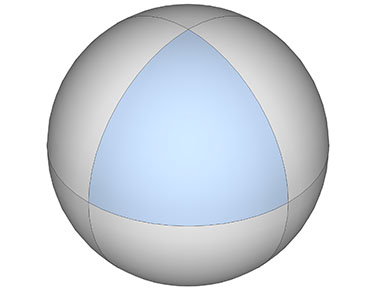
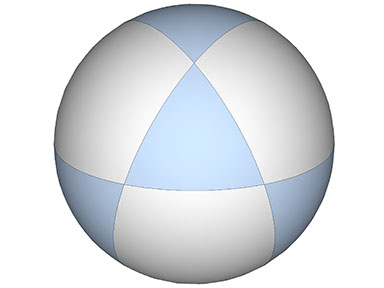
3 Great Circles
The set of 3 great circles discloses the spherical octahedron.
4 Great Circles
The set of 4 great circles discloses the spherical vector equilibrium (VE).
6 Great Circles
The six great circles disclose the spherical rhombic dodecahedron, the spherical tetrahedron (both positive and negative), and the spherical cube.
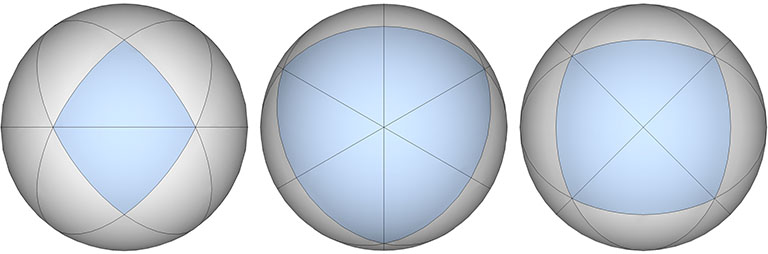
The six great circles complement the three great circles to disclose three additional octahedra.
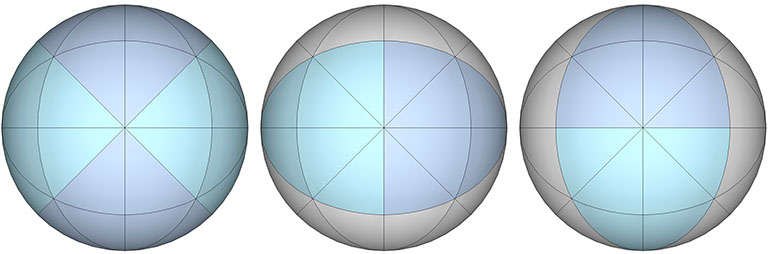
The same combination of great circles (3 and 6) also disclose the perimeter of the basic equilibrium LCD triangle.
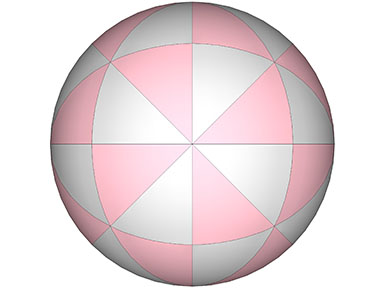
12 Great Circles
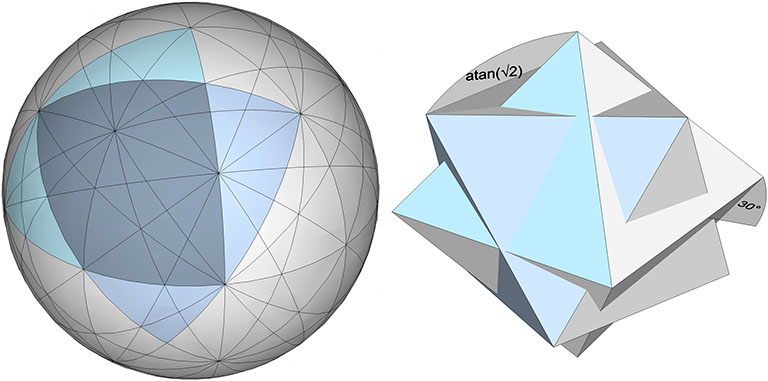
The twelve great circles of VE do not appear to disclose, by themselves, any of the regular polyhedra. However, in combination with the 4 and 6 great circle sets, the 12 great circles do disclose an alternate spherical regular octahedron that is curiously askew from the others, rotated 30° on the z axis, and atan(√2) on the y axis.
 The Geometry of Thinking