Space-Filling Polyhedra as Close-Packed Spheres

Fuller’s four primary models of the isotropic vector matrix—as vectors, as spheres, as the interstices between spheres, and as A and B quanta modules, are as distinct as they are inseparable. Each serves different purposes in Fuller’s geometry, and the terms used for one model are not necessarily synonymous with the same terms applied to another.

For example, the regular tetrahedron and the regular octahedron of the vector model each complement the other to fill all-space. In the sphere model, the tetrahedron is comprised of four spheres that define the domains of the tetrahedron’s four vertices in the vector model, and likewise, the octahedron is comprised of six spheres defining the domains of its vertices. These tetrahedra and octahedra do individually close-pack in the sphere model.

In the first illustration below, five 4-sphere tetrahedra (four positive and one negative) have been stacked to form the F3 tetrahedron on the right. On the left is the vector model of the same F3 tetrahedron. You’ll note that the domains of all the vertices are occupied by the four-sphere tetrahedra in the sphere model, even though space remains (in the shape of edge-bonded octahedra) between the tetrahedra in the vector model.
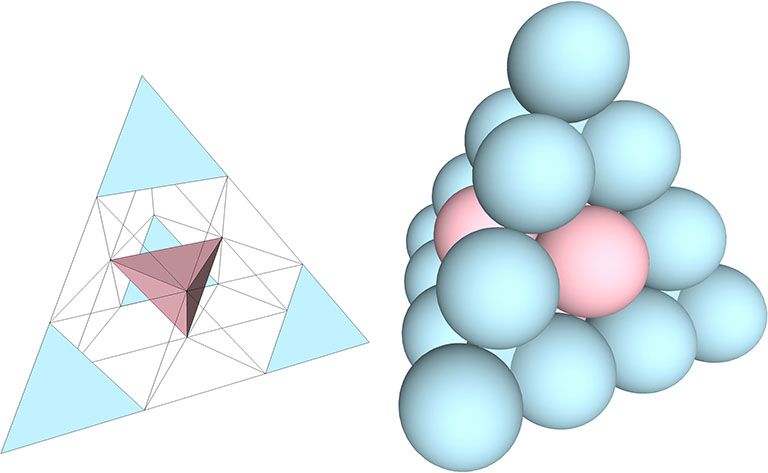
Five 4-sphere tetrahedra (4 positive and one negative) close-packed to form a larger tetrahedron (right), and its vector representation on the left.
4-sphere tetrahedra (right) close-pack to occupy all the vertices of the isotropic vector matrix (left).

Similarly, six-sphere octahedra (right) close-pack to occupy the domains of all the vertices in the vector model (left):
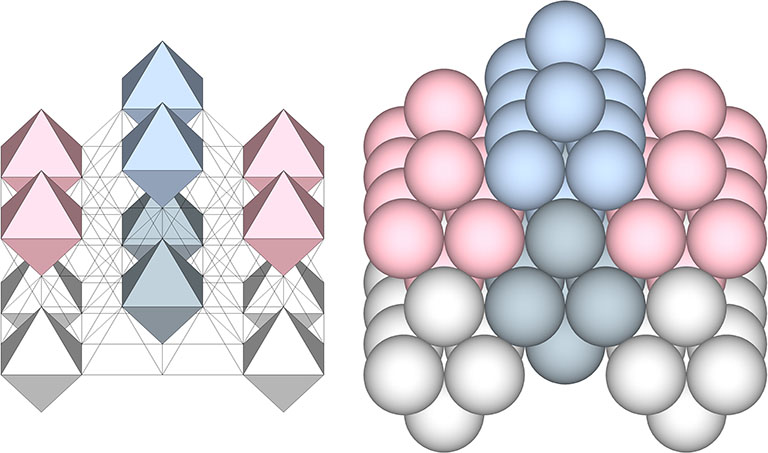
Twelve 6-sphere octahedra close-packed to form a semi-symmetrical matrix two octahedra deep (right), and its vector representation on the left.
6-sphere octahedra (right) close-pack to occupy all the vertices of the isotropic vector matrix (left).

And, 13-sphere VEs and 14-sphere cubes (top) close-pack in combination to occupy the domains of every vertex in the vector model (bottom):
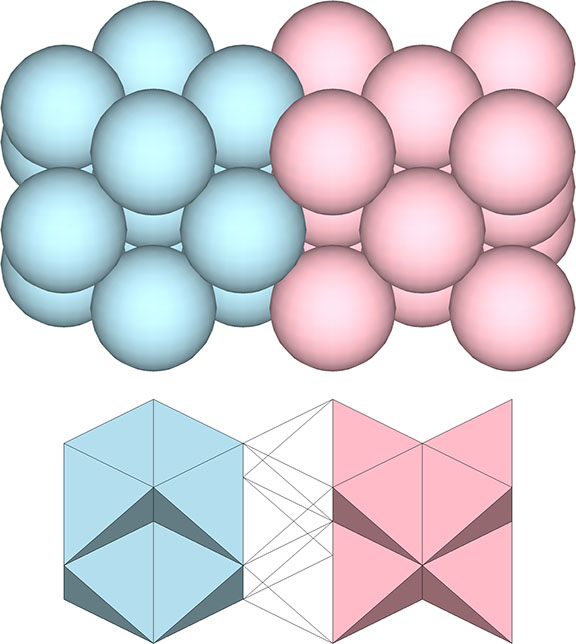
One 13-sphere VE and one 14-sphere cube close packed side-by-side (top), and its vector representation (bottom).
13-sphere vector equilibria (VEs) and cubes (top) close-pack to occupy all the vertices of the isotropic vector matrix (bottom).

Incidentally, this last illustration is also a model of the jitterbug transformation. See: Jitterbug.

Another way of thinking about the different models of the isostropic vector matrix is to imagine the spheres model as squeezing the vector model’s close-packed tetrahedra and octahedra into the concave VEs and concave octahedra of the interstitial model. (See Spheres and Spaces, and Spaces and Spheres (Redux).)

Equivalence of Tetrahedron Edge Length and Structural Quanta per Volume of its Inscribed Polyhedra

A curious mathematical coincidence that I think is worth noting is that the edge length of the tetrahedron in which a unit octahedron or unit icosahedron is inscribed is numerically equivalent to the units of volume, in tetrahedra, provided by each of the inscribed polyhedron’s structural quanta. (For more information on calculating volumes in tetrahedra, see Areas and Volumes in Triangles and Tetrahedra.)

A structural quantum is defined by the six edges of the minimum structural system. The six edges of the tetrahedron comprise one structural quantum, the twelve edges of the octahedron comprise two structural quanta, and the thirty edges of the icosahedron comprise five structural quanta.

In the regular tetrahedron, one structural quantum encloses 1 unit of volume. In the regular octahedron, one structural quantum encloses 2 units of volume. And, in the regular icosahedron, one structural quantum encloses Φ²√2 units of volume (where Φ is the golden ratio: (√5+1)/2).

If these unit polyhedra (i.e., all edges are of unit length) are inscribed within a regular tetrahedron, the edge length of the enclosing tetrahedron is numerically equivalent to the volume enclosed by each structural quantum of the inscribed polyhedron.

The edge length of the tetrahedron in which a unit octahedron or unit icosahedron is inscribed is numerically equivalent to the units of volume provided by each of the inscribed polyhedron’s structural quanta

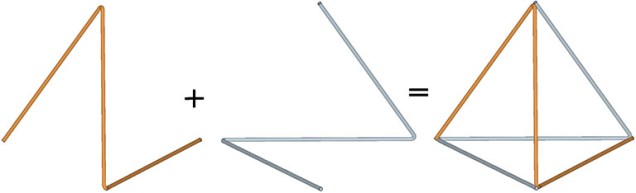
Fuller’s “structural quanta” are related to the idea that all the structural polyhedra can be thought of as self-interfering wave patterns. Each cycle of the wave consists of the three vectors of an open ended triangle. The tetrahedron, for example, consists of two open-ended triangles, one clockwise and one counter-clockwise, as in the following illustration:

Two open-ended triangles (left), one clockwise and one counter-clockwise, combine to form the four triangles of the tetrahedron.
The tetrahedron as a self-interfering wave pattern. The waves are represented here as two open-ended triangles (left), one clockwise and one counter-clockwise, which combine to form the four triangles of the tetrahedron (right).

The six vectors of the two open-ended triangles constitute one “structural quantum.” See also: Isotropic Vector Matrix as Transverse Waves.