Pyritohedron Dimensions and Whole-Number Volume

Note: For instructions on how to construct the Weaire-Phelan structure, see my post: Construction Method for the Pyritohedron and Tetrakaidecahedron of the Weaire-Phelan Structure.

Pyritohedra and tetrakaidecahedra close pack to constitute the Weaire-Phelan structure (or Weaire-Phelan “matrix” as I prefer to call it, and, when dimensioned appropriately, align precisely with the distribution of nuclei in the isotropic vector matrix. The unit vector (d in the illustration below) is identical with the unit vector (sphere diameter) of the isotropic vector matrix.

The Weaire-Phelan structure: the tetrakaidecahedron with height of tall pentagonal face (d) and the pyritohedron in with base of pentagonal face (a) in relation to the distribution of unique (red) and non-unique (pink) nuclei of the isotropic vector matrix.
The pyritohedron (right) and the tetrakaidecahedron (left) combine to form the Weaire-Phelan structure (or matrix) and, when dimensioned appropriately, align with the distribution of unique nuclei (red) and shared nuclei (pink) in the isotropic vector matrix.

The pyritohedron and, presumably, the tetrakaidecahedron have identical rational volumes in both cubic and tetrahedral units of measure. For the cubic volume, we take the long edge of the pentagonal face as the unit length (a in the illustrations). For the tetrahedral volume, we take the diameter of the sphere as the unit length (d in the illustrations).

The pentagonal face of the pyritohedon with the angles and dimensions necessary for calculating its area.
The dimensions of the pyritohedron’s pentagonal face are all related rationally to the length of its long edge, a, which is irrational with respect to d, the diameter of the unit sphere.

When we measure the angles, edge lengths, and radii of the pyritohedron, the numbers do not inspire confidence. It would seem unlikely that so many irrational numbers could possibly result in a rational, whole-number volume. But they do.

a = long edge or base of pentagonal face
d = diameter of sphere*
d = a × ³√4 × √2/2
a = d × ³(√2/2) = (d√2)/(³√4) = d√2 × ³√(1/4)

*d is identical with the unit vector of the isotropic vector matrix. In the Weaire-Phelan matrix, it aligns with the height vectors connecting the base with the peak of the smaller of the two pentagonal faces of the tetrakaidecahedron, and to the radial vectors connecting the height vector’s endpoints (see illustration below).

Lines connecting the center of the tetrakaidecahedron with the base and peak of its tall pentagonal faces are equal to the diameter of the nuclei distributed as pyritohedra in the Weaire-Phelan Matrix.
The unit vector, d, used in the volume calculations of the pyritohedron (right) is identical with the unit vector in the isotropic vector matrix, i.e. the diameter of the unit sphere. It aligns with the Weaire-Phelan matrix as the radial vectors and face heights in the tetrakaidecahedron (left).

The long edge of the pyritohedron’s pentagonal face, a, (which, when taken as unit length results in a cubic volume for the pyritohedron of 4a³) seems to be related to the diameter of the sphere, d, by ³(√2/2) or about 0.890898718. I don’t have a geometric proof to account for the appearance of this third root, but the number seems to work to at least 7 decimal places in my computer models, and the irrational roots cancel out perfectly in the volume calculations to produce the rational result of 24d³ for the tetrahedral volume.

Pyritohedron specifications:

  • 12 irregular pentagonal faces, 20 vertices, 30 edges
  • Face angles:
    • atan(2√5) + atan(√5/4) ≈ 106.6015496°
    • atan(√5/10)+90° ≈ 102.6043826°
    • 2atan(4√5/5) ≈ 121.588136°
  • Dihedral angle: 2atan(2) ≈ 126.8698976°
  • Volume (in tetrahedra): 24a³√2
  • Volume (in tetrahedra): 24d³
  • Cubic volume: 4a³
  • Cubic volume: 2d³√2
  • Quanta modules: 576 modules, types unknown*
  • Surface area (in equilateral triangles): 8a²√15
  • Surface area (in squares): 6a²√5
  • In-sphere radius: 2a/√5
  • Mid-sphere radius (center to mid-long-edge): a
  • Circum-sphere radius: a√5/2

*It should be possible to construct the pyritohedron from quanta modules, but may involve one or more variants of those quanta modules already described by by Fuller.

The image below shows my computer model with the calculated dimensions accurate to 7 decimal places.
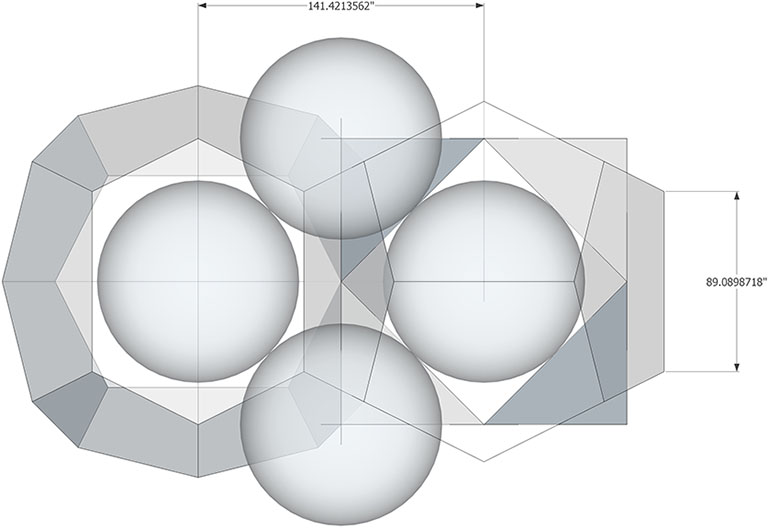
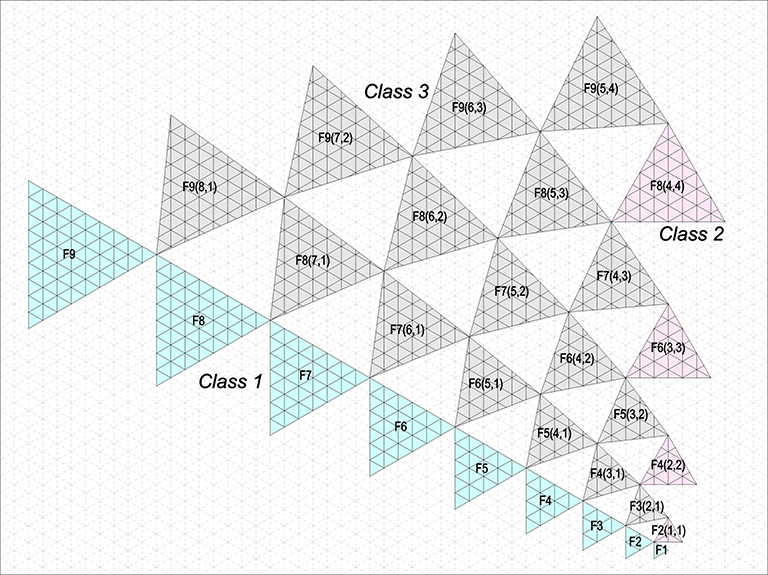
Illustration showing key dimensions (accurate to 7 decimal places) of the Weaire-Phelan matrix sized to the unit spheres of the isotropic vector matrix.
If the circumsphere radius of the tetrakaidecahedron is of unit length (one sphere diameter), the long edge of the pyritohedron is, to an accuracy of at least seven decimal places, equal to √2׳√(1/4), or about 0.890898718, which produces a rational volume of 24 unit tetrahedra for both the pyritohedron and its complementary tetrakaidecahedron.

Geodesics

Geodesic polyhedra are convex polyhedra consisting of triangles, and include the spherical polyhedra generated by subdividing the faces of a tetrahedron, octahedron, or icosahedron into smaller triangles and projecting their crossings out to the underlying polyhedron’s circumsphere radius. Those based on the icosahedron are related to but not necessarily aligned with the 31 great circles of the icosahedron from which their name seems to have originated. The name “geodesic” refers to Fuller’s early conviction that only a triangular latticework of geodesic lines would serve to distribute local stresses evenly throughout the system he patented under the name “Geodesic Dome” in 1954. As the domes evolved into the systems of mostly partial great circles and lesser circles described here, the term “geodesic polyhedra” preserved the memory of that earlier conviction.

Geodesic polyhedra are defined by the equilateral triangles of the primary face (i.e., the face of the underlying tetrahedron, octahedron, or icosahedron) laid out on a 60° grid so that their vertices always align with grid crossings. This produces three classes of tiling or tessellation. The edges of the primary triangular face in Class 1 are parallel to the grid lines. The edges in Class 2 are perpendicular to the grid lines. Those in Class 3 are neither parallel nor perpendicular to the grid lines.

Geodesic tessellation in relation to the sixty degree grid.
Geodesic polyhedra are divided into the three Classes defined by the orientation of the primary face laid out on a 60° grid. The edges of Class 1 polyhedra are parallel to the grid, Class 2 are perpendicular, and Class 3 skewed, neither parallel nor perpendicular to the grid.

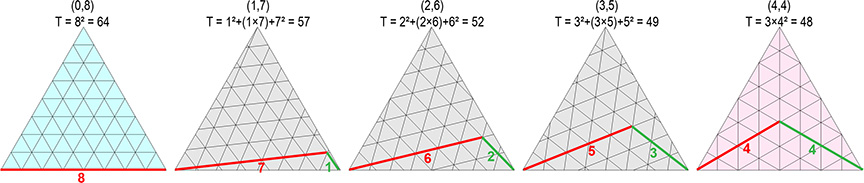
The frequency of each class is given by two numbers (b,c) representing the number of triangular modules along the grid lines connecting adjacent vertices. The general formula for the area, or the number of triangular modules that subdivide the primary face, is given by:

Area (T) = b² + c² + (b×c)

For Class 1, b is the edge length of the primary face; so, c is always 0 and the formula reduces to b². For Class 2, b = c, so the formula can be reduced to 3b².

Illustration of how frequency of geodesic polyhedra is determined.
The frequency of each Class of geodesic polyhedron is given by two numbers (shown in parentheses) representing the number of triangular subdivisions along grid lines connecting adjacent vertices (red and green lines). The primary face of the F8 polyhedra in Class 1 (blue), Class 3 (gray), and Class 2 (pink) are shown, along with their areas (T).

Class 1 Geodesics

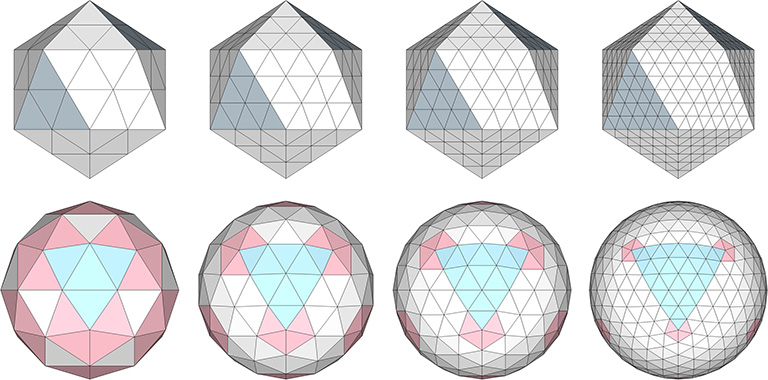
Class 1 geodesics subdivide the primary face with lines parallel to the edges.

Class 1 geodesic polyhedra based on the regular icosahedron.
2F, 3F, 4F and 6F Class 1 geodesic polyhedra (icosahedron base)

Class 2 Geodesics

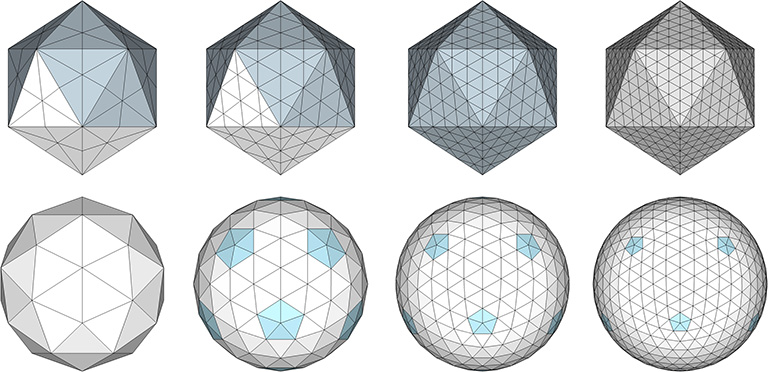
Class 2 geodesics subdivide the primary face with lines perpendicular to the edges.

Class 2 geodesic polyhedra based on the regular icosahedron.
2F, 4F, 6F, and 8F Class 2 geodesic polyhedra (icosahedron base)

Class 3 Geodesics

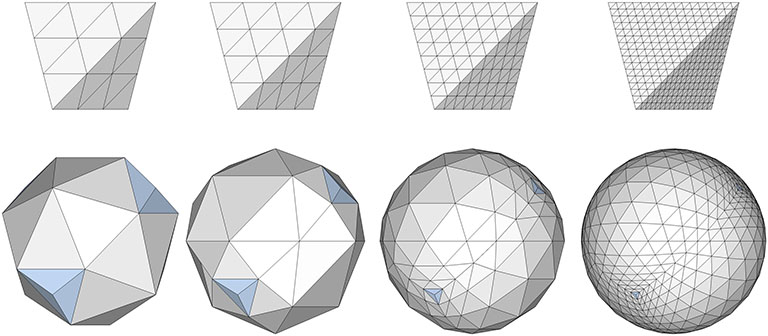
Class 3 geodesics subdivide the face with lines that are askew to the edges, neither parallel no perpendicular.

Class 3 geodesic polyhedra based on the regular icosahedron.
3F, 4F, 6F, and 8F Class 3 geodesic polyhedra (icosahedron base)

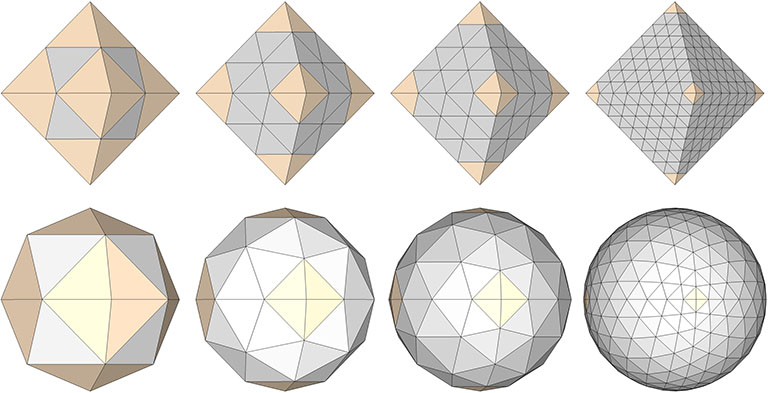
All of the geodesic polyhedra above have as their base the regular icosahedron. Being the most spherical, the icosahedron generates the most uniform tessellations. But the geodesic polyhedra may also be generated using the tetrahedron as their base, as in the following examples:

Class 1 geodesic polyhedra based on the tetrahedron.
3F, 4F, 8F, and 16F Class 1 geodesic polyhedra (tetrahedron base)

And they may also be generated using the octahedron as their base, as in these examples:

Class 1 geodesic polyhedra base on the octahedron.
2F, 3F, 4F, and 8F Class 1 geodesic polyhedra (octahedron base)

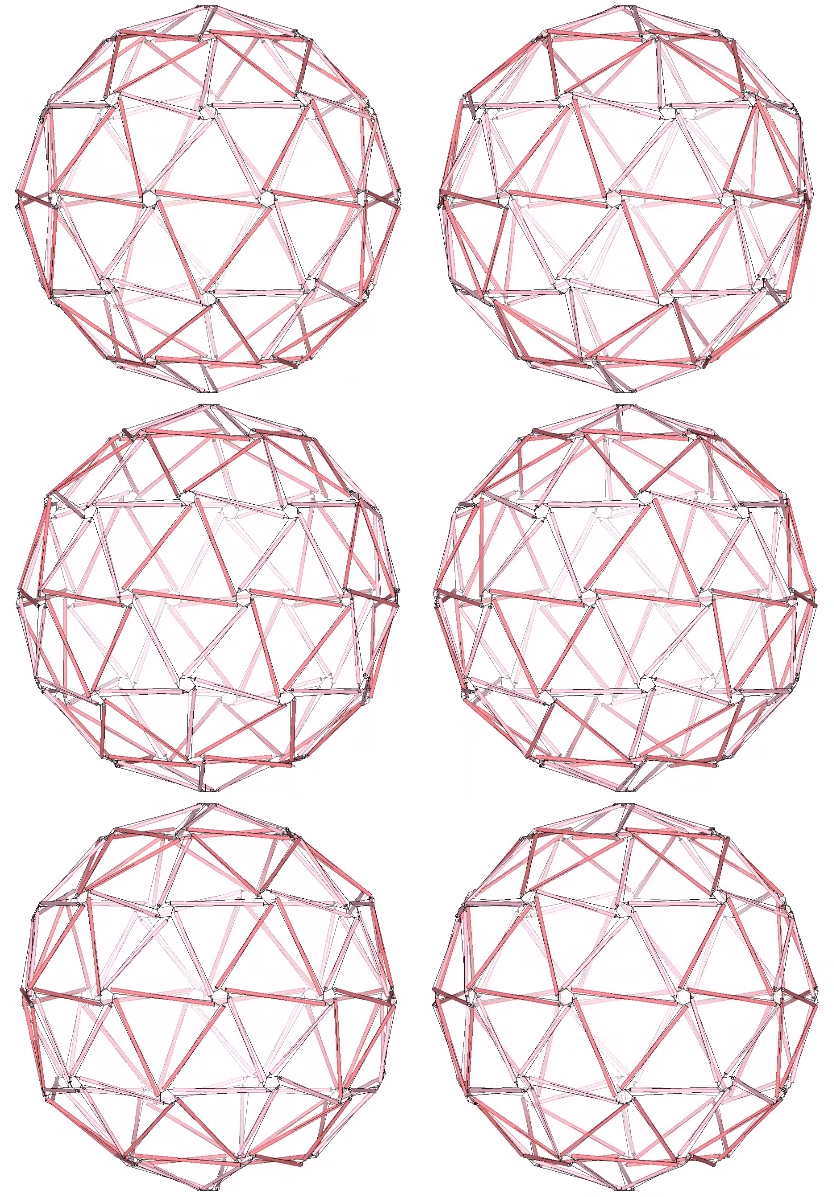
The spherical tensegrities, whether based on the tetrahedron, octahedron, or icosahedron, have the shape of Goldberg polyhedra, the duals of geodesic polyhedra. Fuller held that all of his geodesic domes were, structurally, tensegrities. But then, any self-supporting structure can be described as a tensegrity. That is, all structural arrangements of vectors can be described as islands of compression in a continuous web of tension. Perhaps Fuller meant that his calculations were done on the spherical tensegrities, i.e., the tensor equilibrium phases of the tensegrity forms of the geodesic polyhedra. (See: Tensegrity, and; Tensegrity Equilibrium and Vector Equilibrium.) Many of Fuller’s domes do, in fact, have the appearance of Goldberg polyhedra. Fuller’s geodesic structures may be most accurately described as tensegrity composites incorporating both their spherical and polyhedron states.

The 2F Class 1 geodesic polyhedron as a tensegrity composite, incorporating the 30-strut tensegrity sphere with its polyhedron counterpart, the tensegrity icosahedron.
The 2F Class 1 geodesic polyhedron as a Tensegrity composite, incorporating the 30-strut tensegrity sphere with its polyhedron counterpart, the tensegrity icosahedron.

An alternate construction of the 2F Class 1 geodesic polyhedron is achieved by reducing the the 120-strut tensegrity sphere to its polyhedron phase.

2F Class 1 geodesic polyhedron as tensegrity.
The 120-strut tensegrity sphere reduced to a 2F Class 1 geodesic polyhedron

Composite tensegrities, incorporating the spherical (Goldberg) and polyhedron (geodesic) phases of two or more frequencies may be possible without one interfering with the other. These may be easier to construct and would no doubt have incredible strength.

Operational Geometry

“You can “draw a line” only on the surface of some system. All systems divide Universe into insideness and outsideness. Systems are finite. Validity favors neither one side of the line nor the other. Every time we draw a line operationally upon a system, it returns upon itself. The line always divides a whole system’s unit area surface into two areas, each equally valid as unit areas. Operational geometry invalidates all bias.”
—R. Buckminster Fuller, Synergetics, 811.04

All of Fuller’s geometry is “operational” in the sense that it is conveyed and verified by physical models. The operations of synergetics includes constructions of sticks and flexible connectors, quanta modules, struts and string, wire, elastic cord, paper disks, clusters of ping-pong balls, a list of materials and operations limited only by our imaginations. Science without models is like language without metaphor. In the absence of metaphor, language is merely encoded logic. And without models, Fuller argued, science is equally impoverished. We need metaphor to formulate and articulate as yet unidentified concepts, and models are the metaphors of science. (See: Model Making.)

By way of introducing his operational geometry, Fuller would recall the basic operations of Euclidean geometry. Anyone who’s been through grade school has probably been taught how to use a draftsman’s compass, a straight edge, and a pencil, to repeat the familiar operation by which to find the perpendicular to a line and to construct an equilateral triangle.

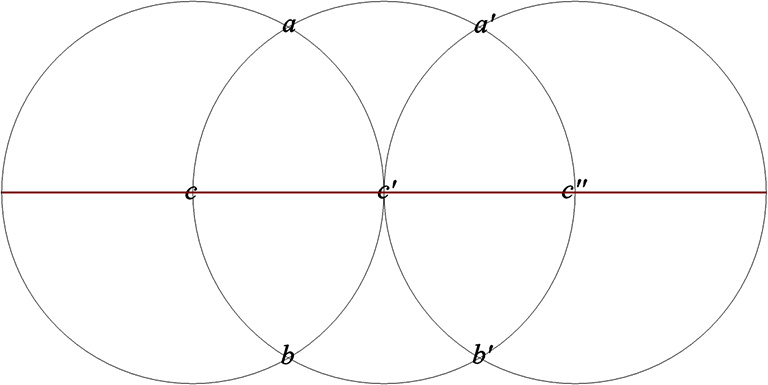
Begin by drawing a circle with the dividers of the compass tightened to a fixed radius. Next, with the straight edge, draw a line from its center (c) to the circle’s perimeter. Fix the compass on the point where the line crosses the circle’s perimeter (c’) and draw another circle. Repeat and draw a third circle centered at the point where the straight line crosses the perimeter of the second circle (c”).

Three overlapping circles with centers labeled c, c' and c'', and intersections labeled a, a', b, and b'

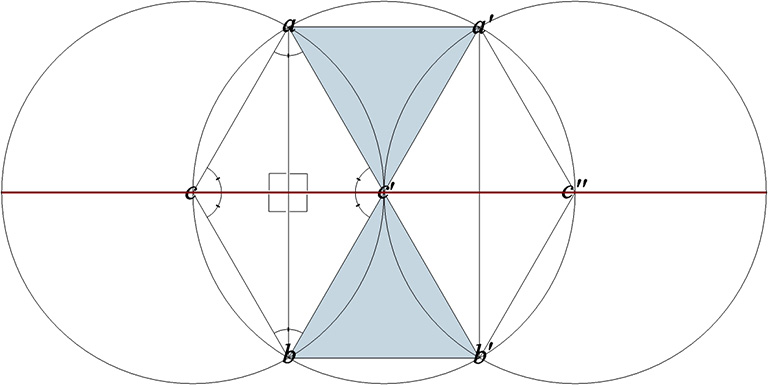
Now you have three circles bisected by a straight line running through the the circle centers, c, c’, and c”. The second circle crosses the first at two points, a and b. The third circle crosses the second at two points, a’ and b’. Lines drawn from a to b, and from a’ to b’ are perpendicular to the line drawn between the circle centers. Finally, draw lines between adjacent points to create six equilateral triangles in the shape of a hexagon.

Three intersecting circles with centers (c, c', and c'') and intersections (a, a', b, and b') connected to form a hexagon inside the center circle.

Fuller often argued that the key shortcoming of plane geometry is its failure to account for the surface on which its operations are performed. The surface is a tool, just like the dividers, the straight edge, and the stick we scratch the surface with.

With the surface in mind, Fuller re-imagined the above operations as follows:

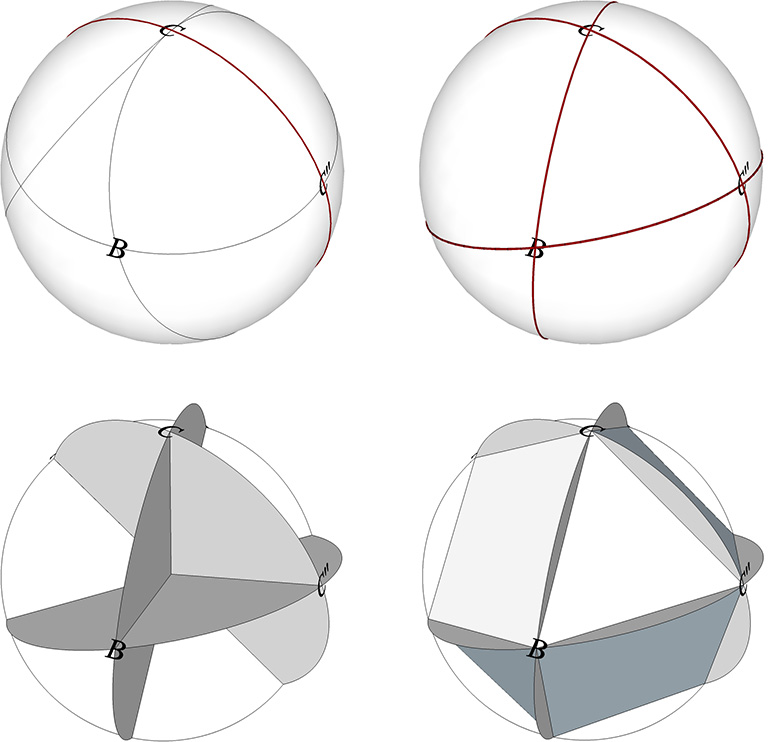
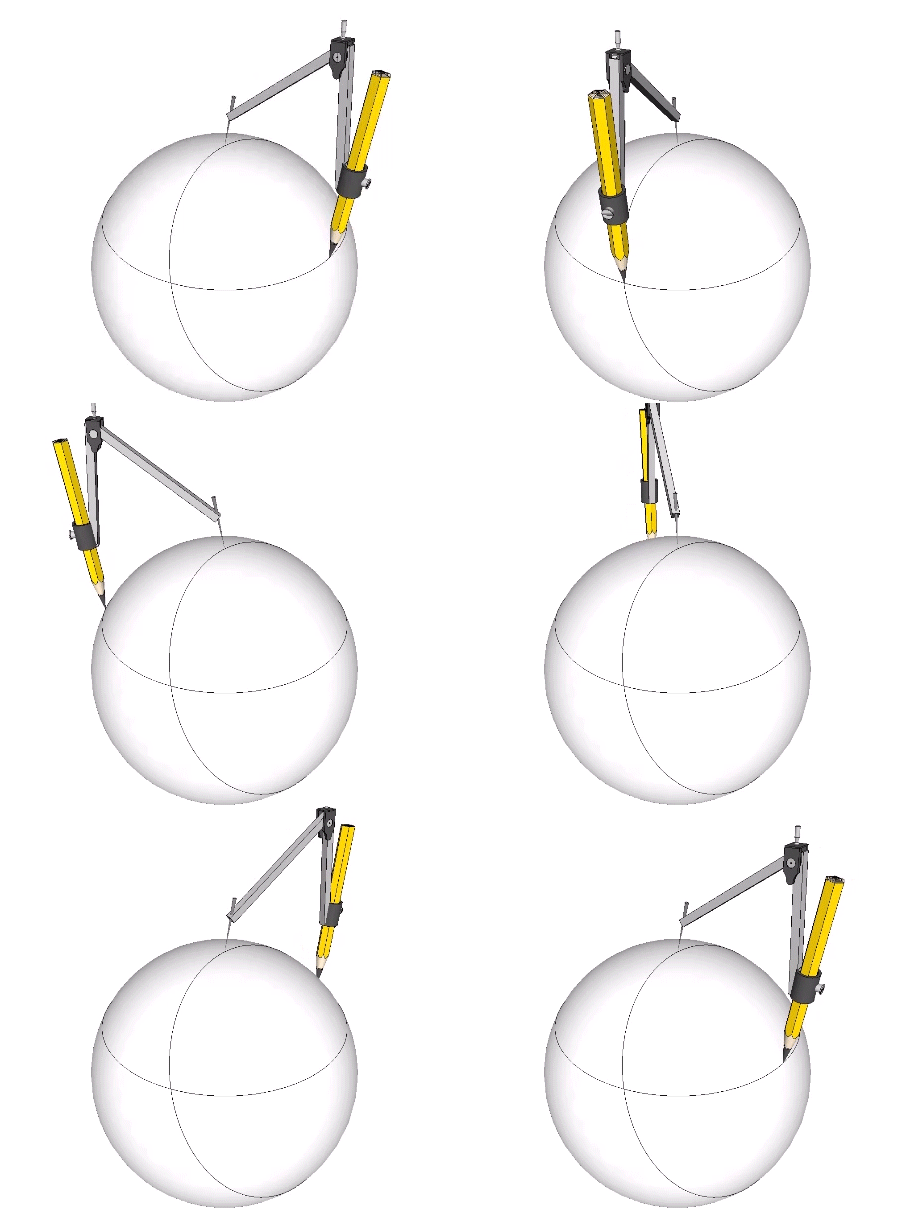
Begin by scribing a sphere. Granted, it isn’t possible to “scribe a sphere.” But we can imagine the process and perform the remaining operations on the surface of the sphere whose radius we are assured is identical with the fixed distance between the dividers of our compass. Mark a center anywhere on the sphere’s surface and draw a circle using the same compass. Next, just as before, draw a straight line from the center (C) to a point on the circle’s perimeter. And, remembering that straight lines on curved surfaces are, by definition, geodesics, we can continue drawing the line until it returns to the circle’s center and divides the sphere into two equal halves. Next, center the compass on one of the two points where the line crosses the perimeter of the circle and draw a second circle. Repeat, as above, to draw a third circle.

Now, when we connect the points as before with straight-line geodesics, we find that we have drawn four great circles. We know, operationally, that the length of the chords between the points is identical with the the sphere’s radius.

1) Sphere scribed with three overlapping circles of the same radius. A geodesic (in red) connects their centers, c, c' and c''. 
2) Sphere with geodesics (in red) connecting circle centers with circle intersections.
3) Geodesics represented as intersecting great circle disks.
4) Chords drawn between the circle centers and intersections describe the vector equilibrium (VE).

We have inadvertently constructed the eight equilateral triangles and six square faces of the vector equilibrium (VE). If we connect the points with the sphere center we create the eight tetrahedra and six half-octahedra that form the core of the isotropic vector matrix. And we have done it all operationally, without any calculations, and using only a compass, straight edge, and pencil.

A circle being scribed with a compass on a sphere with the same radius.

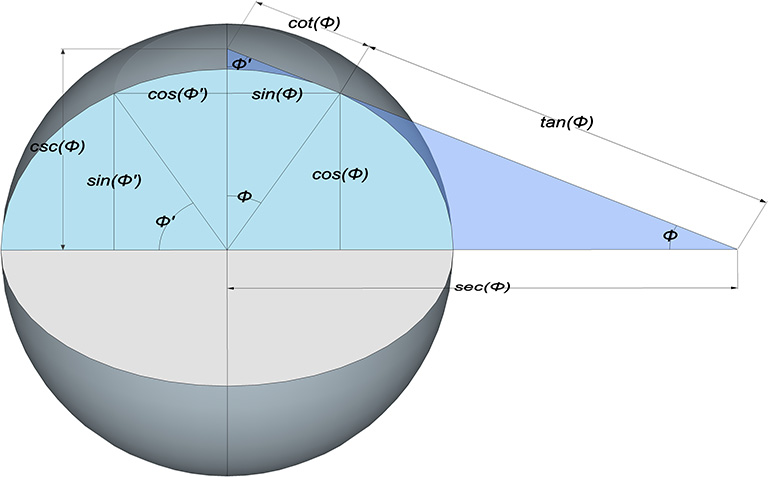
Fuller considered plane geometry to be a special case of the more general field of spherical trigonometry and topology. The Euclidean plane is a hemispheric section sliced through the middle of the sphere, and plane geometry is then the measurement of the chords whose central angles define the arcs of great circles drawn on the sphere’s surface.

Trigonometric functions and their relationships to the unit circle projected onto the hemispheric section of a sphere.
All surfaces are curved. The flat surface in plane geometry is an abstraction, shown here as the hemispherical section of a sphere. Plane geometry is a special case of the more general spherical trigonometry and topology.