Calculating areas and volumes in units of equilateral triangles and regular tetrahedra generally produces more rational results than calculating in units of squares and cubes. See Polyhedra With Whole Number Volumes.
The volume of a regular tetrahedron is conventionally calculated as the base times the perpendicular height divided by three. In the conventional Cartesian (90°) system of measurement, both the area of the triangular base and the volume of the tetrahedron are irrational numbers. Given an edge length of a, the height of the triangle is a√3/2, and the height of the tetrahedron is a√6/2. So,
Base of regular tetrahedron (in squares) = 1/2 × a × a√3/2, or a²√3/4, and
Volume of regular tetrahedron (in cubes) = 1/3 × a√3/2 × a√6/3, or a³√6/2
In Fuller’s 60° system of measurement, the area of the base triangle is simply a², and the volume of the tetrahedron is a³, the same formulas conventionally used for squares and cubes. In the 60° system, the tetrahedron is the unit by which volume is measured, and the equilateral triangle is the unit by which surface area is measured.
For example, an equilateral triangle of edge length 4 has an area of 16, or 4×4 smaller triangles. And a regular tetrahedron of edge length 4 has a volume of 64, or 4×4×4 tetrahedra.
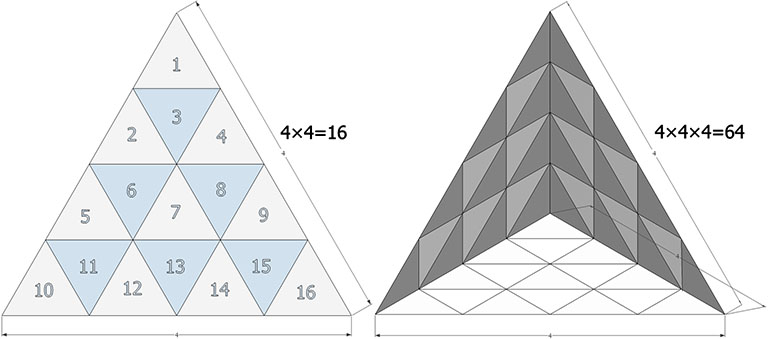
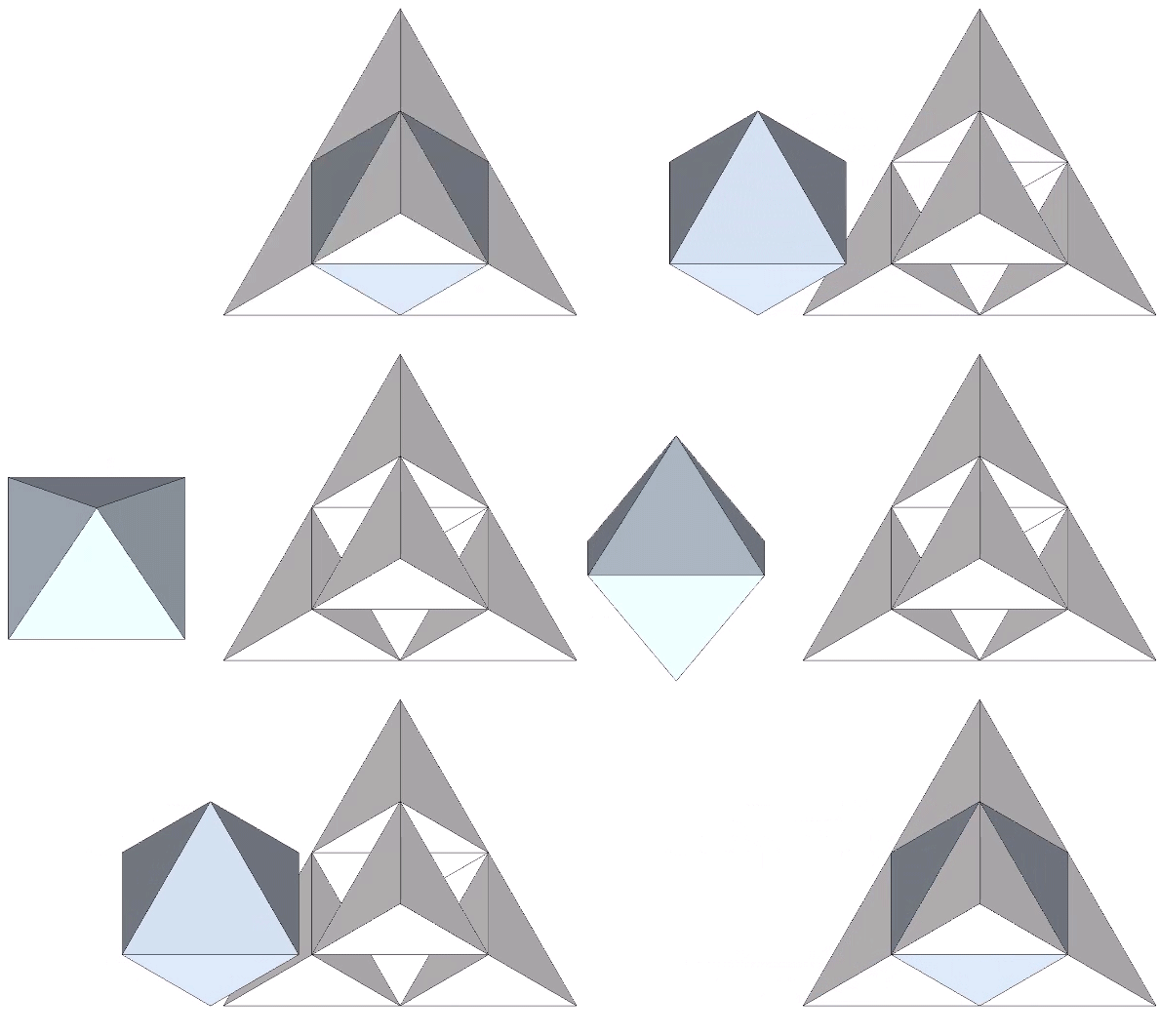
Note that you cannot stack tetrahedra to fill all-space. The large tetrahedron in the above illustration isn’t built of 64 smaller tetrahedra. It is built of a combination of twenty four tetrahedra and ten octahedra. Fortunately, the volume of one octahedron is precisely the same as four tetrahedra. 24 + (10×4) = 64.
To determine the area of a given polygon or the volume of a given polyhedron, we can calculate the area and volume using conventional methods, and then use a conversion factor to find the equivalent area in equilateral triangles or the equivalent volume in tetrahedra. See General Unit Conversions.
Alternatively, we can measure areas and volumes directly, remembering only that the heights differ between the two systems. In conventional geometry, both in plane geometry and in solid geometry, the height is measured at 90° to the base. In 60° geometry, the two-dimensional height is measured at 30° from the perpendicular or 60° from the horizontal base, and the three-dimensional height is measured at arctan(√2/2) from the perpendicular or arctan(√2) from the horizontal base. These are the angles that the edges of the equilateral triangle and tetrahedron make with their respective bases.
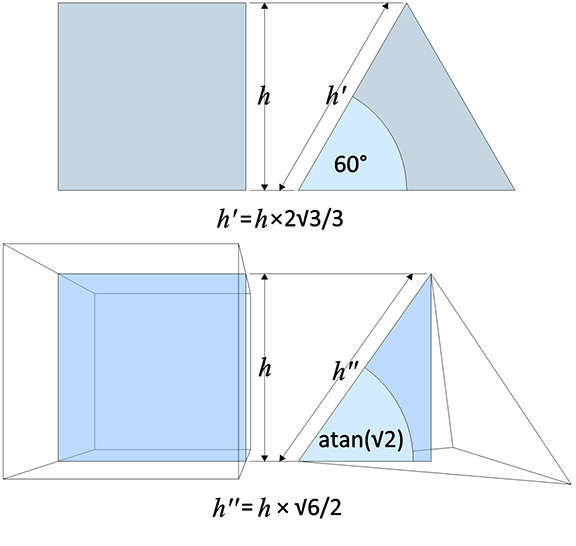
The area for any rhombus (quadrilateral, rectangle, or square) is 2 × base × height, where height is measured at 30° from vertical. Where base = a and the vertical height = h, the formula is:
Triangular area of any rhombus = 2 × a × h2√3/3
Likewise, the area for any triangle is base × height, or, where base = a and h is the vertical height, the formula is:
Triangular area of any triangle = a × h2√3/3
The area for any polygon, regular or irregular, may be calculated by dividing it into rhombuses and/or triangles, calculating the areas of each, and then summing the results. See Calculating Areas of Regular Polygons. The areas of regular polyhedra may be calculated directly from the number sides and the length of its radius. See Calculating Volumes of Regular Polyhedra.
The volume of any polyhedron, regular or irregular, may be calculated by dividing it into cylinders and cones. By cylinders and cones, we mean all cylindrical or conical objects regardless of the shape of their bases. Where h is the perpendicular height…
Tetrahedral volume of a cone = area of base × h × √6/2
Tetrahedron volume of a cylinder = 3 × base × h × √6/2
Examples
Cone with triangular base (Tetrahedron)
This example serves as a proof of the proposition that the volume (in unit tetrahedra) of any regular tetrahedron can be expressed as [edge length]³.
a = edge length
h = height = a√6/3
base (in equilateral triangles) = a²
Volume (in tetrahedra) = base × h√6/2 = a² × (a√6/3 × √6/2) = a³
Cone with Square Base (Half Octahedron)
This example serves as a proof of the proposition that the volume (in unit tetrahedra) of any regular half octahedron can be expressed as 2×[edge length]³.
a = edge length
h = height = a√2/2
base (in equilateral triangles) = a²4√3/3
Volume (in tetrahedra) = base (in equilateral triangles) × h√6/2 = a²4√3/3 × (a√2/2 × √6/2) = 2a³
Cylinder with Square Base (Cube)
This example serves as a proof of the proposition that the volume (in unit tetrahedra) of any cube can be expressed as 3×[length of face diagonal]³.
a = edge length
h = a
d = diagonal = a√2
a = d√2/2
h = d√2/2
base (in equilateral triangles) = 2a×h×2√3/3 = 2(d√2/2)²×2√3/3 = 2d²√3/3
Volume (in tetrahedra) = 3×base (in equilateral triangles)×h = 3×2d²√3/3×(d√2/2×√6/2) = 3d³
 The Geometry of Thinking
Fortunately, the volume of one octahedron is precisely the same as four tetrahedra. 20 + (10×4) = 64.
Obviously this if not correct as the answer is 60!?
Thank you. I could really use a good copy editor. The 4x4x4 tetrahedron contains 24 (not 20) unit tetrahedra, and 10 octahedra. 24 + (10×4) = 64. Good catch. And please, if you find any more errors let me know!