The golden ratio appears nowhere in Fuller’s two-volume exposition of his geometry, Synergetics. This isn’t surprising; Fuller eschewed irrational numbers, and his mathematical explorations persuaded him that all irrational numbers, like the golden ratio, could be expunged from our science if only we adopted his physical geometry, grounded in the real and experimentally verifiable rather than the axiomatic. But the golden ratio turns up again and again in both his and in conventional geometry, and recognizing it when you see it might lead to discoveries otherwise overlooked.
Expressed algebraically, the golden ratio (φ) is:
a+b/a = a/b = φ = (1+√5)/2 ≈ 1.618034
from which we can deduce the following selection of algebraic identities:
φ² = φ + 1
1/φ = φ – 1
1/φ² = 2 – φ
φ + φ² = φ³
1/φ – 1/φ² = 1/φ³
Expressed in trigonometry, the golden ratio has the following identities:
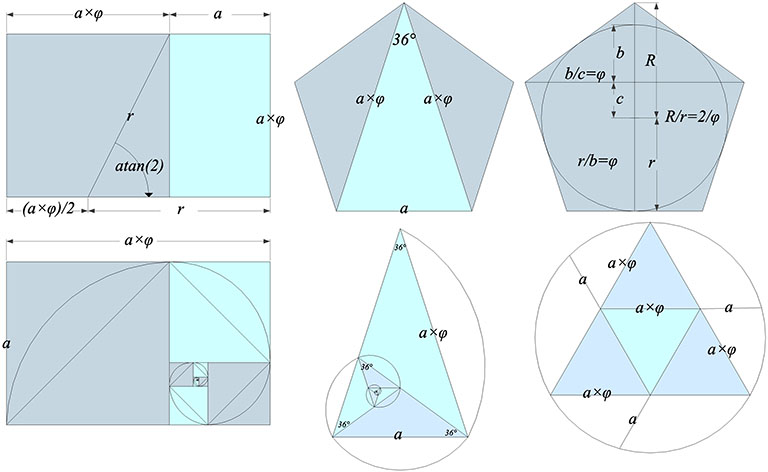
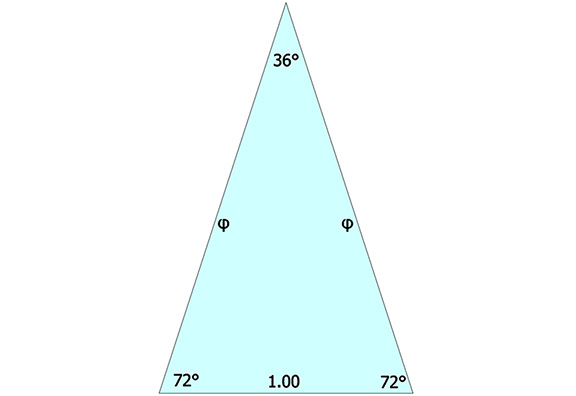
The visual geometric expressions of the golden ratio (φ) are numerous. Here is a selection in two dimensions:
Examples of the golden ratio and its geometrical expression in two dimensions.
The golden ratio turns up in many polyhedra, both regular and irregular.
Icosahedron
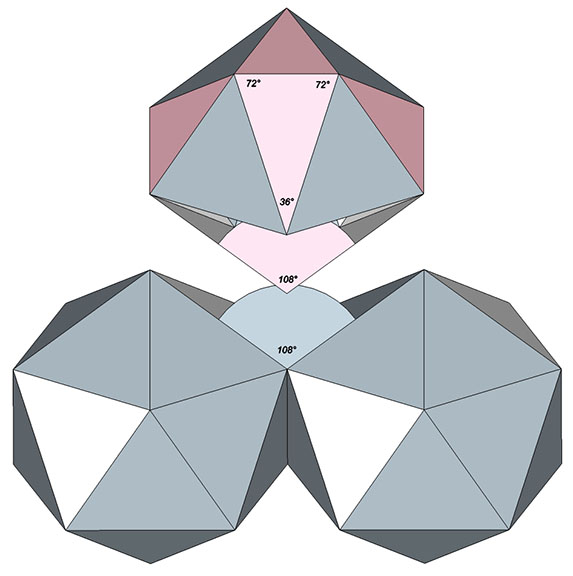
The icosahedron is perhaps the most famous example of the golden ratio in three dimensions. It can be constructed from three golden rectangles intersecting at 90° around a common center, as shown in the following illustration:
The regular icosahedron and its relation to the Golden Ratio.
Regular (Pentagonal) Dodecahedron
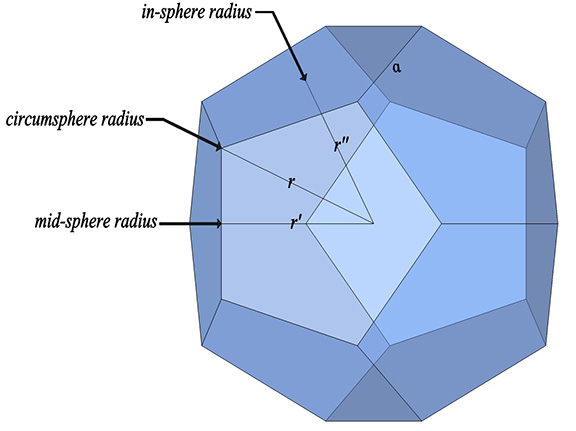
Wherever pentagons are found, the golden ratio is sure to turn up. The in-sphere, mid-sphere and circumsphere radii of the pentagonal dodecahedron are all related to the golden ratio.
a = edge length φ = (√5+1)/2
The in-sphere radius (center to mid-face) = a × φ²/2√(3-φ) The mid-sphere radius (center to mid-edge) = a × φ²/2 The circumsphere radius (center to vertex) = a × √3φ/2
Pentagonal dodecahedron showing the circumsphere radius (r), the mid-sphere radius (r’), and the in-sphere radius (r”).
Rhombic Triacontahedron
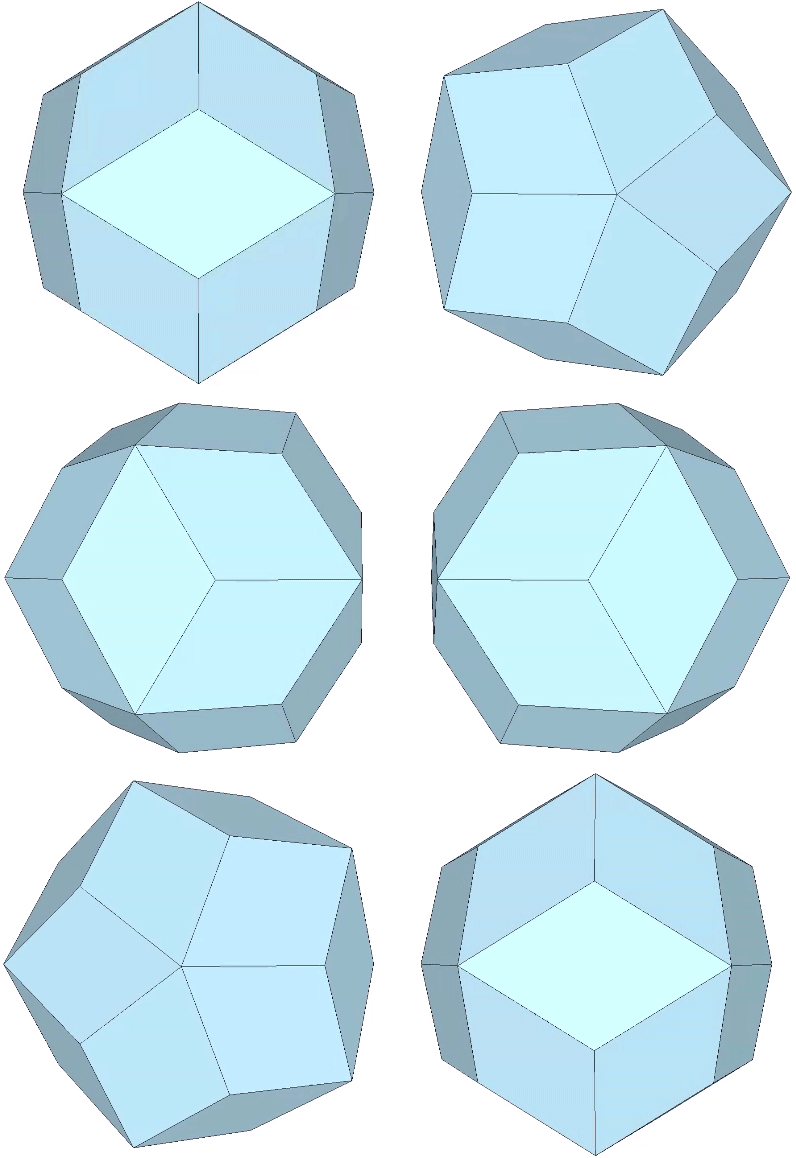
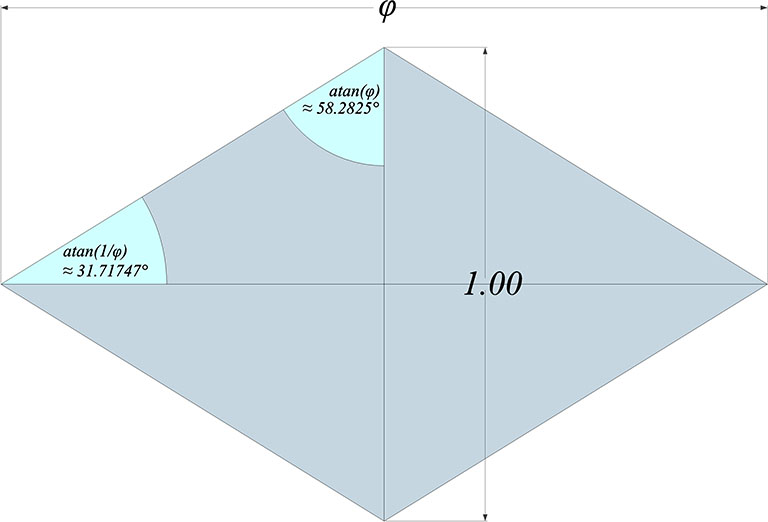
The 30 faces of the the rhombic triacontahedron are identical with the golden rhombus.
The 30 faces of the rhombic triacontahedron are all golden rhombuses.
The long diagonal of the golden rhombus is φ times the length of its short diagonal.
“Starting With Parts: The Nonradial Line: Since humanity started with parallel lines, planes, and cubes, it also adopted the edge line of the square and cube as the prime unit of mensuration. This inaugurated geomathematical exploration and analysis with a part of the whole, in contradistinction to synergetics’ inauguration of exploration and analysis with total Universe, within which it discovers whole conceptual systems, within which it identifies subentities always dealing with experimentally discovered and experimentally verifiable information. Though life started with whole Universe, humans happened to pick one part, the line, which was so short a section of Earth arc (and the Earth’s diameter so relatively great) that they assumed the Earth-scratched-surface line to be straight. The particular line of geometrical reference humans picked happened not to be the line of most economical interattractive integrity. It was neither the radial line of radiation nor the radial line of gravity of spherical Earth. From this nonradial line of nature’s event field, humans developed their formulas for calculating areas and volumes of the circle and the sphere only in relation to the cube-edge lines, developing empirically the “transcendentally irrational,” ergo incommensurable, number pi (π ), 3.14159 . . . ad infinitum, which provided practically tolerable approximations of the dimensions of circles and spheres.” —R. Buckminster Fuller, Synergetics, 982.20
It would seem that conventional 90° geometry has the advantage over Fuller’s 60° geometry in that the area of the circle in squares is stated simply as πr², while its area in equilateral triangles is the more cumbersome π4r²√3/3. But remember that the r in the equation is the circumradius of a very high frequency polygon, and not the midradius assumed by pi.
The simplicity of the formula in 90° geometry is due to the coincidence that the midradius of the unit square is identical with the square’s edges. In fact, this may be why we ended up with a 90° geometry in the first place, and not, as Fuller believed, because we thought the Earth was flat.
The same is true for volumes. The mid-sphere radius of the unit cube is identical with its edges and leads to the relatively simple formula, 4/3 × πr³, as opposed to its 60° equivalent, 6√2 × πr³.
Conversion Factors and Power Constants
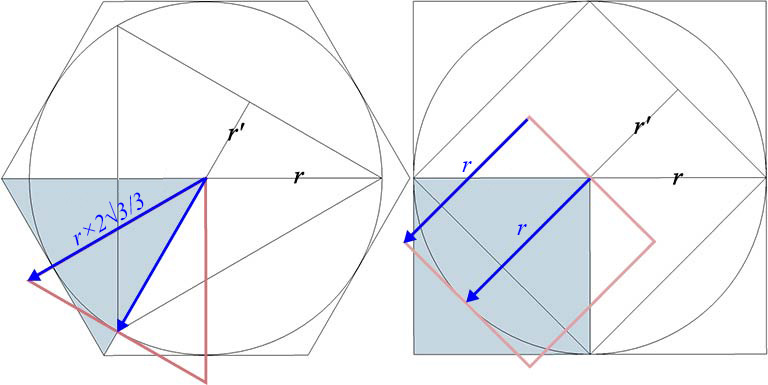
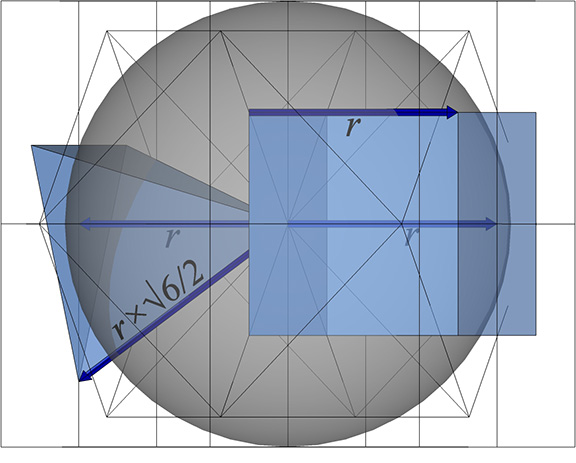
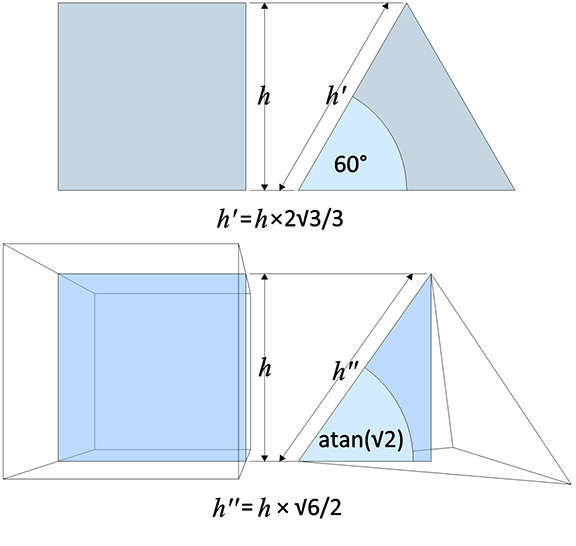
The difference between the midradius and the triangle’s edge accounts for the multiple of 2√3/3 for heights and radii in the 60° formula for areas. The difference between the mid-sphere radius and the tetrahedron’s edge accounts for the multiple of √6/2 for heights and radii in the 60° formula for volumes. See: Areas and Volumes in Triangles and Tetrahedra.
If we divide the 60° area of the circle (in triangles) by its 90° area (in squares), we get my 60° conversion factor for areas, 4√3/3. And if we divide the 60° volume of the sphere (in tetrahedra) by its 90° volume (in cubes), we get my 60° conversion factor for volumes, 6√2. These conversion factors are simply the inverses of the conventional area (in squares) and volume (in cubes) of the equilateral triangle and the regular tetrahedron. The area (in squares) of an equilateral triangle of unit edge length is: 1/2 × base × height = 1/2 × √3/2 = √3/4, and the inverse of √3/4 is 4/√3, or 4√3/3.
Area (in equilateral triangles) = Area (in squares) × 4√3/3 ≈ 2.30940108
The cubic volume of the regular tetrahedron of unit edge length is: 1/3 × base × height = 1/3 × √3/4 × √6/3 = √2/12, and the inverse of √2/12 is 12/√2 = 6√2.
Volume (in regular tetrahedra) = Volume (in cubes) × 6√2 ≈ 8.48528137
“Synergetics has discovered that the vectorially most economical control line of nature is in the diagonal of the cube’s face and not in its edge. […] The isotropic-vector-matrix’s field-occurring-cube’s diagonal edge has the value of 2, being the line interconnecting the centers of the two spheres. […] The square root of 2 = 1.414214, ergo, the length of each of the cube’s edges is 1.414214. […] Therefore, the cube occurring in nature with the isotropic vector matrix, when conventionally calculated, has a volume of 2.828428. […] This same cube in the relative-energy volume hierarchy of synergetics has a volume of 3, [and] 3 ÷ 2.828428 = 1.06066. To correct 2.828428 to read 3, we multiply 2.828428 by the synergetics conversion constant 1.06066.” —R.Buckminster Fuller, Synergetics, 982.21-46 (condensed)
The first appearance of Fuller’s synergetics power constants is in a paper he published in 1950 called the Dymaxion Hierarchy of Vector Generated Field-, Volume-, Mass-, Charge-Potential of Geometric Forms. It was Fuller’s first exposition of his “Dynamic Energetic Geometry,” later to be renamed Synergetics. The paper was republished, without modification, as Table 963.10, in Synergetics I. It includes the first mention of the “A particle,” which will become his A quanta module, and the “Dymaxion,” which will become his vector equilibrium (VE). It is also the first mention of his discovery for the rational volumes of the cube, octahedron, rhombic dodecahedron, VE, and Kelvin’s truncated octahedron.
The synergetics power constants and their applications can be confusing and require, I think, some explanation. What Fuller would later call his synergetics conversion constant is referenced in Table 963.10 as a mathematical derivation of the dymaxion vector constant, or “V”. The synergetics conversion constant is the factor he uses to convert conventional (or cubic) volumes to their “energetic” volumes, while the dymaxion vector constant is two times its third root. In other words, the dymaxion vector constant is 2 times the 1st power synergetics constant which is multiplied by itself to produce the synergetics power constants for the 2nd, 3rd, and higher dimensions.
The synergetics power constants are:
1st power constant: ⁶√(9/8) ≈ 1.019824451328 2nd power constant: ³√(9/8) ≈ 1.040041911526 3rd power constant: √(9/8) ≈ 1.060660171780 4th power constant: ³√((9/8)²) ≈ 1.081687177731 5th power constant: ⁶√((9/8)⁵) ≈ 1.103131032537 6th power constant: 9/8 = 1.125 9th power constant: ²√((9/8)³) ≈ 1.193242693252 12th power constant: (9/8)² = 1.265625
Fuller’s synergetics conversion constant for volumes is the third power constant, arrived at by dividing the vector-diagonal cube’s “energetic” volume of 3 by its conventionally calculated cubic volume of 2√2.
The cube’s energetic volume is 3, a number familiar to readers as the tetrahedral volume of the unit-diagonal cube. But this is inconsistent with the cubic volume in the denominator, which assumes a diagonal twice the length. Careful reading, however, shows that the cube’s “energetic” volume, is not the tetrahedral volume of a unit diagonal cube but, rather, the cubic volume of a cube whose diagonal length is “V,” i.e., two times the 1st power constant.
The “energetic” volume of the cube in the numerator of his synergetics conversion constant is the cubic volume calculated with a diagonal length of V, while the conventional volume of the cube in the denominator is the cubic volume calculated with a diagonal length of 2. The “energetic” volume (in cubes) is numerically identical with the tetrahedral volume (in tetrahedra) of a unit-diagonal cube.
Note: In Fuller’s geometry, the edges of polyhedra (or, sometimes, their diagonals) are vectors connecting sphere centers. If the radius of those spheres is taken to be unity, the vectors connecting the sphere centers must have a length two times their radius, or ‘2’. This explains why his conventionally-calculated volume of the vector-diagonal cube assumes the edges to be of length √2 rather than √2/2. On the other hand, the conversion constant I calculated above (6√2) assumes a vector length of 1. Fuller’s insistence on doubling the edge length in his cubic calculations has merit. After all, conventional geometry already assumes a vector length of 2 when it assigns a radius length of 1 to its prime sphere. It is why the circumference of the circle is 2πr rather than πd, and why cyclical unity (360°) is 2π radians.
Fuller’s primary aim with his synergetics power constants was to resolve all of the mathematical and physical constants (pi, Planck’s constant, etc.) into whole numbers or simple fractions aligned with the rational 60° coordinate system of the isotropic vector matrix. But he left it to others to work out the details. His own attempts were either flawed or unpersuasive. He proposed a whole number value for Planck’s constant (20), and at one point believed he’d succeeded in finding a rational volume for the sphere (5). He later retracted this claim, writing, “My hindsight wisdom tells me that my subconscious demon latched tightly onto this 5 and fended off all subconsciously challenging intuitions.” The “5” that his subconscious demon had latched onto is almost (but not precisely) the cubic volume of the sphere multiplied by his synergetics conversion constant raised to the 3rd power: cubic volume of sphere × (synergetics conversion constant)³ = 4π/3 × (3√2/4)³ ≈ 4.9983. He later realizes he had raised to the third power what was already his third power constant, thereby inadvertently calculating the “energetic” volume of the sphere using the 9th power constant. Had he used the 3rd power constant, the result would have been 4π/3 × 3√2/4 ≈ 4.4429—a number sufficiently distant from 5 so as not be mistaken for a rounding error due to the lack of “absolute resolvability of trigonometric calculations.” The rational value of 20 which he proposed for the Planck constant is based on the observation that its base value of 6.626070 approximates the ratio of the tetrahedral volumes of the VE and the cube.
Volume of VE ÷ Volume of Cube = 20/3 = 6.666…
The difference between 6.626070 and 6.666666 was, he believed, due entirely to our clumsy system of measurement and the units employed, a dubious claim that has mostly been ignored.
In his calculations for the cubic volume of the sphere, Fuller assumes a radius of 1, i.e. half the sphere’s diameter which has a vector length of 2. If we were instead to use my conversion constant for volumes, 6√2, rather than Fuller’s, we would need to calculate the sphere’s cubic volume using a radius of 1/2:
4π/3 × (1/2)³ × 6√2 = π√2 ≈ 4.4429
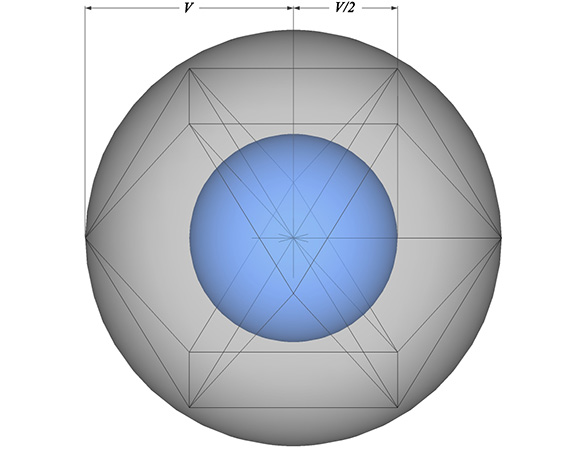
We can calculate the “energetic” (or tetrahedral) volumes of the sphere directly using Fuller’s dymaxion vector constant, V. In the figure below, the energetic volume of the blue nuclear sphere is 4/3 × π(V/2)³ = πV³/6 ≈ 4.442883. The circumsphere of the VE, the gray sphere in the figure below, has an energetic volume of 4πV³/3 ≈ 35.543064.
The “energetic” volume of the nuclear sphere (blue) = πV³/6 ≈ 4.442883. The “energetic” volume of its circumsphere (gray) = 4πV³/3 ≈ 35.543064.
The 3rd root of my conversion constant for volumes, i.e., ³(6√2), is identical with Fuller’s dymaxion vector constant, V. That is, 2 × ⁶√(9/8) = ³√(6√2). In section 985.02 of Synergetics I, Fuller briefly mentions the conversion constant for areas I calculated above, 4√3/3, and applies it to the square area of unit circle, but he does not relate it to his other power constants. If we take the 2nd root of my conversion constant for areas, i.e. √(4√3/2), and apply it as the unit vector for calculations of area, the equilateral triangle has a square area of 1, the hexagon has a square area of 6, etc.
Some Coincidences and Curiosities
There may be more to Fuller’s, and my own, power constants, and I’ll circle back to this topic as fresh insights emerge. If science is to make the transition from the 90° to the 60° system of measurement and geometric modelling, the power constants, or some version of them, would seem to be relevant to the process. For now, the following coincidences and curiosities may lead me somewhere, or they may be mathematically trivial.
If we apply my 2nd power conversion constant for areas to the edge of an equilateral triangle, its area (in squares) is numerically identical to its edge value.
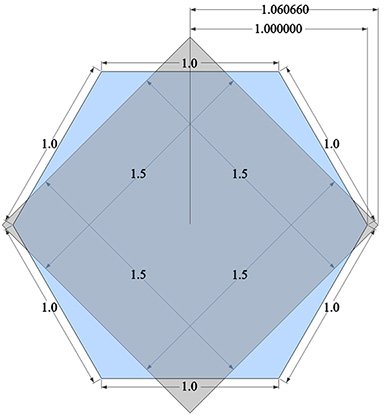
Fuller’s 3rd power constant is equal to the ratio of my conversion factors for heights and radii in two and three dimensions:
√6/2 ÷ 2√3/3 = 3√2/4 ≈ 1.060660172
The dymaxion vector constant (V) raised to the third power is equal to my conversion constant for volumes, 6√2, just as the third root of my conversion constant for volumes in identical with V.
V³ = 6√2 ≈ 8.485281374
My conversion constant for volumes, 6√2, is eight times the synergetics conversion constant:
6√2 ÷ 8 = 3√2/4 ≈ 1.060660172
A square with a perimeter of 6 has a radius equal to the synergetics conversion constant.
The 3rd-power synergetics conversion constant is equal to the radius of perimeter-6 square.
The dymaxion vector constant (V) raised to the second power is equal to the third root of 72.
V² = 2×(³√9) = ³√72 ≈ 4.1601676461
It may be only a coincidence that the prime cube consists of exactly 72 quanta modules.
A rhombic dodecahedron with a short diagonal length of √6/2—my conversion factor for heights and radii in three dimensions—has an edge length of 3√2/4, the synergetics conversion constant.
Calculating areas and volumes in units of equilateral triangles and regular tetrahedra generally produces more rational results than calculating in units of squares and cubes. See Polyhedra With Whole Number Volumes.
The volume of a regular tetrahedron is conventionally calculated as the base times the perpendicular height divided by three. In the conventional Cartesian (90°) system of measurement, both the area of the triangular base and the volume of the tetrahedron are irrational numbers. Given an edge length of a, the height of the triangle is a√3/2, and the height of the tetrahedron is a√6/2. So,
Base of regular tetrahedron (in squares) = 1/2 × a × a√3/2, or a²√3/4, and Volume of regular tetrahedron (in cubes) = 1/3 × a√3/2 × a√6/3, or a³√6/2
In Fuller’s 60° system of measurement, the area of the base triangle is simply a², and the volume of the tetrahedron is a³, the same formulas conventionally used for squares and cubes. In the 60° system, the tetrahedron is the unit by which volume is measured, and the equilateral triangle is the unit by which surface area is measured.
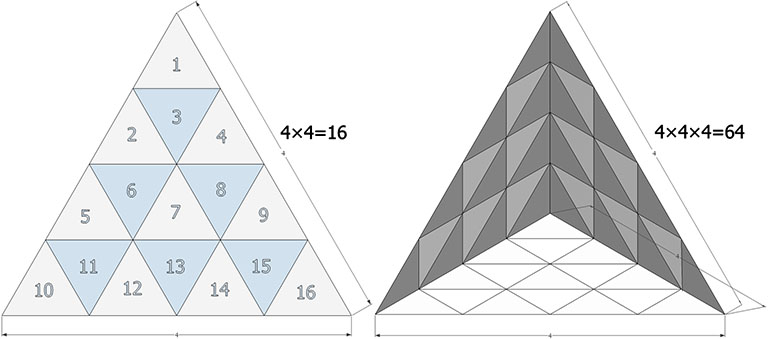
For example, an equilateral triangle of edge length 4 has an area of 16, or 4×4 smaller triangles. And a regular tetrahedron of edge length 4 has a volume of 64, or 4×4×4 tetrahedra.
60° accounting works just like 90° accounting; the 2nd power of the triangle’s edge length gives its area, and the 3rd power of the tetrahedron’s edge length gives its volume.
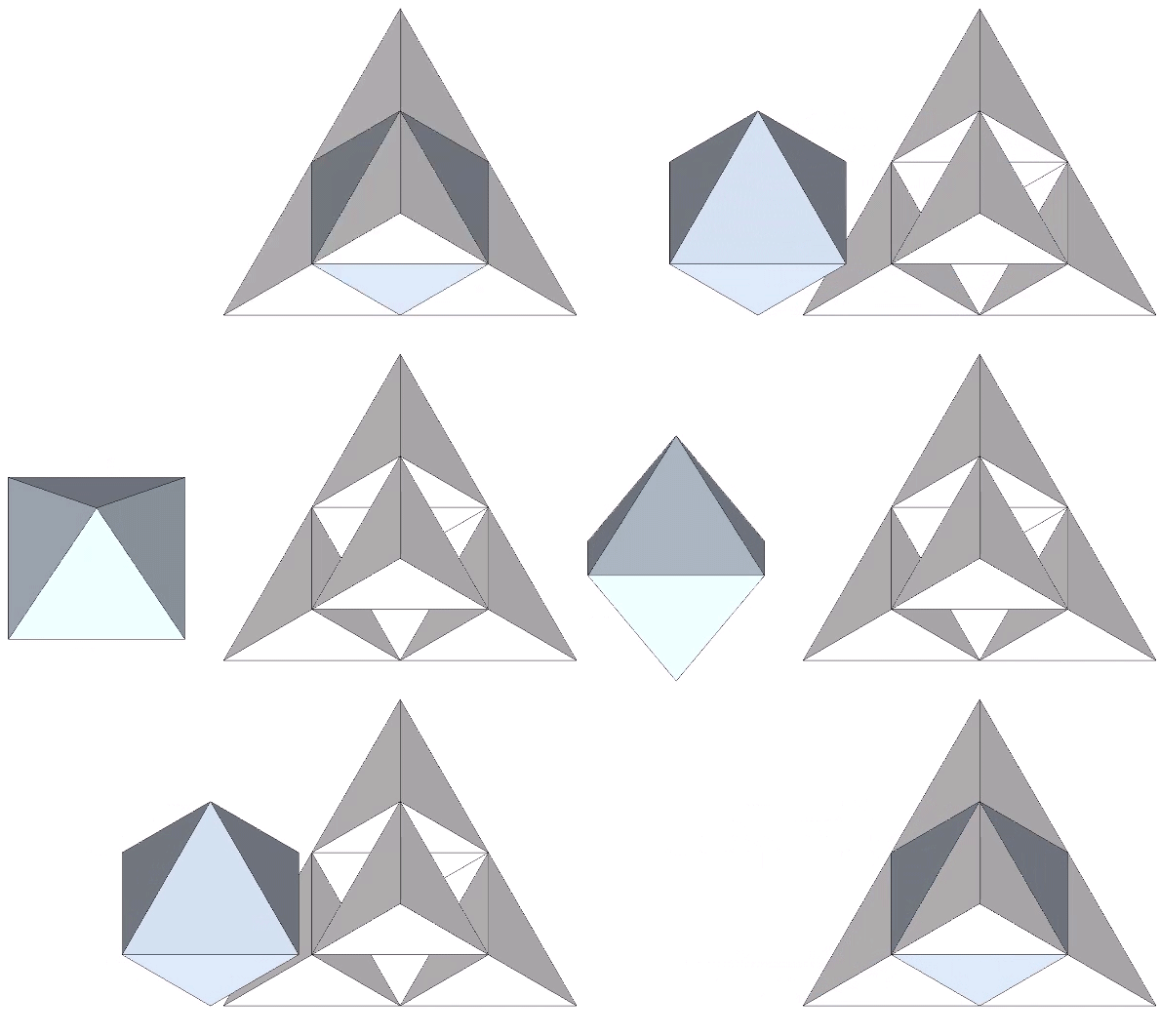
Note that you cannot stack tetrahedra to fill all-space. The large tetrahedron in the above illustration isn’t built of 64 smaller tetrahedra. It is built of a combination of twenty four tetrahedra and ten octahedra. Fortunately, the volume of one octahedron is precisely the same as four tetrahedra. 24 + (10×4) = 64.
Subdividing the tetrahedron produces layers of vertex-bonded tetrahedra face-bonded to edge-bonded octahedra. It can be demonstrated operationally that the regular octahedron has a volume of precisely four regular tetrahedra.
To determine the area of a given polygon or the volume of a given polyhedron, we can calculate the area and volume using conventional methods, and then use a conversion factor to find the equivalent area in equilateral triangles or the equivalent volume in tetrahedra. See General Unit Conversions.
Alternatively, we can measure areas and volumes directly, remembering only that the heights differ between the two systems. In conventional geometry, both in plane geometry and in solid geometry, the height is measured at 90° to the base. In 60° geometry, the two-dimensional height is measured at 30° from the perpendicular or 60° from the horizontal base, and the three-dimensional height is measured at arctan(√2/2) from the perpendicular or arctan(√2) from the horizontal base. These are the angles that the edges of the equilateral triangle and tetrahedron make with their respective bases.
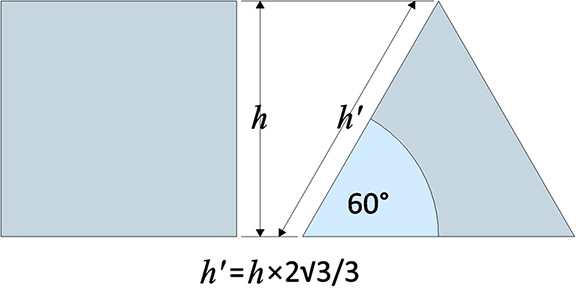
In 90° geometry, height (h) is always measured at 90° from the horizontal. In 60° geometry, height in two dimensions (h’) is measured at 60° from the horizontal: h’=h×2√3/3. Height in three dimensions (h”) is measured at arctan(√2) from the horizontal: h”=h×√6/2.
The area for any rhombus (quadrilateral, rectangle, or square) is 2 × base × height, where height is measured at 30° from vertical. Where base = a and the vertical height = h, the formula is:
Triangular area of any rhombus = 2 × a × h2√3/3
Likewise, the area for any triangle is base × height, or, where base = a and h is the vertical height, the formula is:
Triangular area of any triangle = a × h2√3/3
The area for any polygon, regular or irregular, may be calculated by dividing it into rhombuses and/or triangles, calculating the areas of each, and then summing the results. See Calculating Areas of Regular Polygons. The areas of regular polyhedra may be calculated directly from the number sides and the length of its radius. See Calculating Volumes of Regular Polyhedra.
The volume of any polyhedron, regular or irregular, may be calculated by dividing it into cylinders and cones. By cylinders and cones, we mean all cylindrical or conical objects regardless of the shape of their bases. Where h is the perpendicular height…
Tetrahedral volume of a cone = area of base × h × √6/2 Tetrahedron volume of a cylinder = 3 × base × h × √6/2
Examples
Cone with triangular base (Tetrahedron)
This example serves as a proof of the proposition that the volume (in unit tetrahedra) of any regular tetrahedron can be expressed as [edge length]³.
a = edge length h = height = a√6/3 base (in equilateral triangles) = a²
Volume (in tetrahedra) = base × h√6/2 = a² × (a√6/3 × √6/2) = a³
Cone with Square Base (Half Octahedron)
This example serves as a proof of the proposition that the volume (in unit tetrahedra) of any regular half octahedron can be expressed as 2×[edge length]³.
a = edge length h = height = a√2/2 base (in equilateral triangles) = a²4√3/3
Volume (in tetrahedra) = base (in equilateral triangles) × h√6/2 = a²4√3/3 × (a√2/2 × √6/2) = 2a³
Cylinder with Square Base (Cube)
This example serves as a proof of the proposition that the volume (in unit tetrahedra) of any cube can be expressed as 3×[length of face diagonal]³.
a = edge length h = a d = diagonal = a√2 a = d√2/2 h = d√2/2 base (in equilateral triangles) = 2a×h×2√3/3 = 2(d√2/2)²×2√3/3 = 2d²√3/3
Volume (in tetrahedra) = 3×base (in equilateral triangles)×h = 3×2d²√3/3×(d√2/2×√6/2) = 3d³
When calculating volumes in units of tetrahedra, what would otherwise be perpendicular measurements are instead measured at an angle of atan(√2) from the horizontal. This angle corresponds to the angle the edges of the regular tetrahedron make with their base. Multiplying the perpendicular value, h, by √6/2 gives h’. See Areas and Volumes in Triangles and Tetrahedra.
Polyhedra can be divided up into cones whose bases correspond to the polyhedron’s faces and whose apexes all meet at the polyhedron’s center. This procedure gives the precise volume and, if done correctly, will produce the shorthand formulas that work for all similar polyhedra, as in the following:
The procedures by which the volume formulas are established for these and other polyhedra are demonstrated below. The areas of the faces will mostly be given without showing the work. To learn how each is calculated, see Calculating the Triangular Areas of Regular Polygons.
If the cubic volume of a given polyhedron is known, you can also use a conversion factor to quickly find the equivalent volume in tetrahedra. See General Unit Conversions.
General Volume Formula for all Polyhedra
Given the following parameters:
n = number of faces; n′ = number of alternate faces (if more than one); r = in-sphere radius connecting center to its perpendicular with the face; r′ = in-sphere radius connecting center to alternate faces (if more than one); a = edge length; face = area of face (in equilateral triangles); face′ = area of alternate faces (if more than one),
the general formula for the volume of any polyhedron in cubes is
(n/3)×face (in squares)×r (+ (n’/3)×face′ (in squares)×r′…)
and the general formula for the volume of any polyhedron in regular tetrahedra is
n×face (in triangles)×r√6/2 (+ n′×face′ (in triangles)×r′√6/2…)
Examples
Volume of Tetrahedron = a³
n = 4 a = edge length r = a√6/12 face (in squares) = a²√3/4 face (in equilateral triangles) = a²
Volume (in cubes) = n/3×face×r = 4/3×a²√3/4 × a√6/12 = a³/6√2 Volume (in tetrahedra) = n×face×r√6/2 = 4×a²×(a√6/12×√6/2) = a³
Note: The tetrahedron is more sensibly treated as a single cone with a triangular base, in which case the formula becomes:
Volume (in tetrahedra) = base × height × √6/2 = a² × a√6/3 × √6/2 = a³
Volume of Cube (unit diagonal) = 3d³
n = 6 a = edge length r = a/2 d = diagonal = a√2 a = d√2/2 r = d√2/4 face (in squares) = a² = (d√2/2)² = d²/2 face (in triangles) = 2d²√3/3
Volume (in cubes) = n×face×r = 6×d²/2×d√2/2 = d³√2/4 Volume (in triangles) = n×face×r√6/2 = 6×2d²√3/3×(d√2/4×√6/2) = 3d³
Note: The cube is more sensibly treated as a cylinder with a square base, in which case the formula becomes:
φ = golden ratio = (1+√5)/2 n = 20 a = edge length r = a(√3/12)(3+√5) = aφ²√3/6 d = mid-sphere diameter = a × φ face (in squares) = a²√3/4 face (in triangles) = a²
Note: Alternately, the tetrahedral volume of the regular icosahedron may be calculated using the edge-to-edge (mid-sphere) diameter, d, or the long edge of golden rectangle used in its construction: d³ × 5√2/φ. When the edge length = 1, d = φ, and the formula becomes 5(φ+1)√2 ≈ 18.51223
Volume of Rhombic Dodecahedron (unit long diagonal) = 6d³
n = 12 d = long diagonal a = edge length d = a2√6/3 a = d√6/4 r = a√6/3 = d√6/4×√6/3 = d/2 face (in squares) = 2×a√6/3×a√3/3 = 2×(d√6/4)√6/3 × (d√6/4)√3/3 = d²√2/2 face (in triangles) = 4×a√6/3×a√3/3×2√3/3 = 4×(d√6/4)√6/3×(d√6/4)√3/3×2√3/3 = d²√6/3
n = 6 (square faces) n’ = 8 (hexagonal faces) a = edge length r = a√2 (radius to square face) r’ = a√6/2 (radius to hexagonal face) face (square face in squares) = a² face (square face in equilateral triangles) = a²4√3/3 face’ (hexagonal face in squares) = 6a²√3/4 face’ (hexagonal face in equilateral triangles) = 6a²
Volume (in cubes) = n/3 × face × r = 6/3 × a² × a√2 = 2a³√2 Volume (in tetrahedra) = n × face × r√6/2 = 6 × a²4√3/3 × a√2×√6/2 = 24a³ Volume’ (in cubes) = n’/3 × face’ × r’ = 8/3 × 6a²√3/4 × a√6/2 = 9a³√2 Volume’ (in tetrahedra) = n’ × face’ × r’√6/2 = 8 × 6a² × a√6/2×√6/2 = 72a³ Total Volume (in cubes) = 2a³√2 + 9a³√2 = 11a³√2 Total Volume (in tetrahedra) = 8a³ + 24a³ = 96a³
Volume of Rhombic Triacontahedron = (dφ)³ × 15√2
For a discussion of the 5-tetra-volume rhombic tricontahedron, see T and E Quanta Modules.
n = 30 (rhomboid faces) d = length of short diagonal dφ = length of long diagonal a = edge length = d√(φ+2)/2 d = 2a/√(φ+2) r = in-sphere radius = dφ²/2 r = in-sphere radius = a√(1+(2/√5)) face (in squares) = d²φ/2 face (in squares) = 2a²√5/5 face (in equilateral triangles) = d²φ × 2√3/3 face (in equilateral triangles) = 8a²√15/15
Volume (in cubes) = 4a³×√(5+2√5) Volume (in cubes) = n/3 × face × r = 30/3 × d²φ/2 × dφ²/2 = 5(dφ)³/2 Volume (in tetrahedra) = n × face × r√6/2 = [30] × [d²φ × 2√3/3] × [dφ²/2 × √6/2] = 5(dφ)³ × 3√2
When calculating areas in equilateral triangles, the perpendiculars are measured at 30° from the vertical, or 60° from the horizontal. The equivalent 90° measures require a conversion factor of 2√3/3.
The area for any polygon, regular or irregular, may be calculated by dividing it into rhombuses and/or triangles, calculating the areas of each, and then summing the results.
The area of any regular, symmetrical polygon, may be calculated using its midradius (the distance from the center to mid-edge) and circumference.
Square area = 1/2 × midradius × circumference Triangular area = 2√3/3 × midradius × circumference
The midradius is calculated from the circumradius, the distance from the center to any vertex.
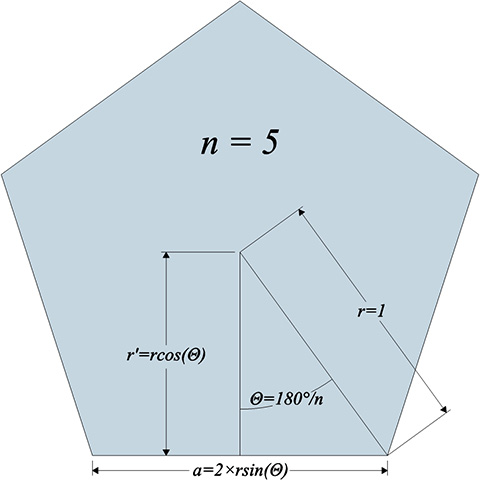
midradius = circumradius × cos(180°/n), where n is the number of sides.
The following illustration shows the relationships between the number of sides, n, the circumradius, r, the midradius, r’, the edge length, a, and the angle 180°/n, Θ.
With the above illustration in mind, the area formulas become:
Square area = n/2 × r cos(Θ) × 2r sin(Θ) = n×sin(2Θ)/2 × r² Triangular area = n × (r cos(Θ) × 2√3/3) × 2×r sin(Θ) = n×sin(2Θ)/2 × 4r²√3/3
Note that as the number sides, n, approaches infinity, the expression, n×sin(Θ)/2, approaches pi (π). That is,
Square area = r² (∞×sin(360°/∞)/2) = πr² ≈ 3.141593×r² Triangular area = 4r²√3/3 × (∞×sin(360°/∞)/2) = πr²×4√3/3 ≈ 7.255197*×r²
* We might consider replacing pi (the ratio of the circumference of the circle to its diameter) with this number, the ratio of the circumference of the circle to the radius of its circumscribed hexagon. But then we might be likewise persuaded into replacing pi with the ratio of the circumference of the sphere to the radius of its circumscribed rhombic dodecahedron, which is a different number.
“Complementarity requires that where there is conceptuality, there must be nonconceptuality. The explicable requires the inexplicable. Experience requires the nonexperienceable. The obvious requires the mystical. This is a powerful group of paired concepts generated by the complementarity of conceptuality. Ergo, we can have annihilation and yet have no energy lost; it is only locally lost.“ — R. Buckminster Fuller, Synergetics, 501.13
“…the sum of the angles around each of every local system’s interrelated vertexes is always two cyclic unities less than universal nondefined finite totality. We call this discovery the principle of finite Universe conservation. Therefore, mathematically speaking, all defined conceptioning always equals finite Universe minus two. The indefinable quality of finite Universe inscrutability is exactly accountable as two.” — ibid., 224.50
“Since unity is plural and, at minimum, two, the additive twoness of systemic independence of the individual system’s spinnability’s two axial poles … must be added to something, which thinkable somethingness is the inherent systemic multiplicative twoness of all systems’ congruent concave-convex inside-outness: this additive-two-plus-multiplicative two fourness inherently produces the interrelationship 2 + 2 + 2 sixness (threefold twoness) of all minimum structural-system comprehendibility.” —ibid., 1073.11
At the core of both Fuller’s geometry and his philosophy is the idea that “unity is plural and at minimum two.” You can’t draw a circle without drawing two circles, for example. The circle must be drawn on the surface of some system, and it always divides the system into that which is contained by the circle’s concavity, and that which is contained by the circle’s convexity. The moral point of this concept is that nature has no preference for one over the other. In the math, this essential duality appears as a plus two (the additive two) and the times two (the multiplicative two).
Additive Twoness
For any polyhedron, the sum of its vertices and faces is always equal to its number of edges minus two:
Vertices + Faces = Edges – 2
This is Euler’s topological abundance formula. It can also be written as:
Vertices – Edges + Faces = 2
This same “2” occurs in Fuller’s shell growth formulas for the close-packing of spheres: for any symmetrically close packed array of spheres, the number of spheres in the outer shell is always:
nF²+2
where n is a constant endemic to the system, and F is its frequency, or number of subdivisions along any edge. Fuller attributes this excess of +2 to the poles or spin axis of the system, and sometimes called it the system’s “polarity constant.”
Other examples of the additive two:
A vector has 2 vertices, its starting point and its endpoint.
If the radius of a sphere is taken to be 1, a line drawn between two sphere centers (a single frequency primitive vector connecting two event foci) has a length of 2.
A triangle, or any polygon, has 2 faces, the obverse and the reverse.
Multiplicative Twoness
The formula for the number of spheres in the outer shell of radially close packed spheres is 10F²+2. At zero frequency (F=0) there is only the central sphere, the nucleus. But the formula returns a shell volume of 2 spheres.
10(0)²+2 = 2
The primitive idealized sphere in isolation from other spheres has no defined poles, but it does have two surfaces, its convex outer surface, and its concave inner surface. So, in the case of the single sphere (or any whole system) the +2 has a different meaning, the division of universe into inside and outside, and of polyhedral systems into the concavity enclosing a defined space, and the convexity enclosing the in-definite remainder of the finite universe. This is what Fuller called the “multiplicative two.”
In any omni-triangulated structural system, that is, for any polyhedron structurally stabilized through triangulation: a) the number of vertices (“crossings” or “points”) is always evenly divisible by two (2×1); b) the number of faces (“areas” or “openings”) is always evenly divisible by four (2×2), and; c) the number of edges (“lines,” “vectors,” or “trajectories”) is always evenly divisible by six (2×3). For example, the icosahedron has twelve vertices, twenty faces, and thirty edges. The number of faces is evenly divisible by two (12/2=6); the number of faces is evenly divisible by four (20/4=5); the number of edges is evenly divisible by six (30/6=5). This holds for any polyhedron of whatever size or complexity, just so long as its faces (areas, openings) are triangulated and therefore constitute a “structure” by Fuller’s definition, i.e. any system that holds its shape without external support.
A principle of angular topology (attributed to Descartes) states that the sums of all the angles around all the vertexes of any polyhedron (whether or not it is omni-triangulated and a “structure” by Fuller’s definition) is always 720° less than the number of vertices times 360°. For example, the sum of the angles around the four vertices of the tetrahedron is 720° (4×3×60), 720° less than 1440°, the number of vertices times 360°. Fuller interpreted this to mean that the difference between the non-conceptual and conceptual, the indefinite and the definite, or between infinity and any conceptual system is always one tetrahedron, 360°×2, or two cycles of unity, the multiplicative 2. In fact, the tetrahedron as the miniumum system is emblematic of all the foregoing. Its two (non-polar) vertices, four faces, and six edges are the divisors in the formula for omni-triangulated systems described in the previous paragraph.


 The Geometry of Thinking