“None of the always co-occurring cube’s edges is congruent with the vectorial lines (edges) of the isotropic vector matrix. Thus we witness that while the cubes always and only co-occur in the eternal cosmic vector field and are symmetrically oriented within the field, none of the cubes’ edge lines is ever congruent or rationally equatable with the most economical energetic vector formulating, which is always rational of low number or simplicity as manifest in chemistry. Wherefore humanity’s adoption of the cube’s edges as its dimensional coordinate frame of scientific-event reference gave it need to employ a family of irrational constants with which to translate its findings into its unrecognized isotropic-vector-matrix relationships, where all nature’s events are most economically and rationally intercoordinated with omnisixty-degree, one-, two-, three-, four-, and five- dimensional omnirational frequency modulatability.”
—R. Buckminster Fuller, Synergetics, 982.12
The cube in Fuller’s geometry is conceived as two tetrahedra, one positive and one negative, sharing a common center of volume. In the absence of the triangulation provided by at least one of the tetrahedra, the cube would lack structure and collapse. The length of the face diagonal, rather than the edge length, is therefore taken as unity and produces a cube whose volume is precisely three (3) regular tetrahedra.
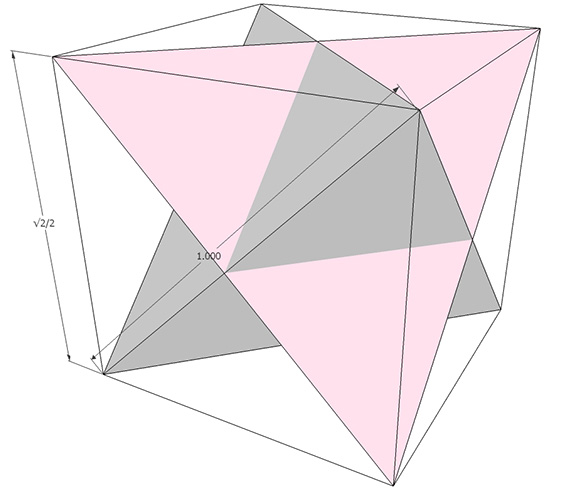
The cube, with the face diagonal taken as unit length, d:
- 6 square faces, 8 vertices, 12 edges
- Face angles: all 90°
- Dihedral angle: 90°
- Tetrahedral volume: 3d³
- Cubic volume: d³×√2/4
- Surface area (in equilateral triangles): 8d²√3
- Surface area (in squares): d²×√2/4
- A quanta modules: 48
- B quanta modules: 24
- In-sphere radius: d×√2/4
- Mid-sphere radius: d/2
- Circumsphere radius: d×√6/4
The cube can be constructed from of a regular tetrahedron with four 1/8th octahedra added to its faces.
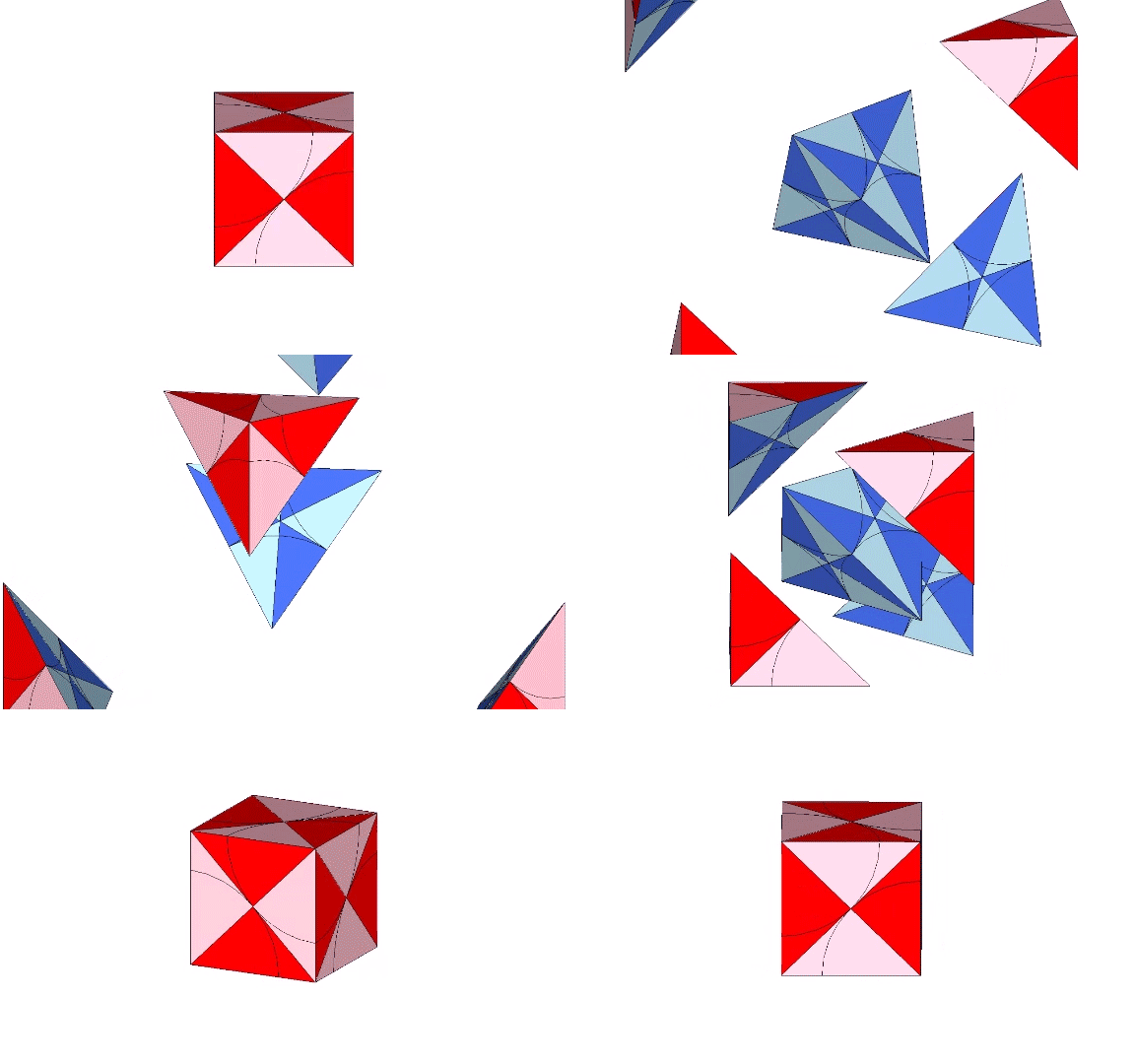
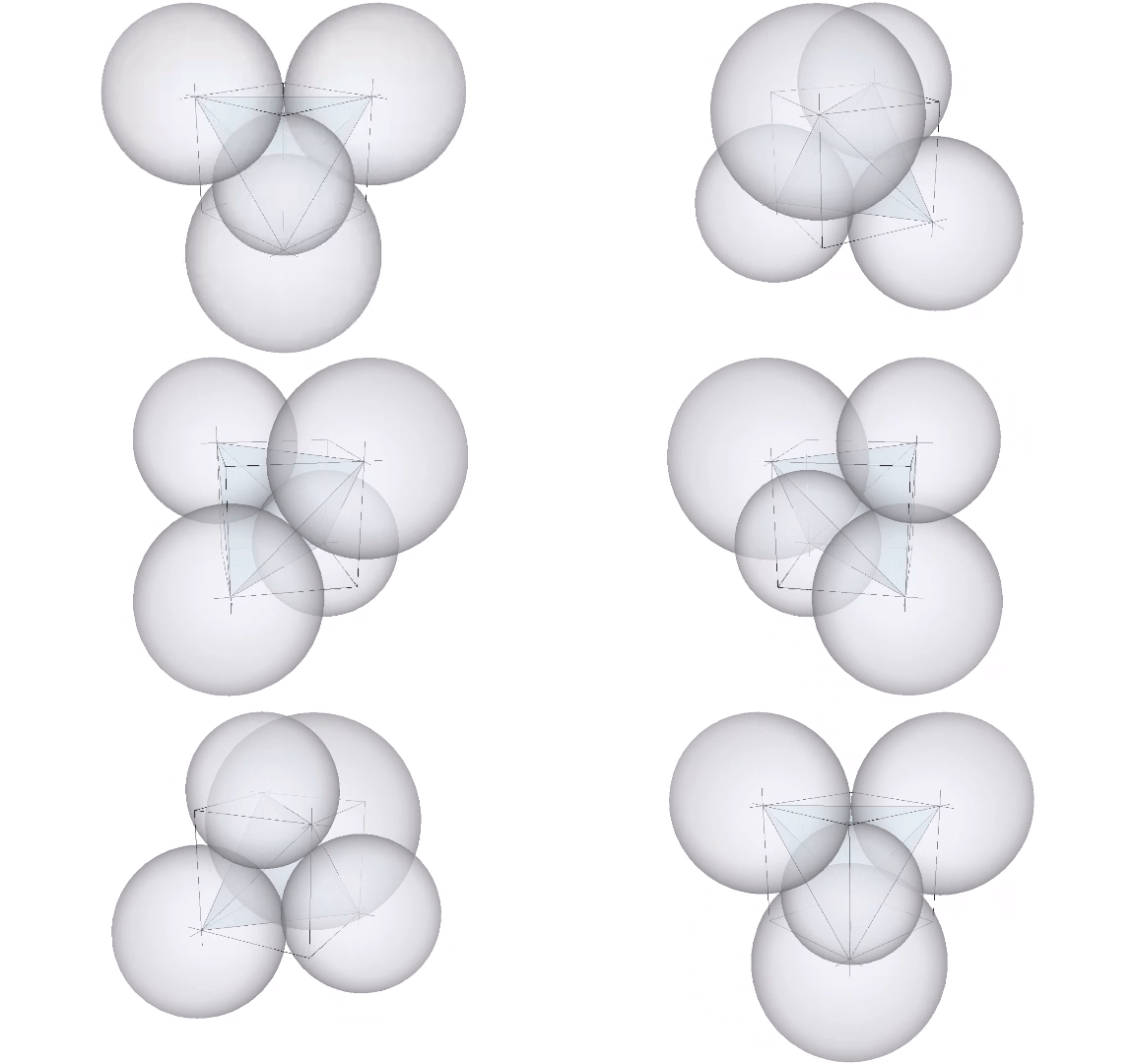
When we model the isotropic vector matrix as vectors between spheres, the volume-3 cube is indistinguishable from the tetrahedron it encloses.
The cube emerges in the isotropic matrix only at higher frequencies, either by adding four tetrahedra centered on the faces of a larger tetrahedron with twice the edge length, or by adding eight tetrahedra to the eight faces of an octahedron with the same edge length.
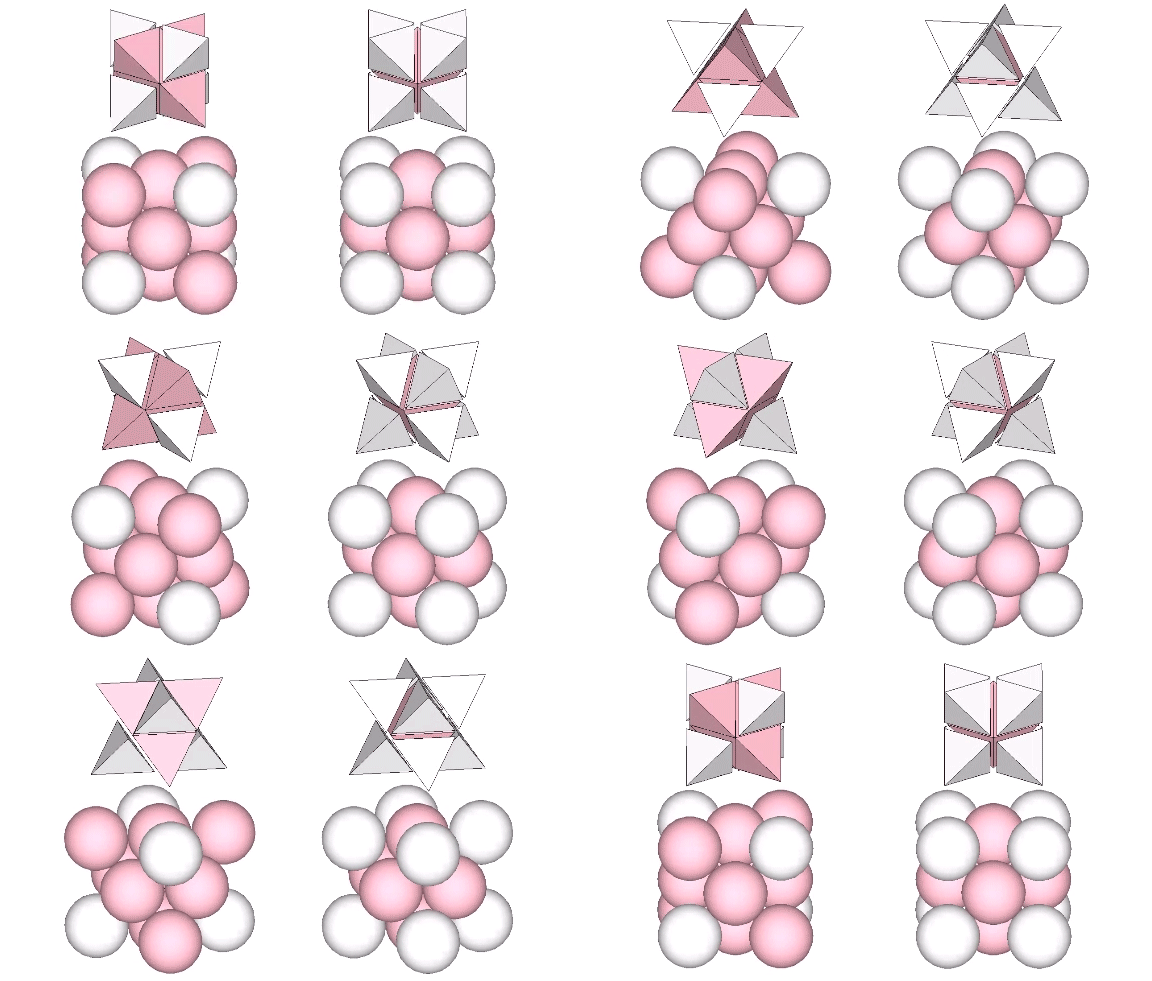
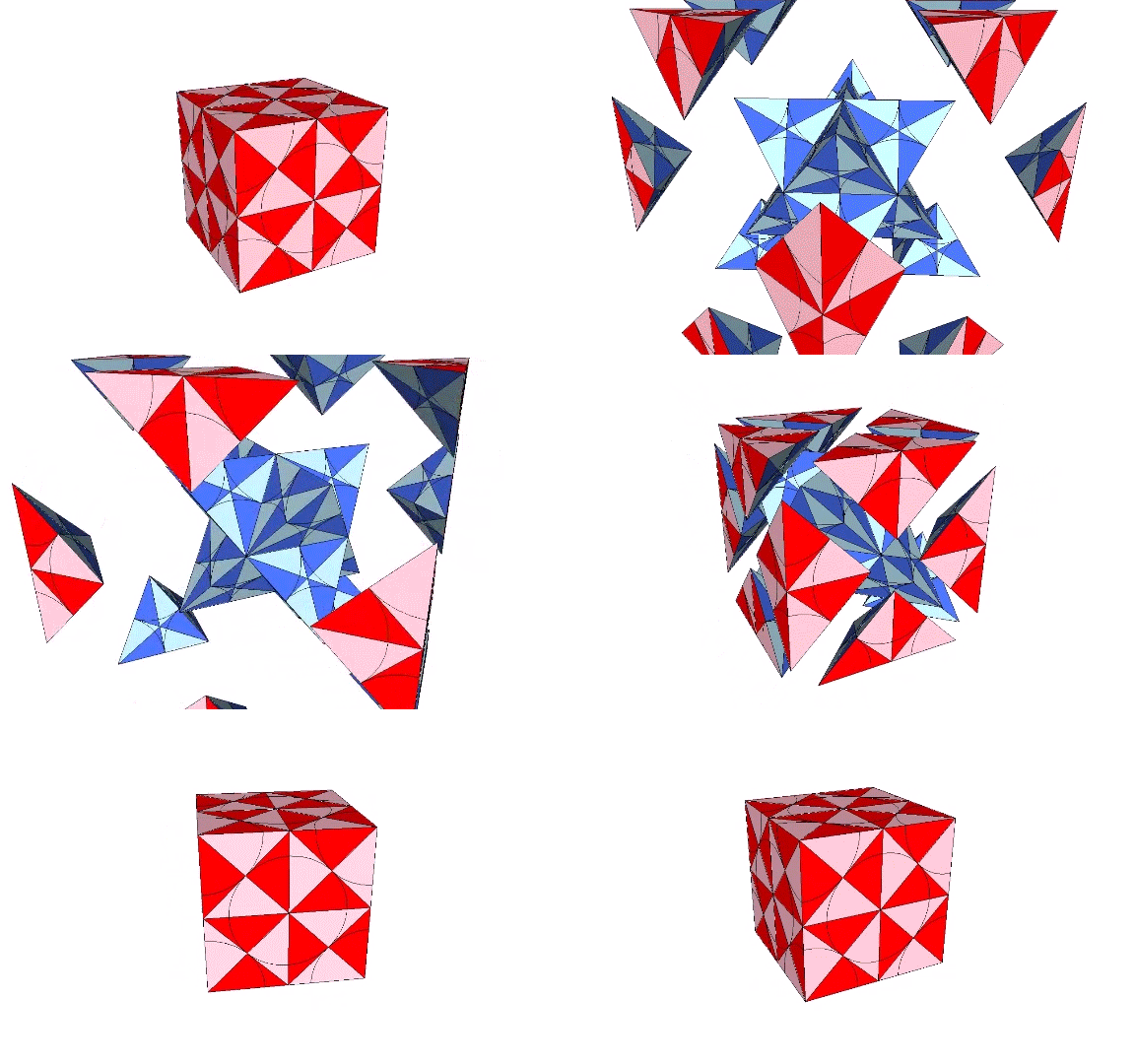
We can stack eight volume-3 cubes in two configurations to form two larger, distinct, cubes, each of volume-24. From the outside, the difference between these two cubes is subtle. What makes each cube unique is the position each occupies in the isotropic vector matrix. The addition of spheres reveals one to be a cube while the other to be a vector equilibrium (VE).
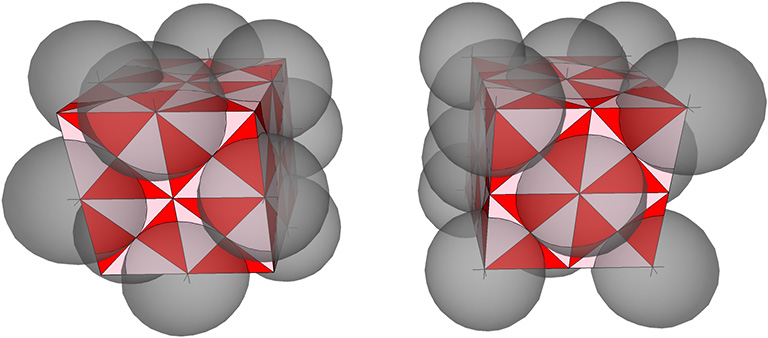
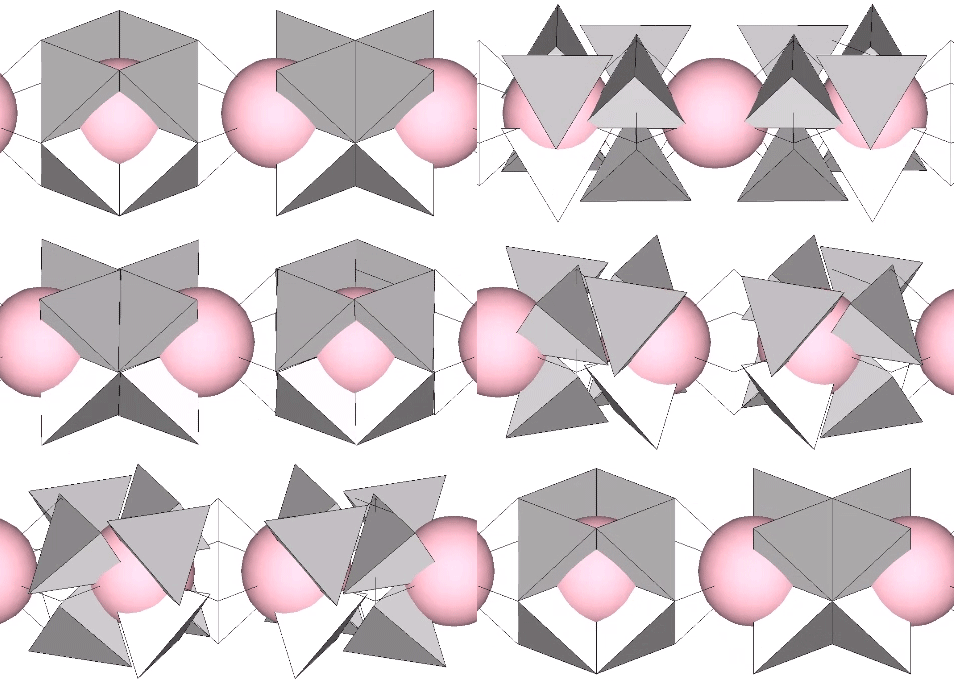
Dissecting the quanta model reveals the VE to contain eight tetrahedra all sharing a common vertex at the center of the vector equilibrium.
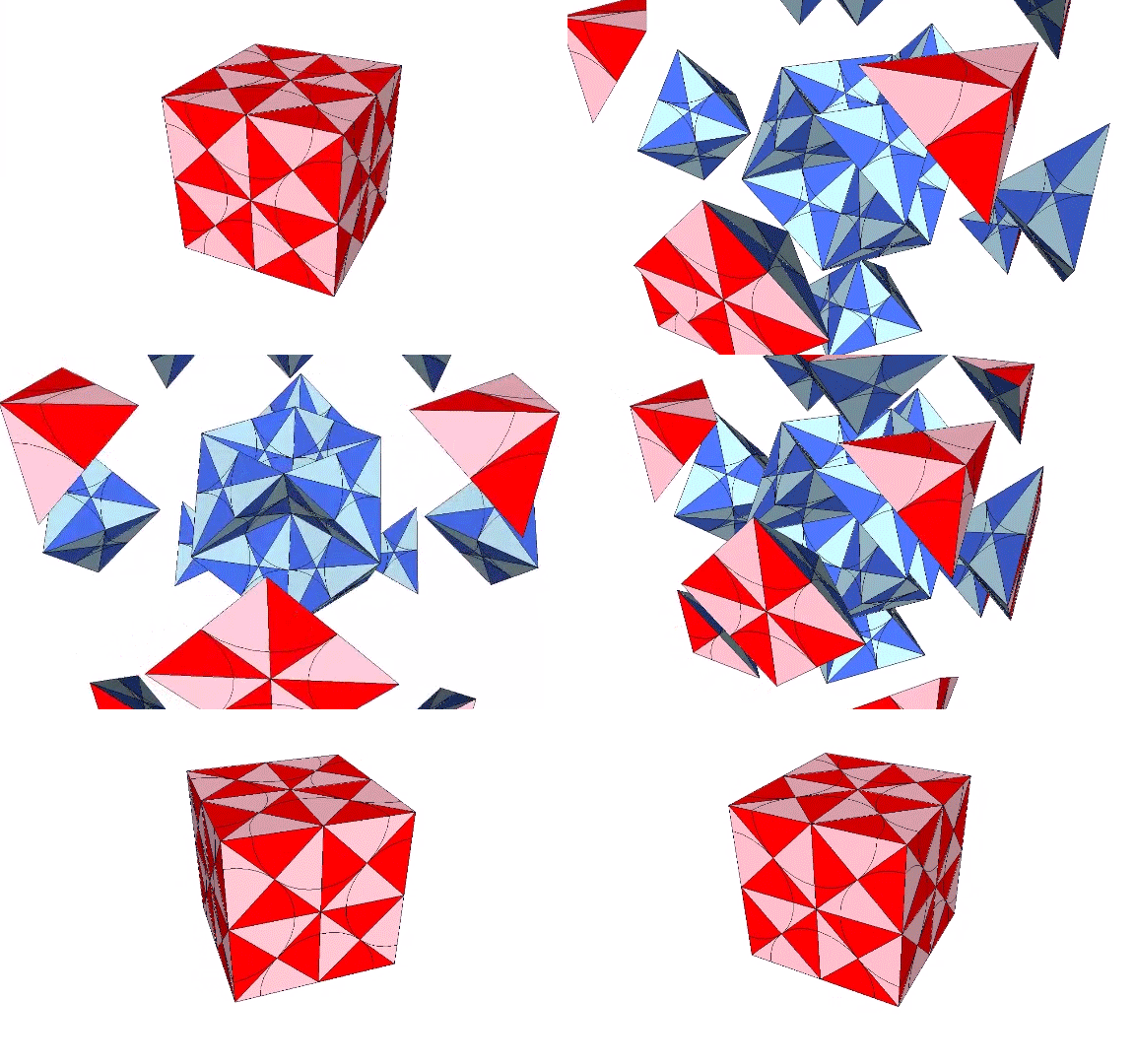
Disecting the quanta model reveals the volume-24 cube to contain eight tetrahedra all rotated at 90° and pointing away from their common center. That is, the two volume-24 cubes constitute the two vector-equilibrium phases of the jitterbug: the VE and the octahedron phases.
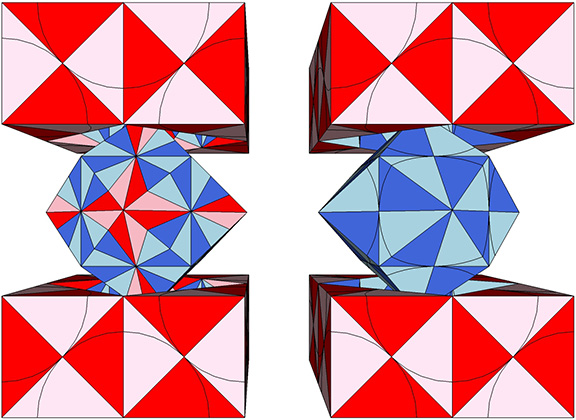
At the centers of both cubes is one of the two constructions of the rhombic dodecahedron, one modeling the nuclear sphere, and the other the nuclear space. See: Spheres and Spaces; and Quanta Module Constructions of the Rhombic Dodecahedron.
In the quanta model of the isotropic vector matrix, the two cubes overlap. One or the other is revealed depending on how we slice the matrix. When modeled as the radial close packing of spheres, however, the two cubes form discrete modules that close pack to fill the matrix.
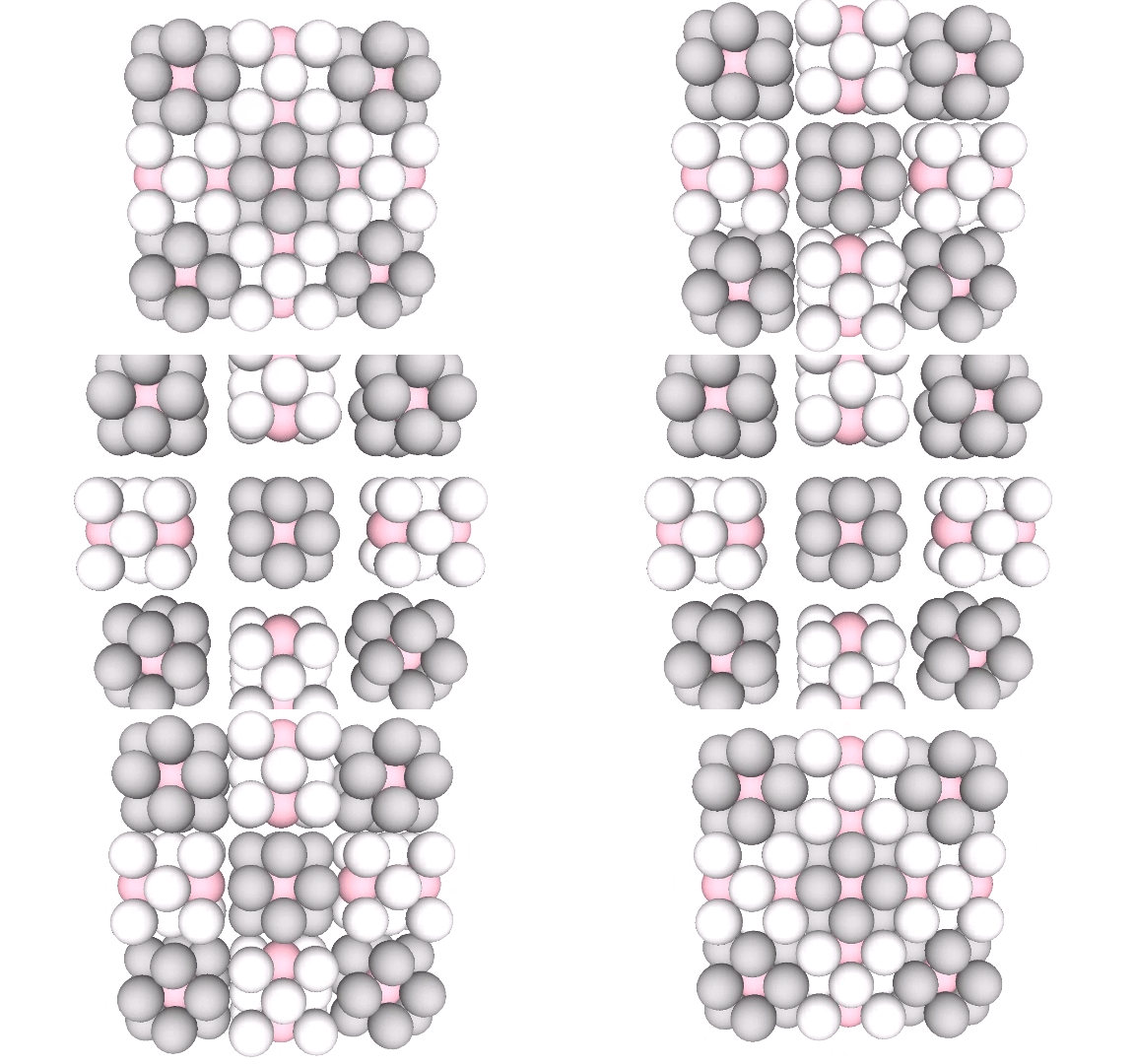
The two exchange places during the jitterbug transformation, i.e., one transforms into the other. Each gains or loses a sphere in the process, suggesting the migration of nuclei.
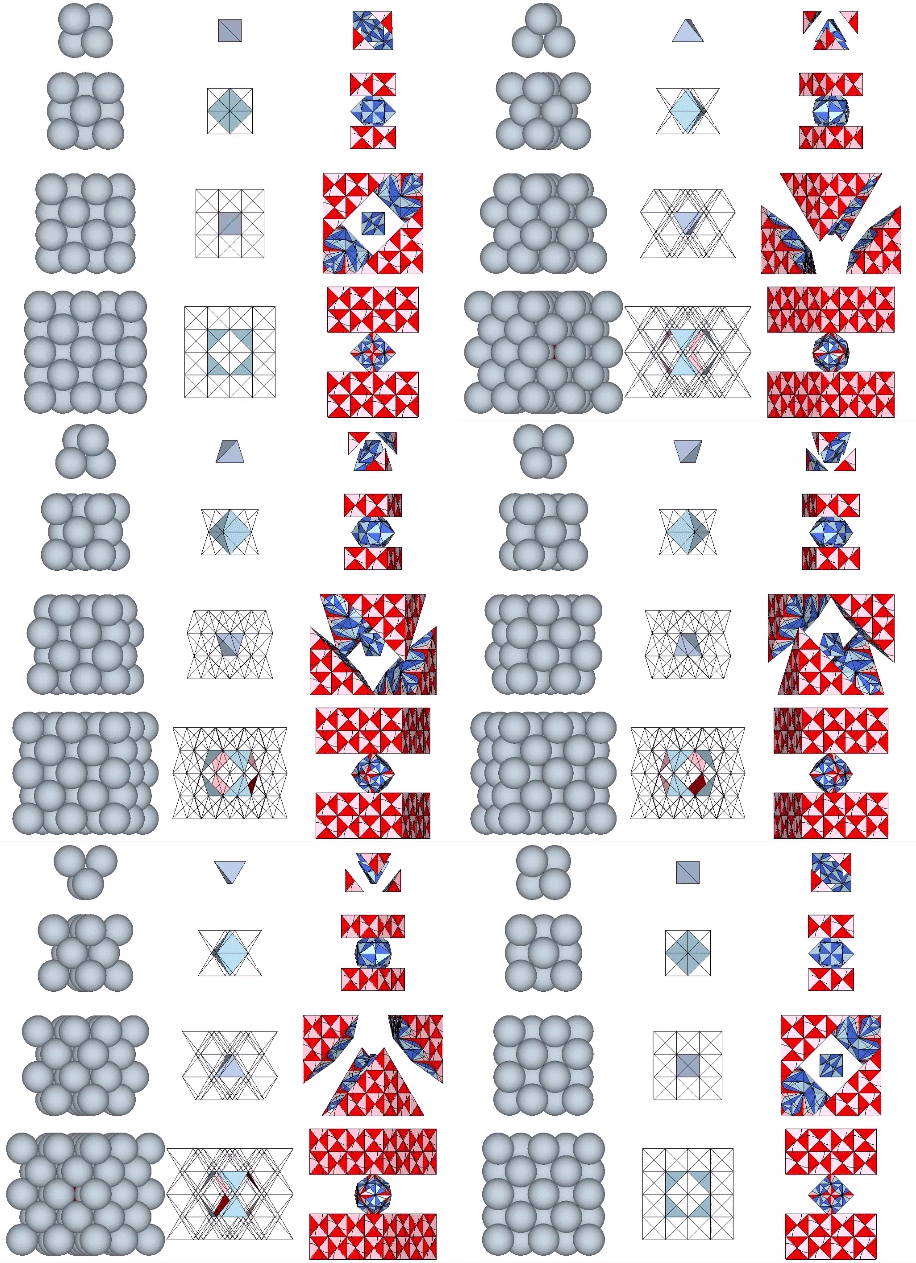
Spheres close pack as cubes in even-numbered layers around octahedra (spaces) and VEs (spheres). In odd-numbered layers, the spheres form partially-truncated cubes surrounding a positive or negative tetrahedron (interstice). The growth pattern repeats every fourth layer, with the first layer surrounding a positive (or negative) tetrahedron; the second layer surrounding an octahedron (or VE); the third layer surrounding a negative (or positive) tetrahedron, and; the fourth layer surrounding a VE (or octahedron).
Note that the cube’s edges, no matter the frequency, never align to the vectors connecting sphere centers in the isotropic vector matrix. Only its face diagonals are congruent with the matrix vectors.
Fuller thought that the vector-edged cube and the icosahedron had a combined “energetic” volume (or volume in regular tetrahedra) of 3³, or 27. Actually, their combined volume is just under 27, about 26.997577.
energetic volume of icosahedron = V³×5φ²/6 ≈ 18.5122959
energetic volume of vector-edge cube = V³ ≈ 8.4852814
combined volume = V³×5φ²/6 + V³ ≈ 26.997577
The constant, V, is Fuller’s dymaxion vector constant which equals 2 × ⁶√(9/8), or about 2.039648903. For more information on calculating “energetic” volumes, see Pi and the Synergetics Constants.
 The Geometry of Thinking