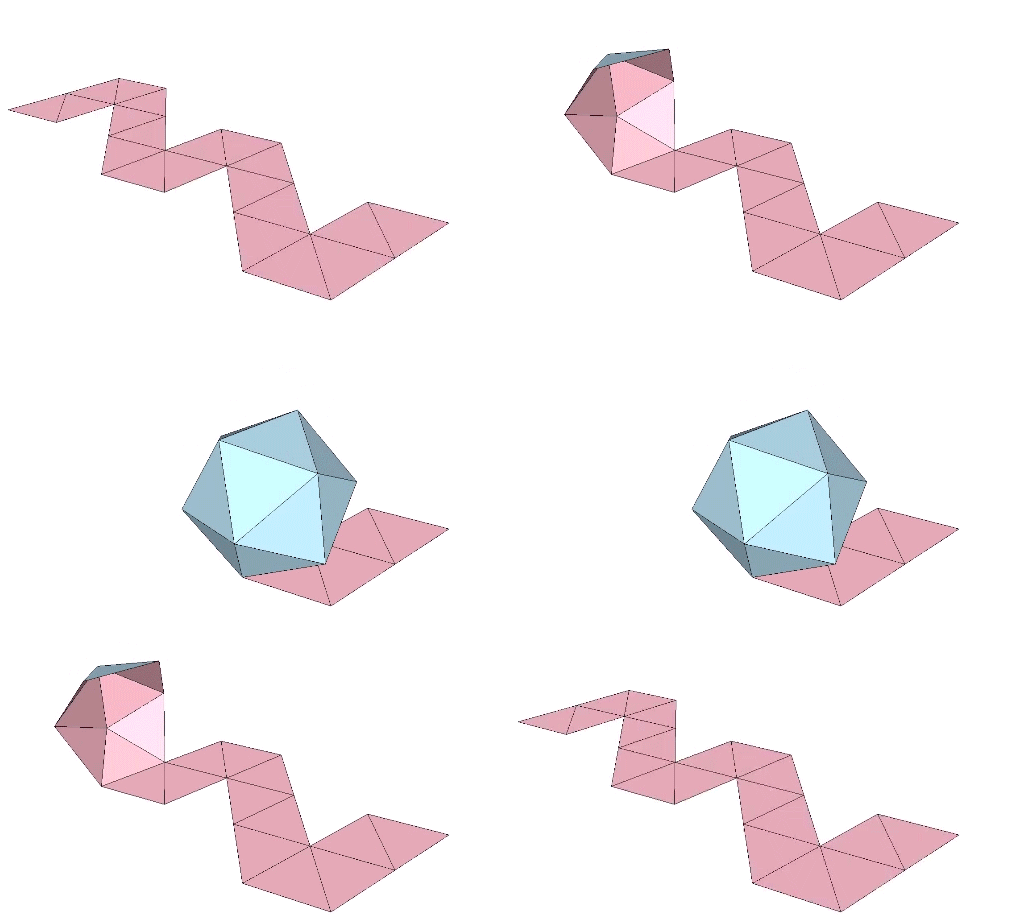
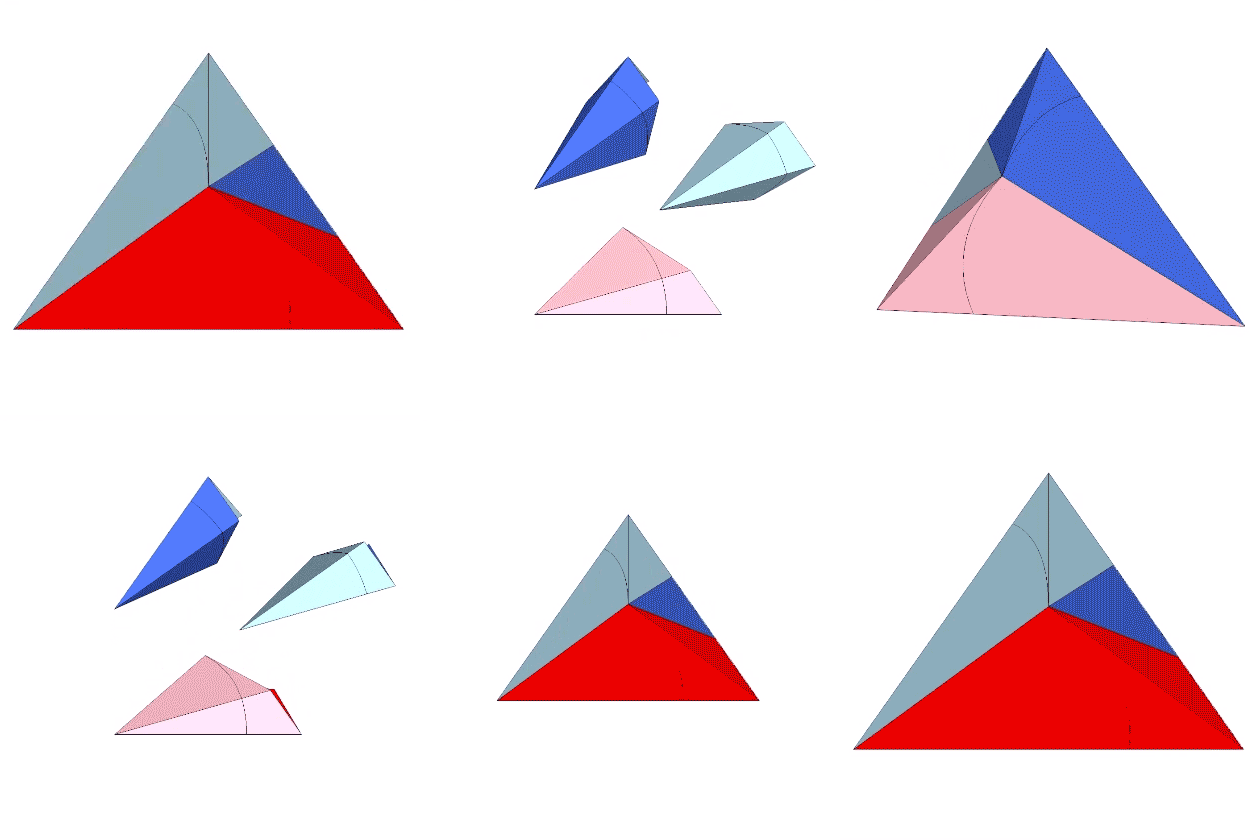
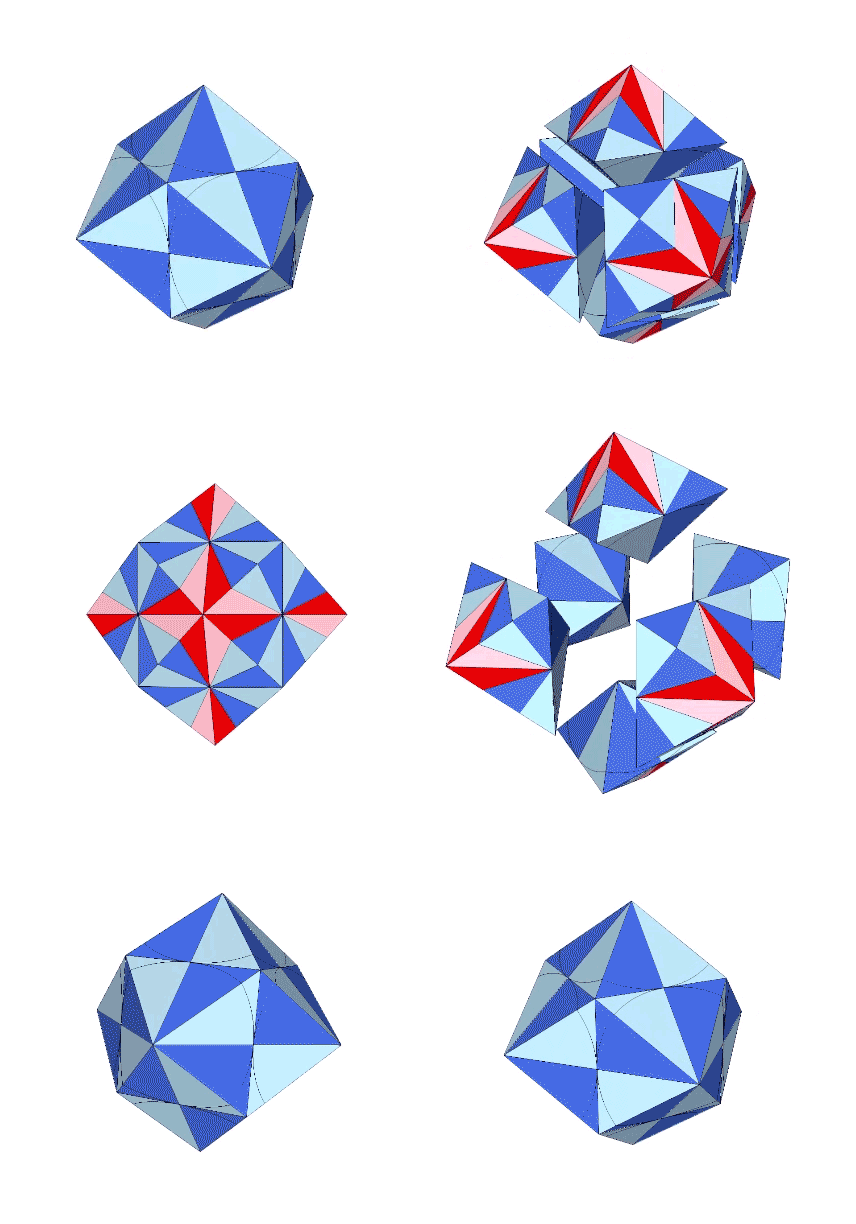
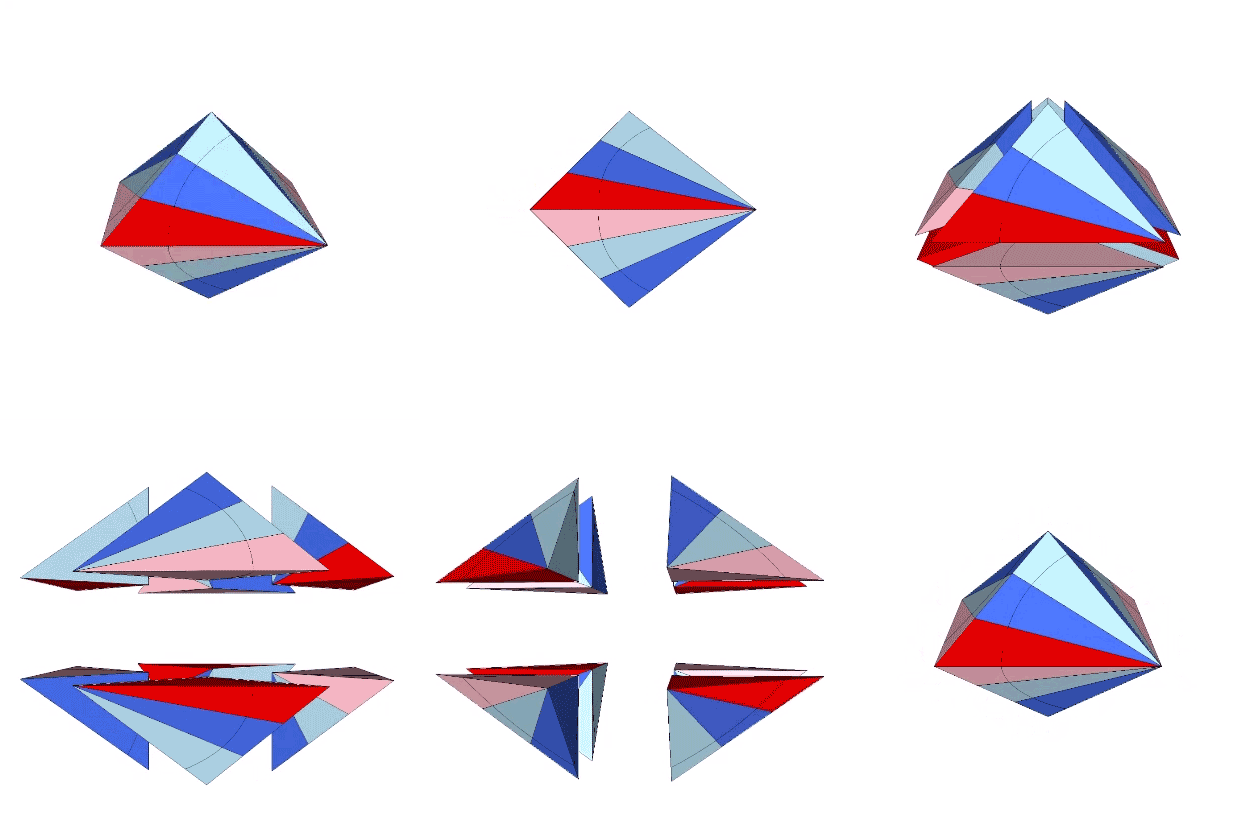
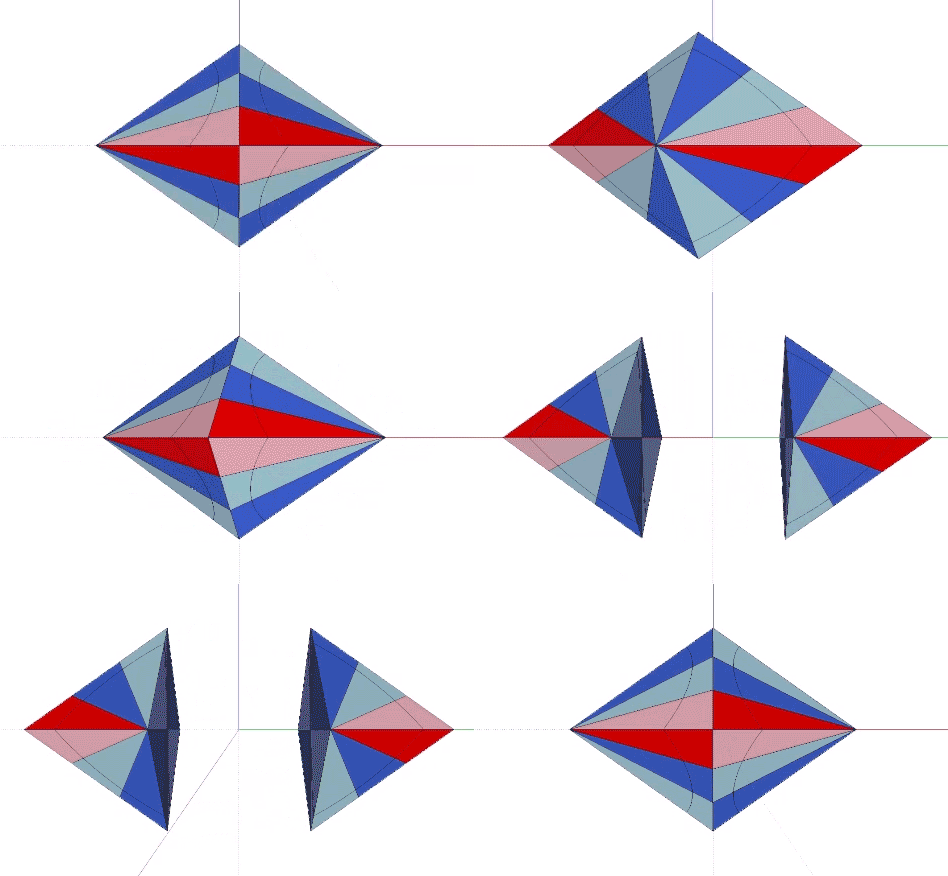
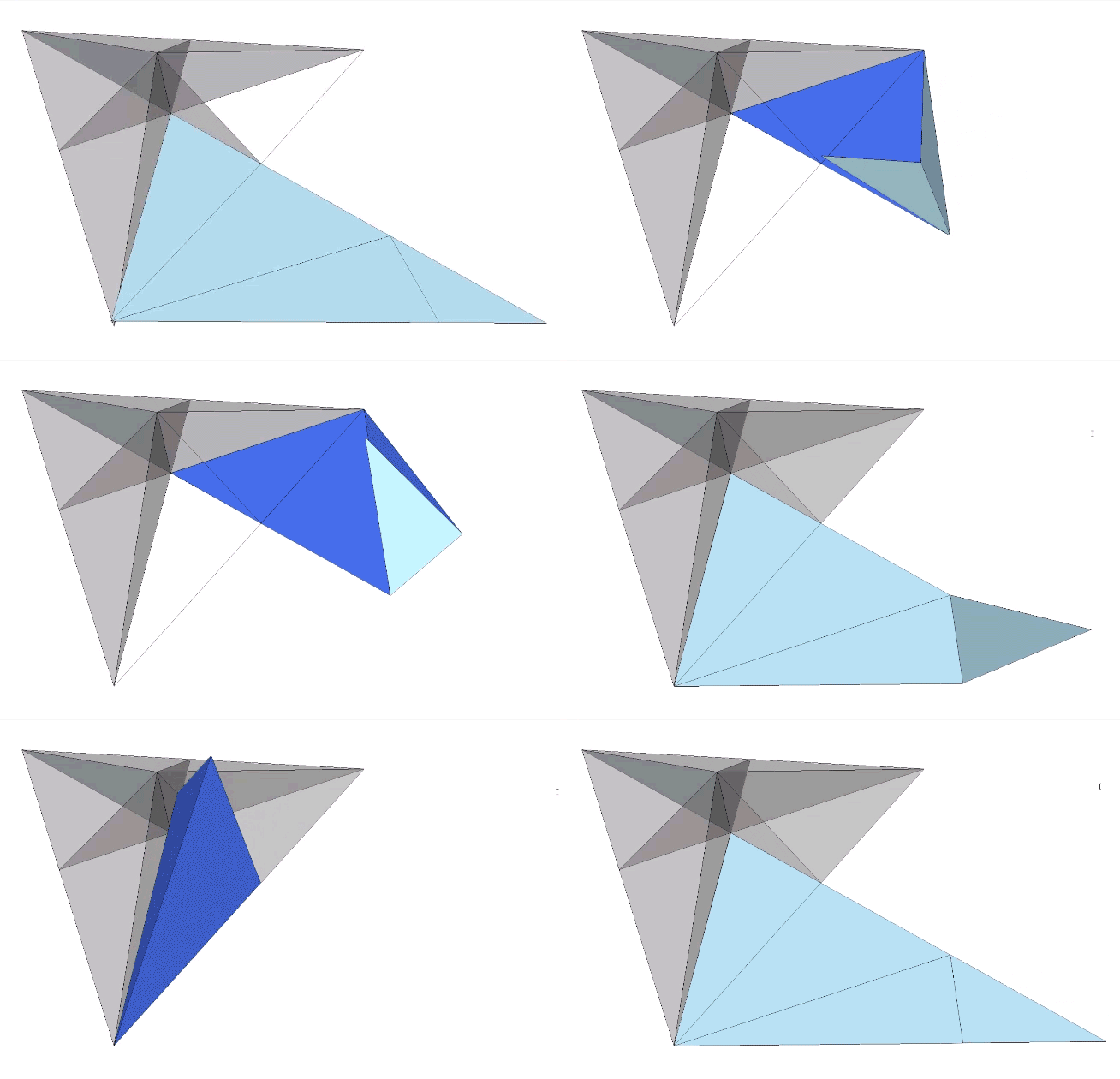
The tetrahedron, rhombic dodecahedron, octahedron, and icosahedron can all be constructed from the sequential linear folds of a single paper strip. Fuller was interested in the shapes of polyhedron nets, especially those of the quanta modules, but does not seem to have devoted much time (nor has anyone else for that matter) to nets that fold into their respective polyhedra sequentially from a single linear strip. I’m drawn to these constructions because their wave-like patterns suggest, at least to my mind, the transformation of potential energy into radiant energy.
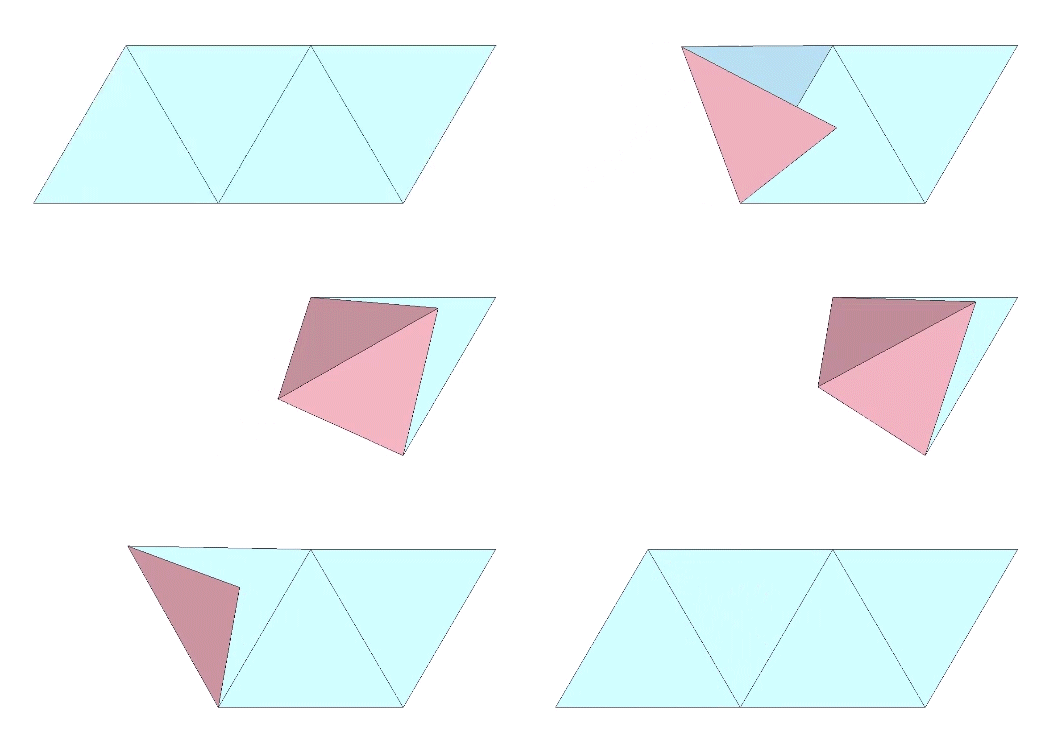
Three sequential folds of 2arctan(√2) each, or approximately 109.4712°, produce the regular tetrahedron.
The sides of a regular tetrahedron unfold sequentially into a single ribbon of equilateral triangles.
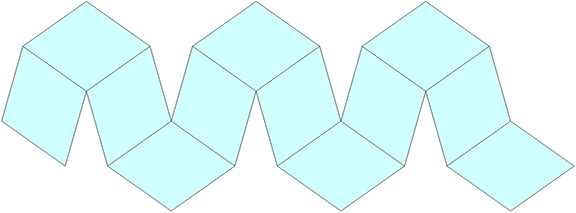
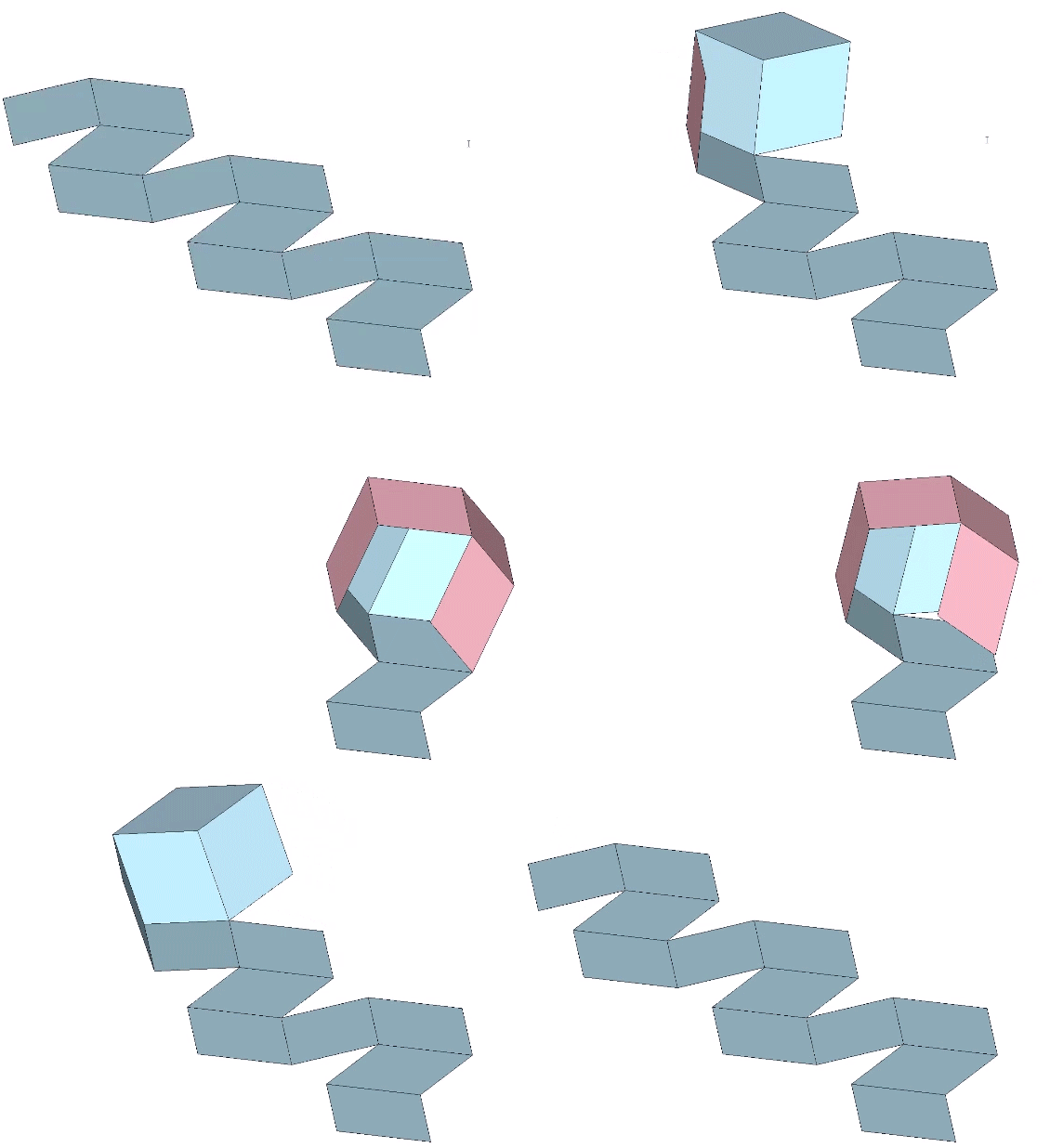
Eleven sequential folds of 60° each produce the the rhombic dodecahedron.
The sides of a regular rhombic dodecahedron unfold sequentially into a snaking ribbon of rhomboid polygons.
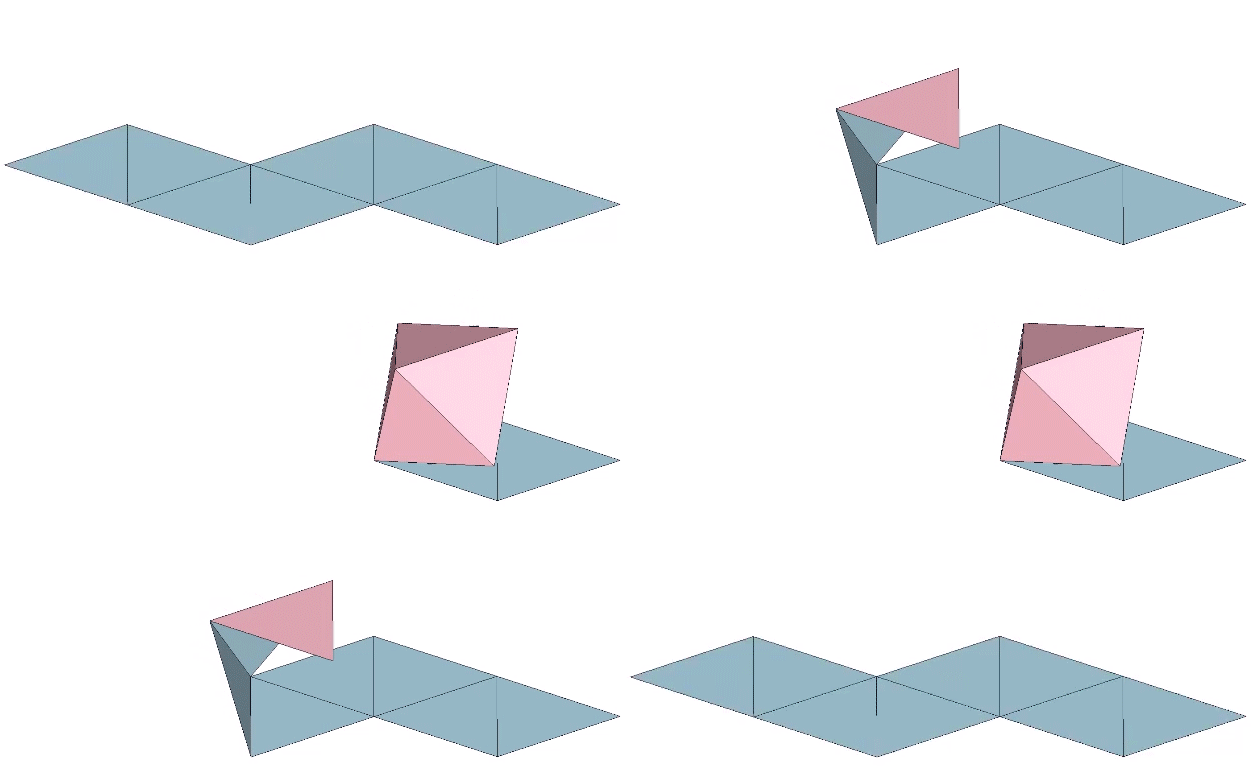
Seven sequential folds of arctan(√2) each, or approximately 70.5288°, produce the octahedron.
The sides of a regular octahedron unfold sequentially into a snaking ribbon of equilateral triangles.
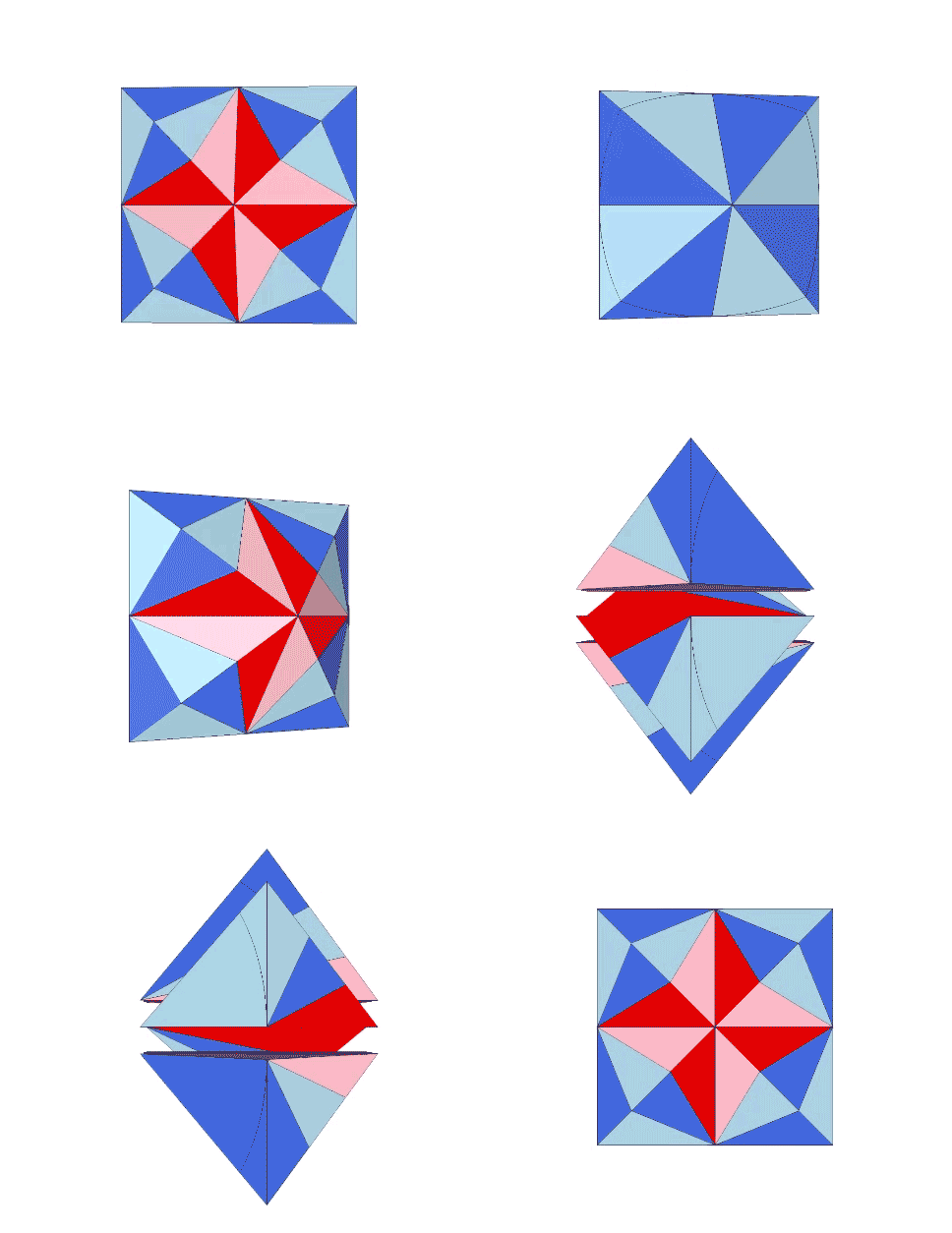
One positive and one negative tetrahedron can be unfolded to form an octahedron, suggesting the neutrality of the octahedron, as well as the gain and loss of quanta modeled in respective volumes, with the two tetrahedra having a combined volume of 2, and the octahedron having a volume of 4.
One positive and one negative tetrahedron can be unfolded to form an octahedron.
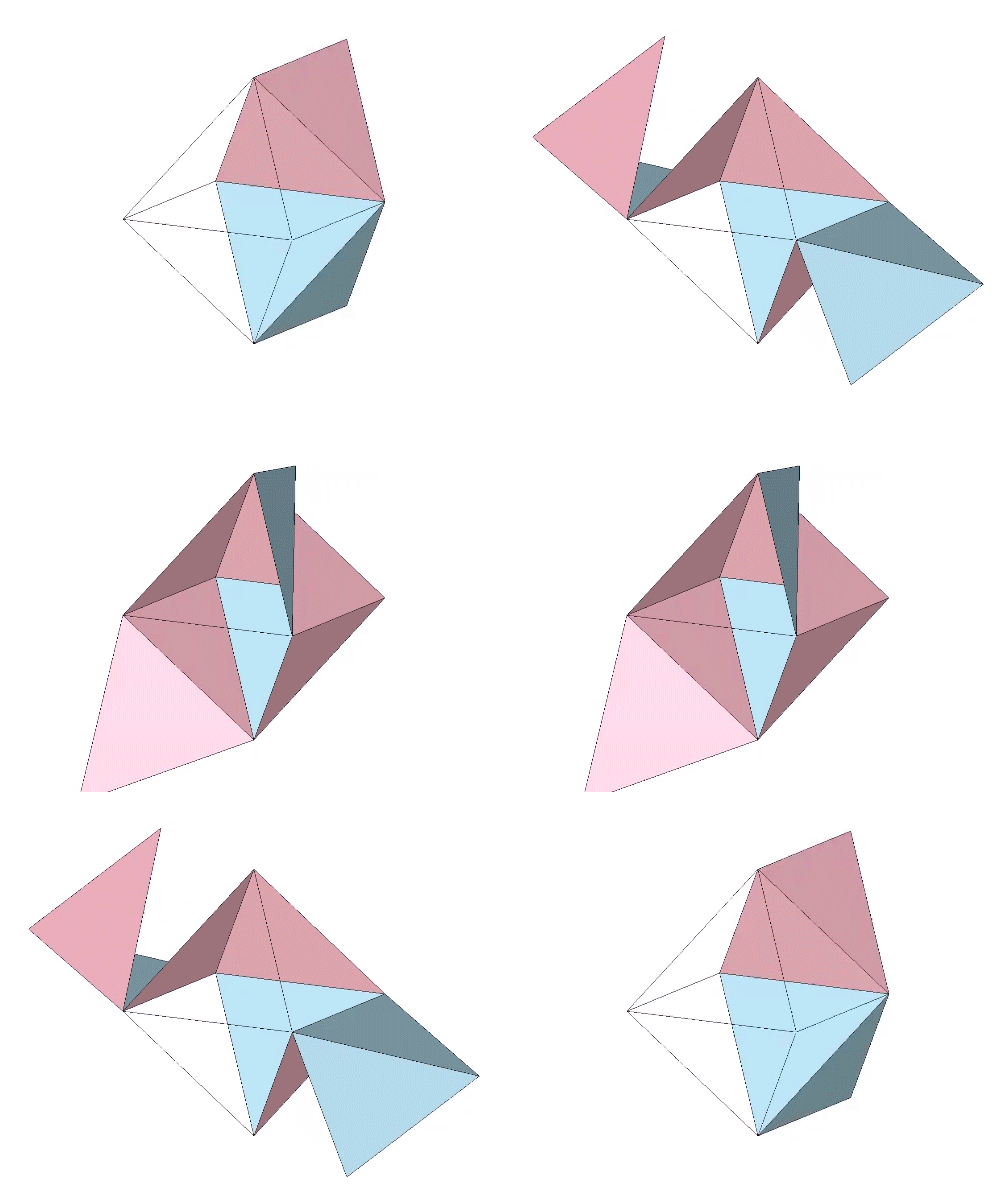
Nineteen sequential folds of arctan(2/√5) each, or approximately 41.8103°, produce the icosahedron.
The sides of a regular icosahedron unfold sequentially into a snaking ribbon of equilateral triangles.
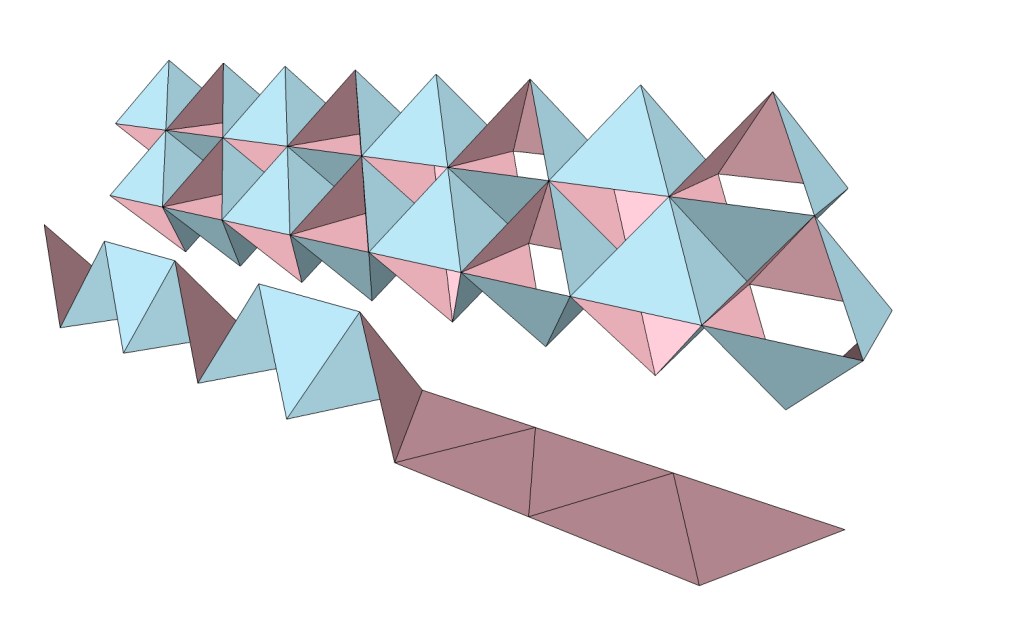
If we alternate the folds, one positive and two negative, linear ribbons of equilateral triangles will form edge-bonded half octahedra which, repeated indefinitely, form a continuous chain of polarized octahedra and tetrahedra spaces. The chains may be combined, placed parallel or perpendicular to one another, to form the the isotropic vector matrix. See also: The Isotropic Vector Matrix as Transverse Waves.
Linear ribbons of equilateral triangles can be folded into chains of half-octahedra and combined to form the isotropic vector matrix.
“… the tetra and VE are a priori incommensurable with the icosa. Despite this, the rhombic triacontahedron of tetravolume 5 (as a product of the icosa’s 15-greatcircle cleavaging), while under the oscillatory pressuring, is volumetrically and rationally coordinate with the tetrahedron and the state we speak of as matter, and when it is under the negative tensive pressure of the oscillatory Universe, it transforms from matter to radiation.” —R. Buckminster Fuller, Synergetics, 987.058
The T quanta module was part of Fuller’s ongoing effort to find that elusive polyhedron of unit edge length whose tetrahedral volume was evenly divisible by 5. The 30-sided rhombic triacontahedron proved promising. It could be evenly subdivided into 120 irregular tetrahedron, each of which would have a volume of 5/120, or 1/24, i.e., the exact volume of his A and B quanta modules. Its edge lengths would be irrational, but when its in-sphere radius was taken as unit length, its calculated volume was almost, but not quite precisely, 5. The difference was so minuscule that Fuller initially dismissed it as due to the resolution of the trigonometry tables he was using.
The T quanta module is associated with the basic disequilibrium LCD triangle which subdivides the surface of the sphere into 120 identical (60 positive and 60 negative) triangles. The 30 rhomboid faces of the triacontahedron may each be subdivided into four triangles for a total of 120 whose spherical form is the basic disequilibrium LCD triangle. (Note: The quartering of twelve rhomboid faces of the rhombic dodecahedron correspond to the basic equilibrium LCD triangle which divides the sphere into 48 identical (24 positive and 24 negative) triangles.)
To construct the T quanta module, a 5-tetra-volume rhombic triacontahedron is subdivided into 30 half-octahedra whose bases are its 30 rhomboid faces and whose apexes converge at its center of volume. Then, these 30 half-octahedra are subdivided into four irregular tetrahedra each, forming 120 T quanta modules, sixty positive and sixty negative.
The T quanta module has precisely the same volume as the A and B quanta modules, i.e. 1/24 the volume of the regular tetrahedron of unit edge length. We know this operationally (see Operational Geometry), because a) the triacontahedron was constructed to have a tetra volume of precisely 5, and b) 5 divided by 120 = 1/24.
The rhombic triacontahedron of tetra volume 5 is constructed of 120 T quanta modules and has an in-sphere diameter of approximately 0.9995. When constructed of 120 E quanta modules, the in-sphere diameter is 1, and the tetra volume is approximately 5.007758.
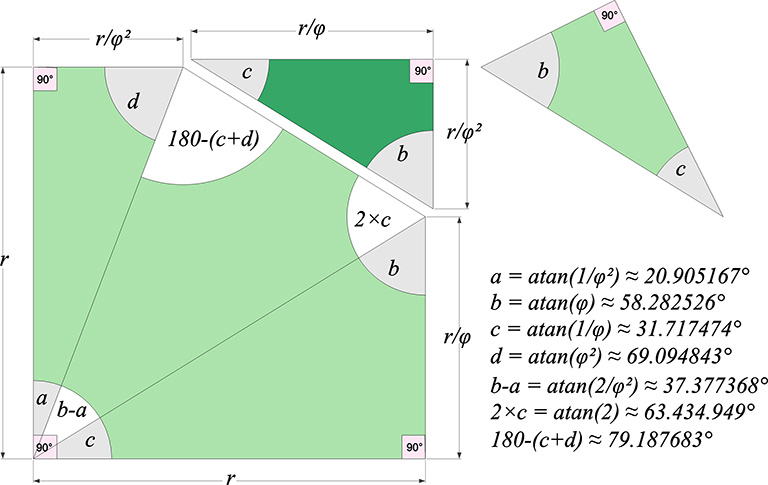
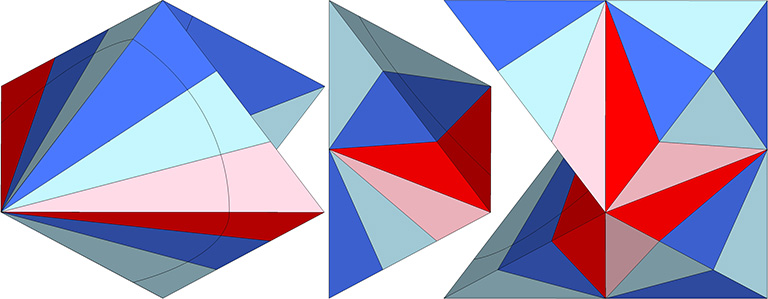
The edge lengths of the T quanta module are based on the in-sphere radius of the 5-tetra-volume rhombic triacontahedron, shown by the letter r in the illustration below. Fuller initially took the in-sphere radius, r, to be of unit length, i.e., half the vector length in the isotropic vector matrix or the radius of the sphere. But he was later persuaded to amend this figure. The in-sphere diameter, 2r, of the rhombic triacontahedron with a tetra volume of 5 is approximately 0.999483. The quanta module with 2r equal to 1 was renamed the E quanta module, and a rhombic triacontahedron built of E quanta modules would have a tetra volume slightly greater than 5, approximately 5.007758.
Unfolded, the T and E modules would form a perfect square of edge length r if the face triangle (upper right in the illustration below) were flipped to expose its obverse side. This demonstrates, operationally, that the surface area (in squares) of the T and E quanta modules is precisely r². In equilateral triangles, the surface area would be 4r²/√3, but Fuller nonetheless took the square to be identical with r² and, by extension, mc², the physical manifestation of the generalized isotropic vector matrix’s prime vector raised to the second power, i.e., mass to energy. In other words, Fuller would model e=mc² as one T module quanta equal to the prime unit vector raised to the second power.
The in-sphere diameter of the tetra-volume 5 rhombic triacontahedron is approximately 0.000517 less than the prime unit vector. This is an exquisitely small difference, smaller than the thickness of a sheet of paper one might use to construct a T quanta module. The mass of the electron is approximately 0.000543 the mass of the proton. Fuller was led to conclude from this and a long list of other observations recounted in Section 986 of Synergetics 2, that the difference between the T quanta module of quanta volume 1, and the E quanta module with quanta volume of approximately 1.001551606, was the difference between energy as mass and energy as radiation.
T and E Quanta Module Dimensions. In the E quanta module, r = 1; in the T quanta module, r ≈ 0.999483.
The dimensions of the T and E quanta modules are all related to the golden ratio (φ), (√5+1)/2. The lengths of the diagonals of the rhomboid face of the triacontahedron are related to the in-sphere diameter (d) and φ:
short diagonal = d/φ² long diagonal = d/φ
The central and surface angles of the T and E quanta modules referenced in the above illustration are:
a = atan(1/φ²) ≈ 20.905167° b = atan(φ) ≈ 58.282526° c = atan(1/φ) ≈ 31.717474° d = atan(φ²) ≈ 69.094843° b-a = atan(2/φ²) ≈ 37.377368° 2×c = atan(2) ≈ 63.434.949° 180°-(c+d) = atan(2φ²) ≈ 79.187683°
Note that these angles are all identical to, or composed of, the surface and central angles of the Basic Disequilibrium LCD Triangle, the lowest common denominator of a spherical surface. This is consistent with Fuller’s proposition that the rhombic triacontahedron of tetra volume 5 “has the maximum limit case of identical tetrahedral subdivisibility, i.e., 120 subtetra.” (Synergetics, 986.412)
Central angles of the Basic Disequilibrium LCD Triangle (the lowest common denominator of a spherical surface) are all identical with, or composed of multiples of, those of the rhombic triacontahedron and the T quanta module.
“Of all the all-space-filling module components, the simplest are the three-quanta-module Mites, consisting of two A Quanta Modules (one A positive and one A negative) and of one B Quanta Module (which may be either positive or negative). Thus a Mite can be positive or negative, depending on the sign of its B Quanta Module. The Mites are not only themselves tetrahedra (the minimum-sided polyhedra), but they are also the simplest minimum-limit case of all-space-filling polyhedra of Universe, since they consist of two energy-conserving A Quanta Modules and one equi-volume energy-dispersing B Quanta Module. The energy conservation of the A Quanta Module is provided geometrically by its tetrahedral form: four different right-triangled facets being all foldable from one unique flat-out whole triangle, which triangle’s boundary edges have reflective properties that bounce around internally to those triangles to produce similar smaller triangles: Ergo, the A Quanta Module acts as a local energy holder. The B Quanta Module is not foldable out of one whole triangle, and energies bouncing around within it tend to escape. The B Quanta Module acts as a local energy dispenser.” —R. Buckminster Fuller, Synergetics, 986.421
“We then discover that the Mite, with its two energy-conserving A Quanta Modules and its one energy-dispersing B Quanta Module (for a total combined volume of three quanta modules), serves as the cosmic minimum allspace-filler, corresponding elegantly (in all ways) with the minimum-limit case behaviors of the nuclear physics’ quarks. The quarks are the smallest discovered “particles”; they always occur in groups of three, two of which hold their energy and one of which disperses energy. This quite clearly identifies the quarks with the quanta module of which all the synergetics hierarchy of nuclear concentric symmetric polyhedra are co-occurrent.” —ibid., 986.454
The minimum all-space filling tetrahedron, or “Mite,” is formed from one negative and one positive A quanta module, plus either one positive or one negative B quanta module. (See A and B Quanta Modules.) As with all quanta modules, the mite comes in pairs, one positive and one negative.
The minimum space-filling tetrahedon, or “Mite” consists of a positive and negative A quanta module, and one positive or negative B quanta module.
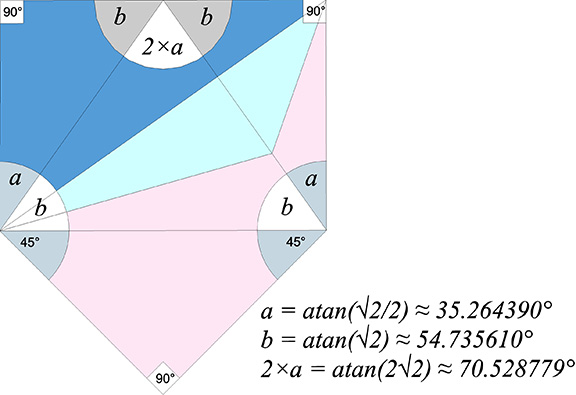
The Mite is an irregular tetrahedron that unfolds symmetrically to form a rectangle surmounted by an isosceles right triangle. From the mite’s isosceles triangular base, two sides unfold to form a rectangle with the base. The remaining side is an isosceles right triangle. The internal angles of the unfolded mite are: atan(√2/2) ≈ 35.264390°; atan(√2) ≈ 54.765610°, and; atan(2√2) ≈ 70.528779°.
Angular dimensions of the minimum all-space filling tetrahedron, or “Mite”, unfolded.
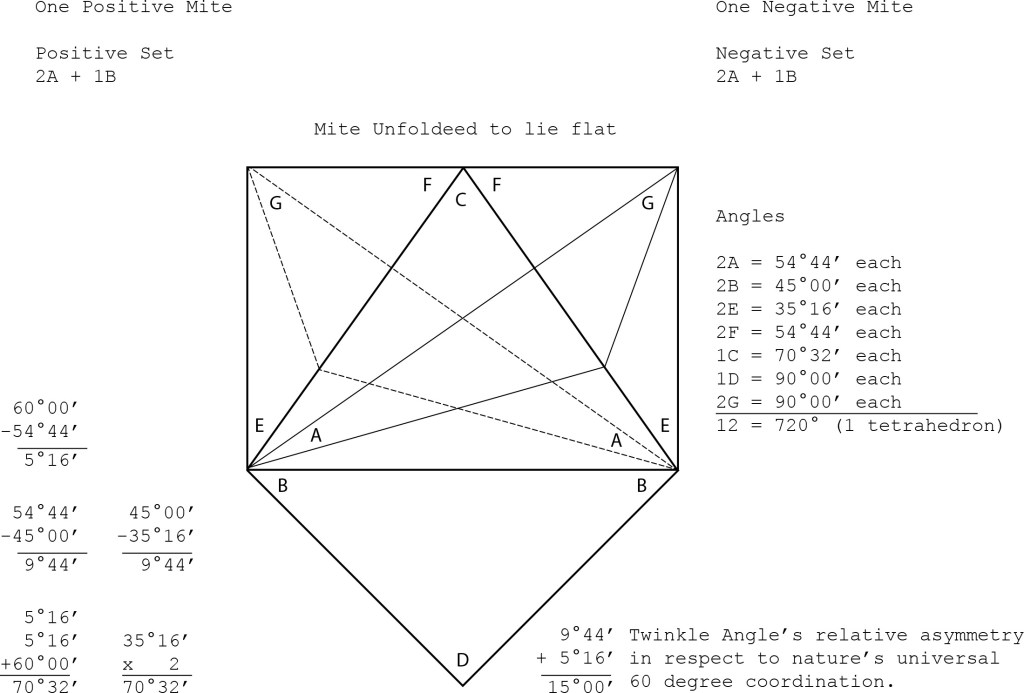
In the section of Synergetics where Fuller introduces the Mite, he adds, in the third edition, the following to Figure 953.10 without comment:
Figure 953.10 from the third edition of Synergetics, relating the “Twinkle Angle” to the Mite.
The “Twinkle Angle” (≈ 5.26439°) is the amount shy of 90° in the largest angle of the unfolded A quanta module which otherwise bears striking resemblance to the right-angled Basic Disequilibrium LCD Triangle. The Mite beautifully resolves the Twinkle Angle’s asymmetry into right angles, and these calculations provide some insight into how it is done. The Mite’s internal angle of arctan(√2) is one Twinkle Angle shy of 60°:
60° – 54.735610° = 5.26439°.
The Mite’s internal angle of arctan(2√2), is two Twinkle Angles greater than 60°:
60° + (2×5.26439°) = 70.52878°
The difference between the Mite’s two internal angles, arctan(√2) and 45°, and the difference between 45° and the Mite’s last remaining non-90° angle, arctan(√2/2), is approximately 9.73561° which when added to the Twinkle Angle equals exactly 15°:
5.26439° + 9.73561° = 15°
Fuller believed such subtle asymmetries as this were a signal of identities between phenomena otherwise hidden by phase changes:
“Probability of Equimagnitude Phases: The 6° spherical excess of the Basic Disequilibrium 120 LCD Triangle, the 5° 16′ “twinkle angle” of the A quanta module triangle, and the 7° 20′ “unzipping angle” of birth, as in the DNA tetrahelix, together may in time disclose many equimagnitude phases occurring between complementary intertransforming structures.” —Synergetics, 915.20
Fuller identified his quanta modules with the quarks which in particle physics constitute the fundamental units of matter. Quarks, like Mites, always come in sets of three. A proton, for example, consists of two “Up” quarks and one “Down” quark, while a Mite consists of two A quanta modules and one B quanta module.
The Couplers
Eight Mites (four positive and four negative) combine to form either the Coupler, or the 1/6th rhombic dodecahedron. Each is a shallow octahedron with dimensions identical to the other—their only difference being in the orientation of their constituent Mites. The Coupler joins rhombic dodecahedra, and the 1/6th rhombic dodecahedra combine to form either of two rhombic dodecahedra—one representing the sphere and the other representing the space between spheres in the quanta model of the isotropic vector matrix.
The 1/6th rhombic dodecahedron arranges the the long edges of eight mites around its single short axis. This forms a shallow octahedron consisting of 24 quanta modules (1 tetra volume) with 16 A and 8 B quanta modules.
The 1/6th rhombic dodecahedron is a shallow octahedron constructed from eight Mites, four positive and four negative. The Mites’ long edges are arranged around the shallow octahedron’s single short axis.
Six 1/6th rhombic dodecahedra combine to form the two rhombic dodecahedra which always and only coexist in the quanta model of the isotropic vector matrix—one enclosing the space between spheres and the other enclosing the spheres themselves. (See Quanta Module Constructions of the Rhombic Dodecahedron.) The transformation of one to the other is accomplished by rotating the 1/6th rhombic dodecahedra 180°, essentially turning the rhombic dodecahedron inside out.
One rhombic dodecahedron can be transformed into the other by rotating its six 1/6th rhombic dodecahedra 180°.
When combined to fill all-space in the isotropic vector matrix, the 1/6th rhombic dodecahedron’s short axis connects the two distinct rhombic dodecahedra, i.e., spheres with spaces.
The Coupler, identified by Fuller, orients the short edges of the eight mites around the its single short axis.
Fuller’s “Coupler” (top) is a shallow octahedron identical to the 1/6th rhombic dodecahedron, but with its eight mites arranged so that their long edges form an equator around shallow octahedron’s single short axis.
When combined to fill all-space in the isotropic vector matrix, the two long axes of Fuller’s Coupler connect like-with-like rhombic dodecahedra, i.e. spheres with spheres, and spaces with spaces, their connections running perpendicular to each other.
The two bisections of the Coupler present two faces, those of the two rhombic dodecahedron representing spheres and spaces.
Fuller’s Coupler actually connects four, not two rhombic dodecahedra, two representing spheres, and two representing spaces in the isotropic vector matrix.
Fuller’s Coupler actually occurs at the center of four, not two, rhombic dodecahedron, i.e. two spheres and two spaces.
The following two illustrations show the relationship between constructions of the two configurations of Mites.
Fuller’s Coupler on the left, and the 1/6th rhombic dodecahedron on the right, are two different arrangements of the same eight Mites.
One positive and one negative Mite combine to form an irregular tetrahedron symmetrical around one edge-to-edge axis. Rotations around those two edges produce either Fuller’s Coupler (left), or the 1/6th rhombic dodecahedron (right).
In Fuller’s geometry, areas and volumes are measured in unit triangles and tetrahedron, rather than unit squares and cubes (see Areas and Volumes in Triangles and Tetrahedra). Fuller seems to have made unit conversions between his 60° coordinate system and the conventional 90° coordinate system unnecessarily complicated with the synergetics power constants (see Pi and the Synergetics Constants). There may be more to his constants than I’ve been able to untangle, but the following two formulas for areas and volumes, which are simply the inverses of the conventionally-calculated area of the unit triangle and unit tetrahedra, are more straight-forward; and they work, at least in two and three dimensions.
The area, in unit squares, of a triangle is conventionally calculated as the base times the height divided by two. An equilateral triangle of unit edge length would therefore have an area, in unit squares, of 1 times √3/2 divided by 2, or √3/4. To convert any given area in squares to its equivalent area in equilateral triangles, we would simply multiply by the inverse, 4/√3, or 4√3/3.
area in squares × (4√3/3) = area in equilateral triangles
For example, the area of an equilateral triangle of edge length 4 is conventionally calculated as (4×2√3)/2, an irrational number approximately equal to 6.9282. Multiplying this number by 4√3/3 returns exactly 16, or 4×4, or 4².
The volume, in unit cubes, of a tetrahedron is conventionally calculated as the base times the height divided by three. A regular tetrahedron of unit edge length would therefore have a volume, in unit cubes, of √3/4 × √6/3 ÷ 3, or √2/12. Therefore, to convert any given volume in cubes to its equivalent volume in in tetrahedra, we would multiply by the inverse, 12/√2, or 6√2.
cubic volume × (6√2) = volume in tetrahedra
For example, the cubic volume of the unit-diagonal cube is (√2/2)3, or √2/4 which when multiplied by (6√2) equals 3 tetrahedra. A rhombic dodecahedron with its long diagonal of unit length has an edge length of √6/4. The formula for its cubic volume is (16√3)/9 × edge length3 = (16√3)/9 × (√6/4)³ = 16√3/9 × 6√6/(16×4) = 18√2/36 = √2/2, which, multiplied by 6√2 = 6 tetrahedra.
What Fuller called the “topological abundance formulas” distill topology, a complex branch of mathematics, down to a handful of relationships, including a special case of Euler’s polyhedron formula. The formula states that for any spherical polyhedron, the number of vertices (V) minus the number of edges (E) plus the number of faces (F) always equals two (2). The ‘2’ is conventionally identified as the Euler characteristic ( χ ) of the sphere:
χ = V – E + F = 2
Fuller identified the ‘2’ with the polyhedron’s axis of spin, the two poles which the formula subtracts from the total number of vertices:
faces + (vertices – 2) = edges
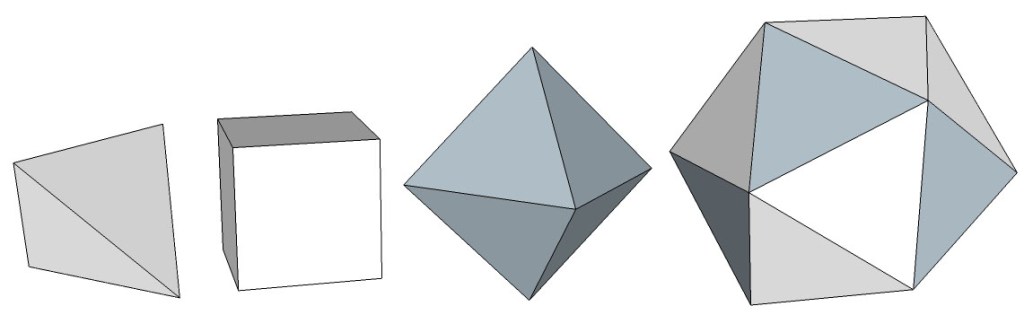
For example, take the following four polyhedra: the four-sided tetrahedron, the six-sided cube, the eight-sided octahedron, and the twenty-sided icosahedron.
Tetrahedron, Cube, Octahedron, and Icosahedron
The tetrahedron has four faces, four vertices, and six edges: 4 faces+(4 vertices – 2) = 6 edges.
The cube has six faces, eight vertices, and twelve edges: 6 faces+(8 vertices – 2) = 12 edges.
The octahedron has eight faces, six vertices, and twelve edges: 8 faces+(6 vertices – 2) = 12 edges.
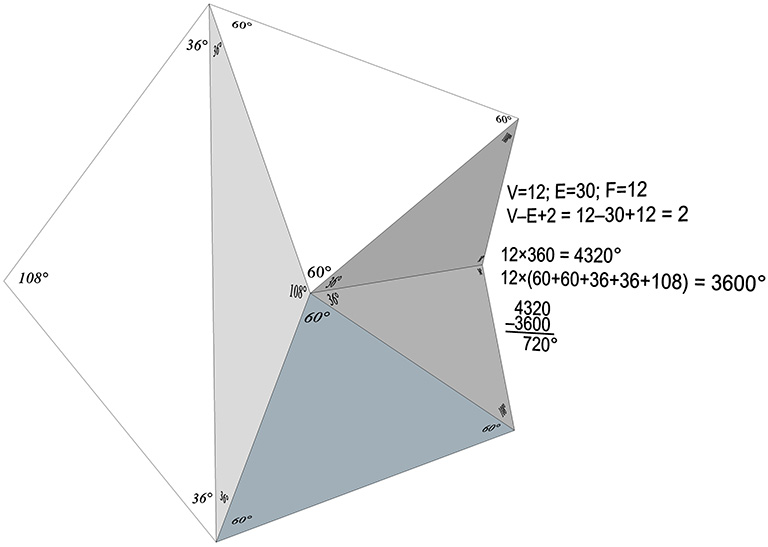
The icosahedron has twenty faces, twelve vertices, and thirty edges: 20 faces + (12 vertices – 2) = 30 edges.
The topological abundance formula and the Euler characteristic of the sphere, “2,” is related to the 720° deficit of a polyhedron’s angular abundance compared with that of its spherical counterpart, 720° being two cycles of unity, or 360°.
the sum of all angles around every vertex = (vertices x 360°) – 720°
Using the the same four polyhedra as above:
The tetrahedron has four vertices surrounded by three 60° triangles. 3 x 60° = 180°, 180° x 4 = 720°. Four vertices x 360° = 1440°, and subtracting 720° from 1440° we get, again, 720°.
The cube has eight vertices surrounded by three right (90°) angles. 3 x 90° = 270°, 270° x 8 = 2160°. Eight vertices x 360° = 2880°, and subtracting 720° from 2880° we get the same 2160°.
The octahedron has six vertices surrounded by four 60° angles. 4 x 60° = 240°, 240° x 6 = 1440°. Six vertices x 360° = 2160°, and subtracting 720° from 2160° we get 1440°.
The icosahedron has twelve vertices surrounded by five 60° angles. 5 x 60° = 300°, 300° x 12 = 3600°. Twelve vertices x 360° = 4320°, and subtracting 720° from 4320° yields, once more, 3600°.
As noted, 720° is the sum of the angles in a tetrahedron, the minimum polyhedral system. This led Fuller to state that all polyhedral systems are two cycles of unity or one tetrahedron removed from infinity. The tetrahedron has two non-polar vertices, four faces and six edges. And, in any omni-triangulated structural system, that is, for any polyhedron structurally stabilized through triangulation: the number of vertices (“crossings” or “points”) is always evenly divisible by two (2×1); the number of faces (“areas” or “openings”) is always evenly divisible by four (2×2), and; the number of edges (“lines,” “vectors,” or “trajectories”) is always evenly divisible by six (2×3). For example, the icosahedron has twelve vertices, twenty faces, and thirty edges. The number of faces is evenly divisible by two (12/2=6); the number of faces is evenly divisible by four (20/4=5); the number of edges is evenly divisible by six (30/6=5). This holds for any polyhedron of whatever size or complexity, just so long as its faces (areas, openings) are triangulated and therefore constitute a “structure” by Fuller’s definition, i.e. any system that holds its shape without external support.
The above formulas work for any polyhedron, not just the regular ones. For example, the polyhedron made from any conceivable projection of Fuller’s Basic Disequilibrium LCD Triangle would have 120 faces, 62 vertices, and 180 edges, and 62 – (180+120) = 2. All phases of the jitterbug, including those polyhedra with concave faces that comprise the icosahedron phases of the jitterbug, exhibit these regularities. All phases exhibit the same number of vertices, edges, and faces, and their surface angles all add up to 3600°.
The topological abundance formulas apply to all phases of the jitterbug in transition between its VE and octahedron phases. Here the transitional polyhedron describes an icosahedron with 12 of its 20 faces inverted.
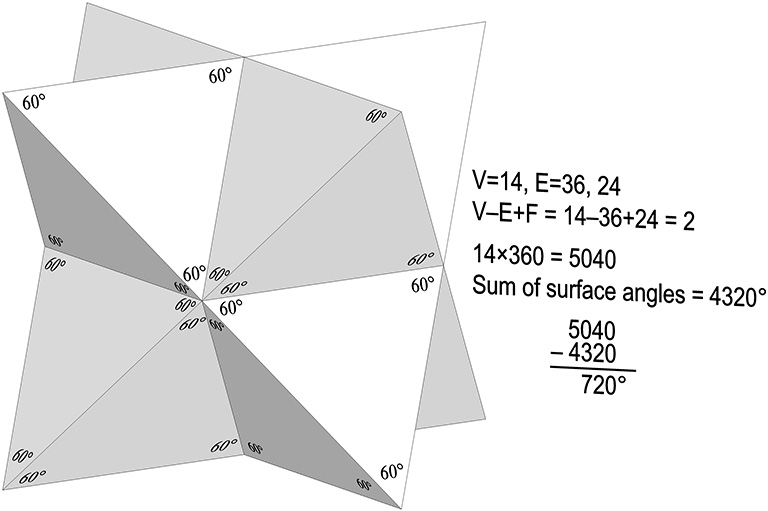
Polyhedron aggregates also seem to work. For example, a polyhedron constructed of eight tetrahedra face-bonded to an octahedron has 14 vertices, 36 edges, and 24 faces.
The topological abundance formulas work for eight regular tetrahedra face-bonded to a regular octahedron.
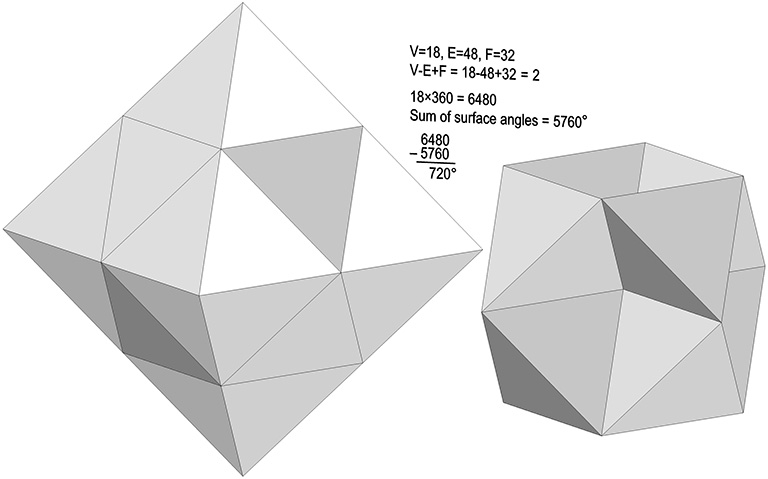
However, when we rotate those tetrahedra 90° so that they all share common vertex at the center of the VE, the formulas seem to break down. To make them work, we need to count all the edges of the eight tetrahedra, for a total of 48, and multiply the shared vertex at the center of VE by 6, making it topologically identical with the 2F octahedron.
Eight tetrahedra sharing a common vertex at the center of the VE (right) conforms to the topological abundance formulas only if its is conceived as topologically identical to the 2-frequency octahedron (left).
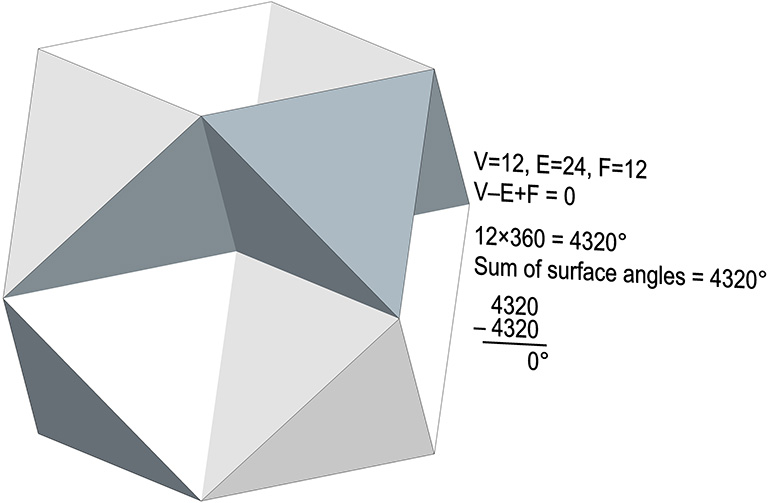
A topological variant of the VE, the octahemioctahedron, deserves further study. Unlike the other quasiregular hemipolyhedra, the octahemioctahedron is orientable, and is topologically the equivalent of a torus. Its Euler characteristic is ‘0’, and its spherical deficit is 0°. It has 24 edges and, like the VE, eight triangular faces. But instead of six square faces its four hexagonal equatorial planes each count as one, for a total of 12 faces. The sum of the angles around each of its 12 vertices is 60+60+120+120 = 360°, and V–E+F = 12–24+12 = 0.
A quasiregular hemipolyhedron, the octahemioctahedron is topologically equivalent to a torus.
Relation to Gibb’s Phase Rule
Fuller saw a relationship between Euler’s topological abundance formula and Gibbs phase rule that goes a bit beyond the obvious. On the surface, the similarity between the two formulas is compelling. The vertices (V), edges (E), and faces (F) in Euler’s formula align neatly with the phases (P), compounds (C), and degrees of freedom (F) in Gibb’s phase rule:
V – E + F = 2 P – C + F = 2
But the relationship isn’t that simple. Phases don’t have a direct parallel in vertices, nor do compounds parallel edges, or degrees of freedom parallel faces. At least not directly.
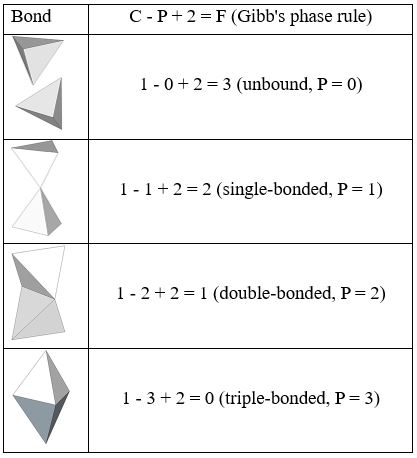
Fuller equated the three primary phases of matter—gaseous, liquid, and water—with the bonding of polyhedra by their vertices (single bonds), edges (double bonds), and faces (triple bonds). In the following table, the degrees of freedom, F, are reduced from three (3) for unbound polyhedra where P=0, to zero (0) for triple-bonded polyhedra where P=3.
In Gibb’s phase rule, degrees of freedom (F) are reduced in phases, represented here by the bonding of tetrahedra, from free atoms (top row) through the gas, liquid, and solid phases of matter (bottom row).
As shown in the following table, Fuller found that for any fully triangulated polyhedral system he could reduce Euler’s formula to “1 + 2 = 3” and the following three factors: the additive 2 (third column); the multiplicative 2 (4th column) and; one or more of the first four prime numbers (1, 2, 3, 5) characteristic of the polyhedral system being analyzed (fifth column). Note that the prime number in the fifth column is simply the factored reduction of the number of non-polar vertices.
Fuller’s reduction and factoring of Euler’s topological abundance formula (column 2) to: the additive 2 (column 3); multiplicative 2 (column 4); the prime number characteristic of the system (column 5), and the core of Gibb’s phase rule, 1+2=3 (last column).
As a result, Fuller proposed a revision to Euler’s formula which is a combination of the topological abundance formula and Fuller’s own formulas for sphere shell growth rates, i.e., nF²+2, with λ or μ substituting for F. The n in the growth rate formula relates to the Prime No. in the revision to Euler’s formula:
With Fuller’s revision of Euler’s formula, we are able to calculate the relative topological abundances of any system given a) its frequency or wavelength, i.e. number of modular subdivisions of either its radial or circumferential vectors, and b) its prime number characteristic. Its application to theoretical and experimental thermodynamics is less clear. Fuller was satisfied that he’d established a compelling geometrical correlation between “the timelessness of Euler” and “the frequency of Gibbs” (Synergetics, 1054.74), providing us with a physical model with which to conceptualize the abstract math of thermodynamics and to better understand the phase changes and equilibrium states of matter. But if Fuller adequately articulated the correlation and how to apply it, I’ve yet to disentangle it from his writings.
“Because the 120 basic disequilibrious LCD triangles of the icosahedron have 2 l/2 times less spherical excess than do the 48 basic equilibrious LCD triangles of the vector equilibrium, and because all physical realizations are always disequilibrious, the Basic Disequilibrium 120 LCD Spherical Triangles become most realizably basic of all general systems’ mathematical control matrixes.” —R. Buckminster Fuller, Synergetics, 901.18
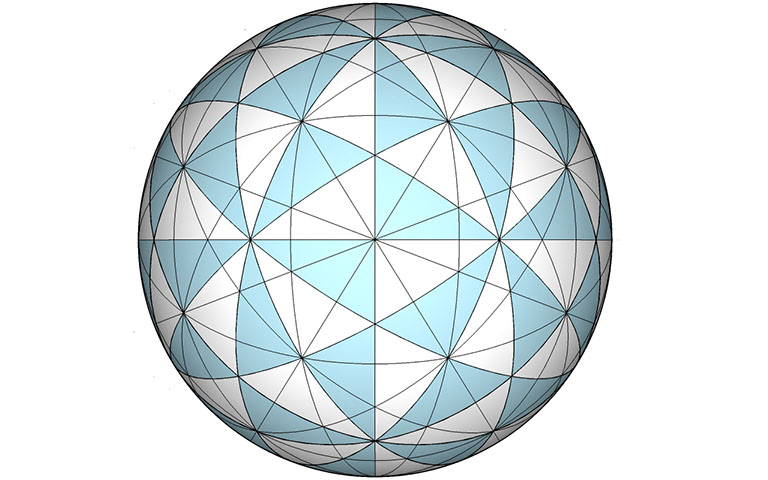
The 15 great circles that define the basic disequilibrium LCD triangle are constructed by spinning the icosahedron on its 15 edge-to-edge axes. It can be shown by spherical trigonometry that further subdividing of the surface would only result in dissimilar triangles. The Basic Disequilibrium LCD Triangle constitutes the lowest common denominator (LCD) of the sphere’s surface, just as the A and B quanta modules constitute the lowest common denominator of polyhedral systems. The trigonometric data for the Basic Disequilibrium LCD Triangle includes the data for the entire sphere and is the basis of all geodesic dome calculations. (See Geodesics.)
The 120 basic disequilibrium LCD triangles represent unit whole subdivisions of the spherical octahedron, icosahedron, pentagonal dodecahedron, icosidodecahedron, rhombic triacontahedron, and VE. (See Icosahedron: Spherical Polyhedra Described by Great Circles.
Surface of sphere showing the 120 Basic Disequilibrium LCD Triangles (60 positive and 60 negative) inscribed with the 31 great circles of the 10, 6 and 15 axes of spin of the icosahedron.
The sum of all the angles around the vertices of any polyhedral system multiplied by the number of vertices is always 720° less than the number of vertices multiplied by 360°. That is to say that any polyhedral system projected onto the surface of a sphere will have a spherical excess of 720° over its polyhedral counterpart. It is no coincidence that 720° is also the sum of all the surface angles of a tetrahedron.
720° distributed equally among the 120 LCD triangles is 6° per triangle. The surface angles of the spherical LCD triangle are: 90°, 60°, and 36°. The surface angles of the spherical LCD triangle projected onto the face of the regular icosahedron are: 90°, 60°, and 30°. Note that all of the spherical excess of 6° is allotted to just one of its angles, i.e., 30° + 6° = 36°.
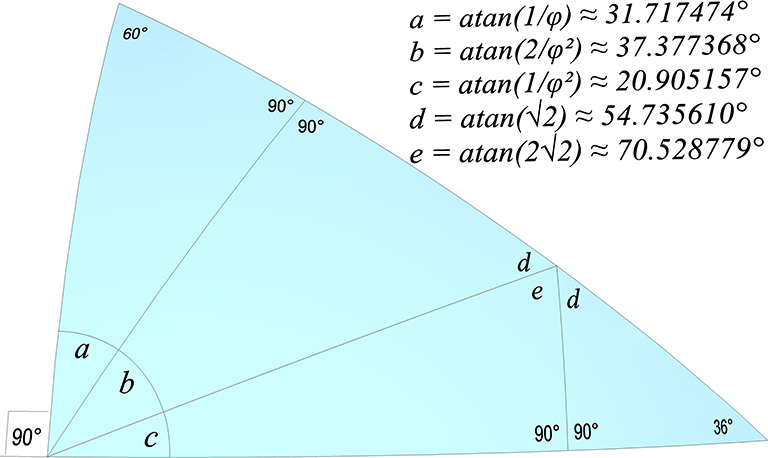
The sets of 10 and 6 great circles of the icosahedron subdivide the LCD triangle into 4 smaller right triangles. Their non-right angles are:
a = arctan(1/φ) ≈ 31.717474° b = arctan(2/φ²) ≈ 37.377368° c = arctan(1/φ²) ≈ 20.905157° d = arctan(√2) ≈ 54.735610° e = arctan(2√2) ≈ 70.528779°
The angles a, b, and c add to 90° and constitute the LCD triangle’s right angle. The angles d(×2) and e add to 180°.
Surface Angles of the Basic Disequilibrium LCD Triangle
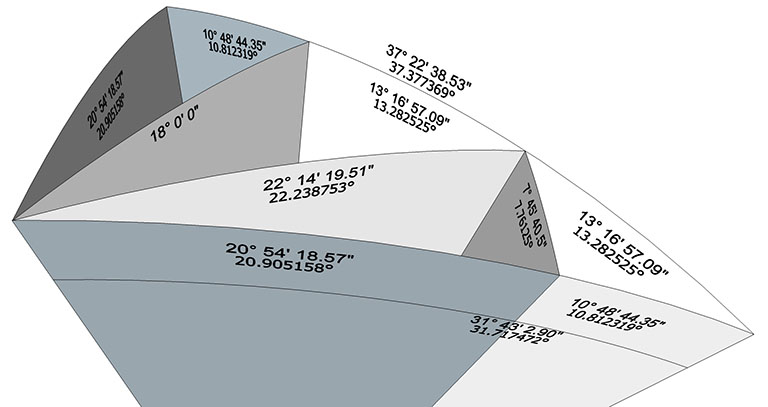
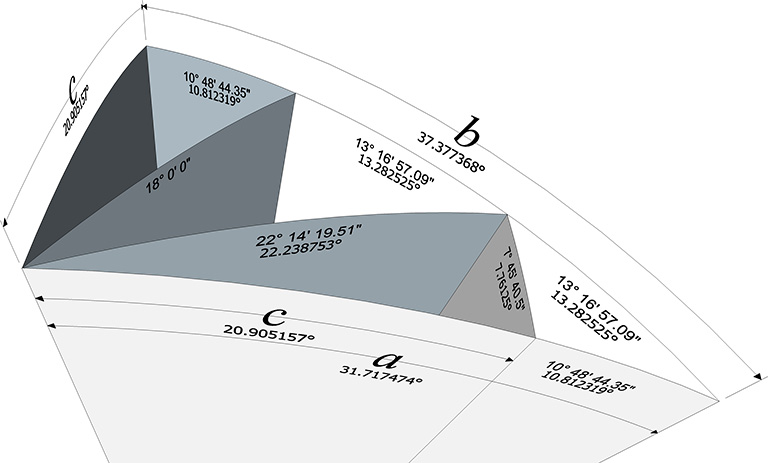
In a surprising and beautiful coincidence, the central angles of the Basic Disequilibrium LCD Triangle add up to exactly 90° and correspond exactly to the surface angles subdividing its 90° corner: atan(φ) ≈ 31.717474° ; atan(2/φ²) ≈ 37.377368″, and; atan(1/φ²) ≈ 20.905157°. It follows that the triangle may therefore be folded along these surface angles to form a tetrahedral cone exactly proportional to that formed from its central angles.
Central Angles of the Basic Disequilibrium LCD Triangle
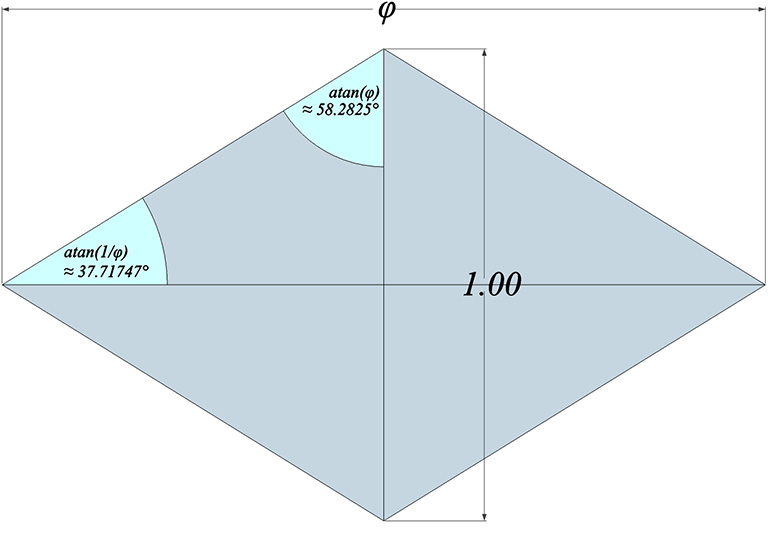
The three angles subdividing the LCD’s 90° corner—the same three angles that constitute the central angles of the LCD’s edges—also relate to the golden rhombus (see The Golden Ratio.) The first angle, atan(1/φ) ≈ 31.71747°, and the other two, atan(2/φ²) ≈ 37.377369° and atan(1/φ²) ≈ 20.905158°, add to atan(φ) ≈ 58.2825°.
Golden rhombus, whose width is φ times its breadth (φ = the golden ratio = (√5+1)/2.)
Another surprising coincidence is that the central angles of the interior arcs, 22.238753° and 7.76125° add to 30°, and are equivalent to the angles of rotation that separate the icosahedron phases of the jitterbug.
The basic disequilibrium LCD triangle bears a striking resemblance to the unfolded A quanta module. The six degrees of spherical excess are subtracted from the angles in the A quanta module which correspond to the 36° and 90° angles of the Basic Disequilibrium LCD Triangle. In the A quanta module the 36° angle is reduced to to 35.2644° (atan(√/2/2). The 90° angle is reduced to 84.7356° (atan(√2) + 30°), for a difference of approximately 5.264390° which Fuller called the “Twinkle Angle.” The Twinkle Angle’s asymmetry in respect to the isotropic vector matrix is discussed further in The Minimum All-Space-Filling Tetrahedon: “MITE”.
All the other angles of the A quanta module are identical with those of the spherical LCD triangle. The correlation is intriguing. Both are least common denominators—one for surfaces and one for volumes—and both are derived from the basic operational mathematics and constructive geometry of the close packing of spheres.
The A quanta module unfolded into an (almost) right triangle. It’s largest angle is approximately 5.2649390° shy of 90°, what Fuller called the “Twinkle Angle.”
The planar counterpart of the spherical LCD triangle derived from the regular icosahedron is used in most geodesic dome calculations. As already noted, the three corner angles are reduced from 36°, 60°, 90° in the spherical triangle, to 30°, 60°, 90° in the planar triangle. That is, the six degrees of spherical excess is carried entirely by the 36° angle.
Basic Disequilibrium LCD Triangle projected onto the faces of a regular icosahedron
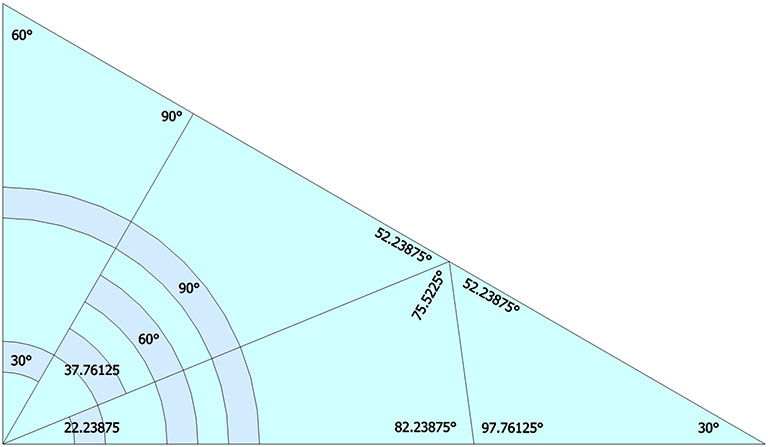
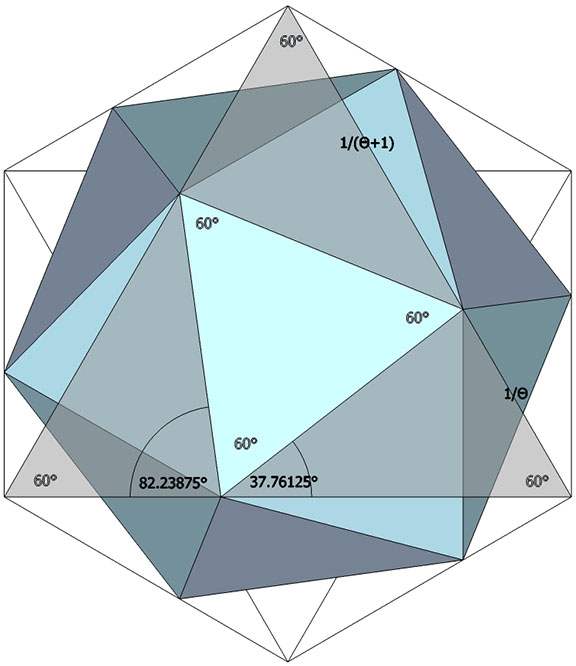
As with the spherical LCD triangle, The coincidence of spherical angles and surface angles also shows up in this planar projection. The central angle of 22.23875° in the spherical LCD is the same as the angle from the base to the the chord of that arc in its planar projection. Three others are sums of the central angles previously noted as coincident with the angles of rotation in the jitterbug: 30° + 22.23875° = 52.23875°; 60° + 22.23875 = 82.23875°; 30° + 7.76125° = 37.76125°; and 90° + 7.76125° = 97.76125°.
Detail of all surface angles of the Basic Disequilibrium LCD triangle projected on the face of a regular icosahedron
The angles of rotation in the jitterbug which correspond to the regular icosahedron, the Jessen icosahedron (tensegrity equilibrium), and the irregular space-filling complement to the regular icosahedron are identical to the surface angles the LCD triangle projected onto the regular icosahedron.
The angles 37.76125° (arctan(√(3/5)) and 82.23875° (arctan(√(5/3)) + 30°) also show up in the icosahedron inscribed inside the octahedron. They are the same angles at which the face of the icosahedron is skewed from the face of the octahedron into which it is nested.
The regular icosahedron nested inside the regular octahedron is skewed at angles that correspond to the icosahedron projection of the LCD triangle, and to angles of rotation associated with the space-filling complement to the icosahedron in the jitterbug.
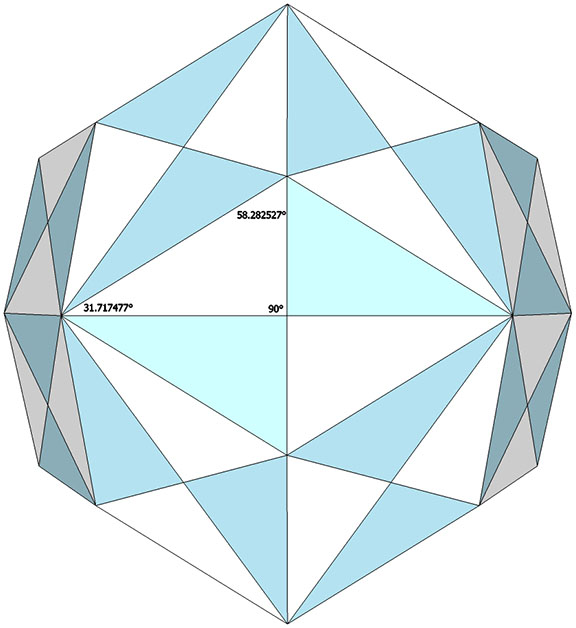
The planar angles of the of the Basic Disequilibrium LCD Triangle may also be derived from the rhombic triacontahedron whose faces are identical with the golden rhombus (see above, and The Golden Ratio.) Instead of subdividing the twenty triangular faces of the regular icosahedron into six identical triangles, we can subdivide the thirty rhomboid faces of the rhombic triacontahedron into four. In this case the planar angles are: 90°, 58.282526° (atan(φ)), and 31.717474° (atan(1/φ)). The six degrees of spherical excess is distributed between the two non-right angles: 4.282526° from smaller of the two (31.717474° + 4.282526° = 36°), and 1.717474° from the larger (58.282526° + 1.717474° = 60°).
Note that both angles are 1.717474° removed from the angles of the planar projection of the LCD onto the icosahedron (30° and 60°) , as well as 4.282526° removed from the angles of planar projection of the LCD onto the pentagonal dodecahedron (36° and 54°) which is described later.
Projection of the Basic Disequilibrium LCD triangle onto the surface of the 30-sided rhombic triacontahedron
The angles of the planar projection of the LCD onto the rhombic triacontahedron also correspond to the central angles of the spherical LCD triangle. The larger of the two non-right angles of the planar LCD, atan(φ) (≈ 58.282527°), is the sum of 37.377369° and 20.905158°, the central angles of the spherical LCD’s hypotenuse and the smaller of its two legs. The smaller of the two non-right angles in the planar LCD, atan(1/φ) (≈31.717477°) is the also the central angle of the spherical LCD’s base. It is obvious in the planar LCD that these two angles add to 90° as the sum of the angles of any planar triangle must add to 180°. But it is not at all obvious with reference to the spherical LCD triangle alone.
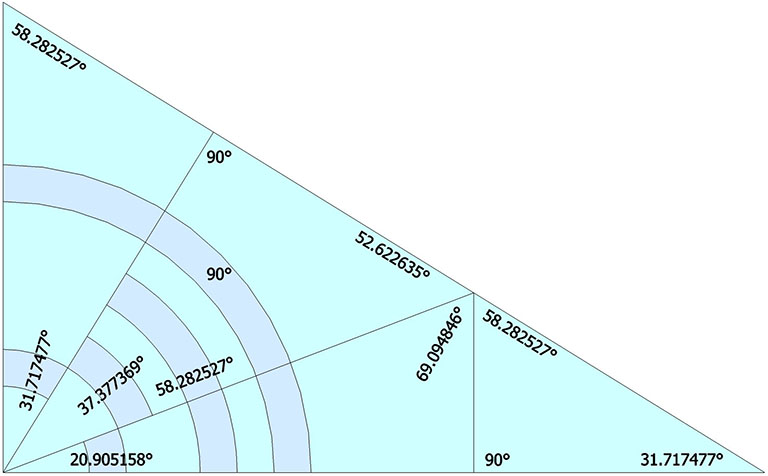
In fact, all of the surface angles of the spherical LCD triangle projected onto the face of the rhombic triacontahedron correspond with the spherical LCD’s central angles. You’ll recognize all but two of the angles in the figure below: 69.094846°, and 52.622635°. These are sums of the LCD triangle’s central angles, 58.622635° + 10.812319°, and 31.717477° + 20.905158°, respectively.
Detail of surface angles of the Basic Disequilibrium LCD triangle projected on the surface of the rhombic triacontahedron
The T and E quanta modules are derived from the projection of the LCD onto the rhombic triacontahedron. See: T and E Quanta Modules.
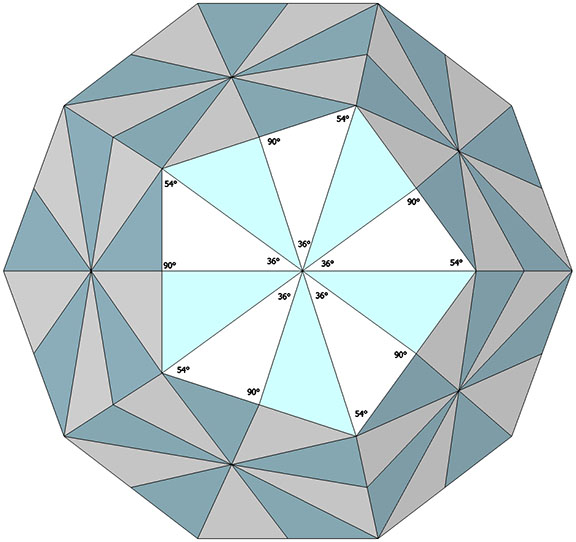
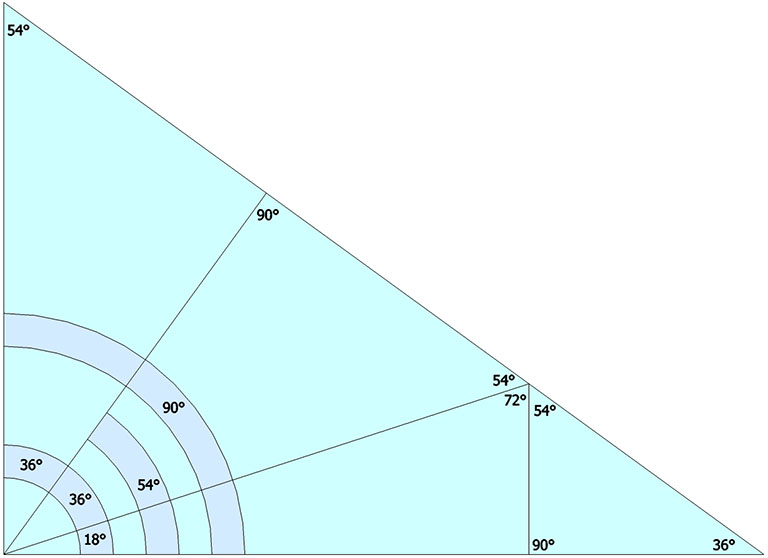
A third option is to derive the planar angles of the of the basic disequilibrium LCD triangle from the pentagonal dodecahedron. Its twelve pentagonal faces are subdivided into ten planar triangles whose angles are 36°, 54°, and 90°.
Projection of the Basic Disequilibrium LCD triangle projected onto the surface of the pentagonal dodecahedron
When projected onto the face of the pentagonal dodecahedron, it is perhaps surprising at this point to discover that all of the angles corresponding to surface angles of the of the spherical LCD triangle are whole rational numbers.
Detail of the surface angles of the Basic Disequilibrium LCD Triangle projected onto the surface of the pentagonal dodecahedron
These angles correspond neatly to the face angles of the concave regular icosahedron and its space-filling complement.
The face angles of the concave regular icosahedron and its space filling complement are identical to the surface angles of the LCD triangle projected onto the surface of a pentagonal dodecahedron.
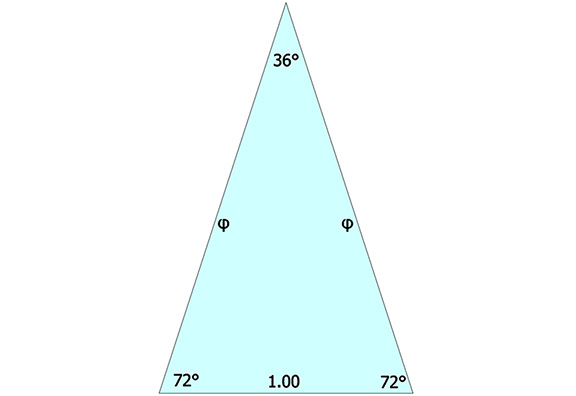
The face angles and dihedral angle of the space-filling complement to the regular icosahedron nest with edge-bonded regular icosahedra: 72° and 36°, the same angles, incidentally, of the golden triangle.
The golden triangle
The surface angles of the LCD triangle projected onto the surface of the pentagonal dodecahedron match these angles precisely. This and the foregoing suggests an intriguing relationship between the Basic Disequilibrium LCD Triangle and the jitterbug transformations of the isotropic vector matrix. (See also: Icosahedron Phases of the Jitterbug.)
The regular icosahedron and its space-filling complement. The face angles and dihedral angle of the irregular icosahedra nest with the interstitial angles of the edge-bonded regular icosahedra, and correspond to the surface angles of the LCD triangle projected onto the surface of the pentagonal dodecahedron.
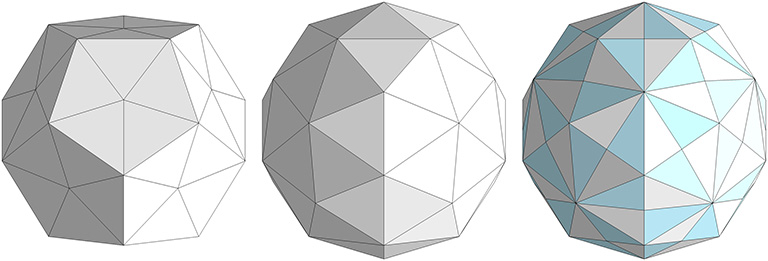
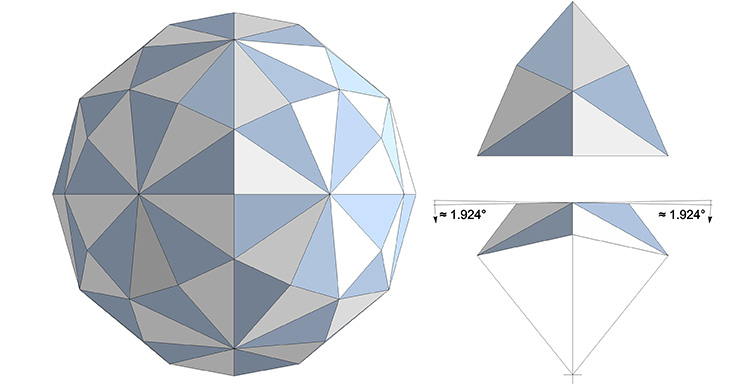
A fourth option is to derive the planar angles of the of the basic disequilibrium LCD triangle from the 60-faceted geodesic polyhedron based on the pentagonal dodecahedron. Each of its 12 pentagonal facets is divided into five isosceles triangles. The shared vertex at the center of the pentagon is then projected outward to the circumsphere radius. (Note: This polyhedron is identical with a 2F Class 2 geodesic icosahedron. See Geodesics.)
Each of the 60 facets of this geodesic polyhedron consists of one positive and one negative LCD triangle bonded on the right angle’s long leg.
We can go one step further and project all the vertices of the LCD triangle out to the same circumsphere radius. On first inspection, this appears to produce a 60-faceted polyhedron with each face consisting of two LCD triangles bonded on their hypotenuse. Closer inspection, however, shows their planes to be rotated about two degrees from the other.
“Though of equal energy potential or latent content, the [A and B quanta modules] are two different systems of unique energy-behavior containment. [The A quanta module] is circumferentially embracing, energy-impounding, integratively finite, and nucleation-conserving. [The B quanta module] is definitively disintegrative and nuclearly exportive. A is outside-inwardly introvertive. B is outside-outwardly extrovertive.” —R. Buckminster Fuller, Synergetics, 921.40
The A and B quanta modules constitute the lowest common denominator of polyhedral systems, just as the Basic Disequilibrium LCD Triangle constitutes the lowest common denominator (LCD) of the sphere’s surface.
Construction of the A and B Quanta Modules
To construct the A quanta module, the regular tetrahedron is divided into four identical quarter-tetrahedra whose apexes converge at its center of volume.
Subdivision of the regular tetrahedron into quarter-tetrahedra
The quarter-tetrahedra are further subdivided into six identical irregular tetrahedra—three positive and three negative (inside-out)—by describing lines that are perpendicular bisectors from each vertex to their opposite edge. These are the A quanta modules.
The A quanta module is constructed by bisecting the quarter-tetrahedron from its apex to each of the edge midpoints.
The regular octahedron has a volume equivalent to that of four regular tetrahedra. The octahedron may be subdivided symmetrically into eight equal eighth-octahedra by planes going through the three axes connecting its six vertexes.
Subdivision of the octahedron into eight 1/8th octahedra
The quarter-tetrahedron and the eighth-octahedron each have the same equilateral triangular base. With their bases congruent we can superimpose the eighth-octahedron over the quarter-tetrahedron. We find, operationally, that the height of the eighth-octahedron is exactly twice that of the quarter-tetrahedron. So, by removing the quarter-tetrahedron and subdividing as before, we are left with six uniformly symmetrical components—three positive, and three negative (inside-out)—with the same volume as the A quanta module. These are the B quanta modules.
The B quanta module is constructed by subtracting the quarter tetrahedron from the eighth octahedron and then bisecting the result from apex to each of the edge midpoints.
The A and B quanta modules each have the volume of 1/24th that of the regular tetrahedron. Combinations of the two produce rational, whole-number volumes for all the regular polyhedra that appear in the isotropic vector matrix.
Dimensions of the A and B Quanta Modules
The A Quanta Module unfolds into a scalene triangle; all its angles are different, and all are less than 90°. Two of the fold lines are perpendicular to the triangle’s sides, thus producing the four right angles of the folded module. The A quanta module triangle may be unique in that neither of its two perpendiculars bisect the edges that they intersect. It has three internal folds and no internal triangle. It drops its perpendiculars in such a manner that there are only three external edge increments, which divide the perimeter into six increments of three pairs. The folds progress linearly, in a spiral.
The unfolded A quanta module may be the only scalene triangle with these properties, and may be the only scalene triangle that can be folded into a tetrahedron.
A quanta module unfolds, perhaps uniquely, to a scalene triangle.
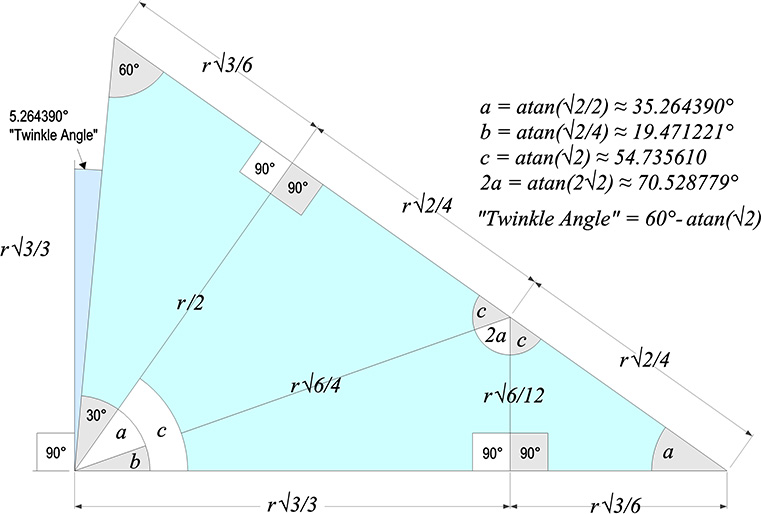
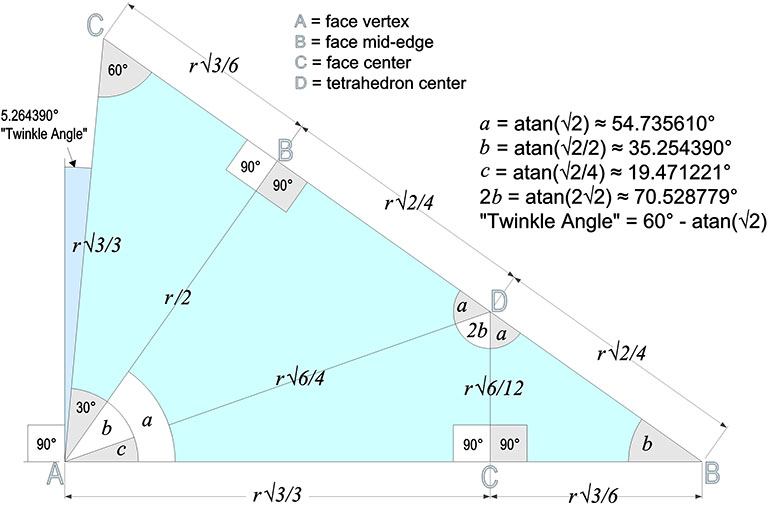
The plane net of the unfolded A quanta module in the following illustration will fold along the fold lines AB, AD and CD to produce either a positive or a negative A quanta module. The vertex D is at the center of the tetrahedron from the A quanta module is derived, A is at the vertex, B is at mid-edge, and C is at mid-face.
Its six edges have the following lengths, with r taken as unity:
AC = r√3/3;
CB = r√3/6;
BD = r√2/4;
AB = r/2;
AD = r√6/4;
DC = r√6/12;
Given the following angles:
a = atan(√2) ≈ 54.735610°;
b = atan(√2/2) ≈ 35.254390°;
c = atan(√2/4) ≈ 19.471221°;
2b = atan(2√2) ≈ 70.528779°;
the vertices are: A(30°,b,c); B(90°,90°,b); C(90°,90°,60°); and D(a,2b,a).
Angles and dimensions of the unfolded A quanta module.
The faces of an A quanta module unfold to form a triangle with 84.73560°as its largest angle. This is 5.264390° less than a right angle, which is known as the “Twinkle Angle” in synergetics, and relates to the unfolded A quanta module bearing a striking resemblance to the Basic Disequilibrium LCD Triangle. Fuller proposed that the two were, in fact, the same triangle; that is, the basic disequilibrium LCD triangle is the spherical version of the A quanta module triangle. Supporting this proposition is the fact that all of the LCD triangle’s central angles are paired in the same way the edge lengths are paired in the A module triangle. So, if it were possible to fold a spherical triangle into a tetrahedron, the basic disequilibrium LCD triangle would have all the appropriate dimensions.
Central angles of the Basic Disequilibrium LCD Triangle. Matching edge lengths in the unfolded A quanta module correspond to the matching central angles in the LCD triangle: AC=arctan(1/φ²) ≈ 20.905157°; BC=arctan((3-φ)/(2(φ+2)) ≈ 10.812319°, and; BD=arctan(1/2)/2 ≈ 13.282525°.
The B quanta module cannot be unfolded into a single triangle. It can only be unfolded into an irregular polygon made up of four dissimilar triangles. The plane net of the unfolded B quanta module in the following illustration will fold along the fold lines BE, EA, and AC to produce either a positive or a negative B quanta module. The vertex E is at the center of the octahedron from which the B quanta module is derived; A is at the vertex; B is at mid-edge; and C is at face center.
Its six edges have the following lengths, with r given as 1/2 unity:
AB = r/√2
BD = r√2/4
DE = r√6/12
BE = r/2
EA = r√2/2
AD = r√6/4
Given the following angles:
a = atan(√2) ≈ 54.735610°;
b = atan(√2/2) ≈ 35.364390°;
c = atan(√2/4) ≈ 19.471221°;
d = atan(1/φ)/2 ≈ 15.858737°;
b + 90° ≈ 125.264390°;
2a = c+90° ≈ 109.471221°
The vertices are: A(b, d, 45°); B(c, 90°, 90°); D(2a, a, b+90°), and E(b, 45°, a).
Angles and dimensions of the unfolded B quanta module.
All of Fuller’s quanta modules come in pairs, positive and negative. One is the inside-out version of the other, which can be shown by opening three of their six edges and folding the three triangles’ hinged edges in the opposite direction until their edges come together again.
Energy Characteristics of the A and B Quanta Modules
Fuller describes the A quanta modules as energy-conserving and the B modules as energy-dispersing. This claim is backed up with a billiard table analogy—the triangles being the billiard table and the billiard balls being energy. A billiard table in the shape of an obtuse triangle would tend to direct the ball toward the pocket with the most acute angle. Whereas, on a billiard table in the shape of an equilateral triangle, no one pocket would attract more balls than another. A ball bouncing randomly around inside of the former would very quickly end up in the most acute corner’s pocket. In the latter it take would take longer, possibly forever, for the ball to reach a pocket. The A quanta modules combine to form the regular tetrahedron which, by the billiard table analogy, would tend to hold energy. The B modules, in addition to being made of highly obtuse triangles with sharply acute angles cannot combine with one another to form a single tetrahedron with energy-conserving proclivities. The B modules, therefore, tend to disperse rather than hold energy.
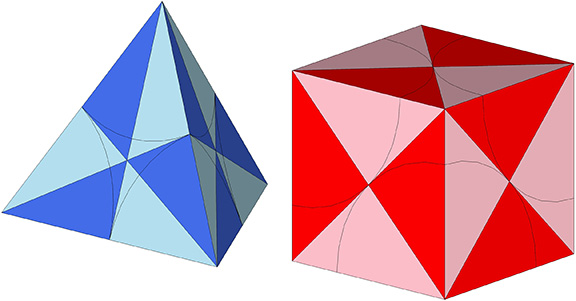
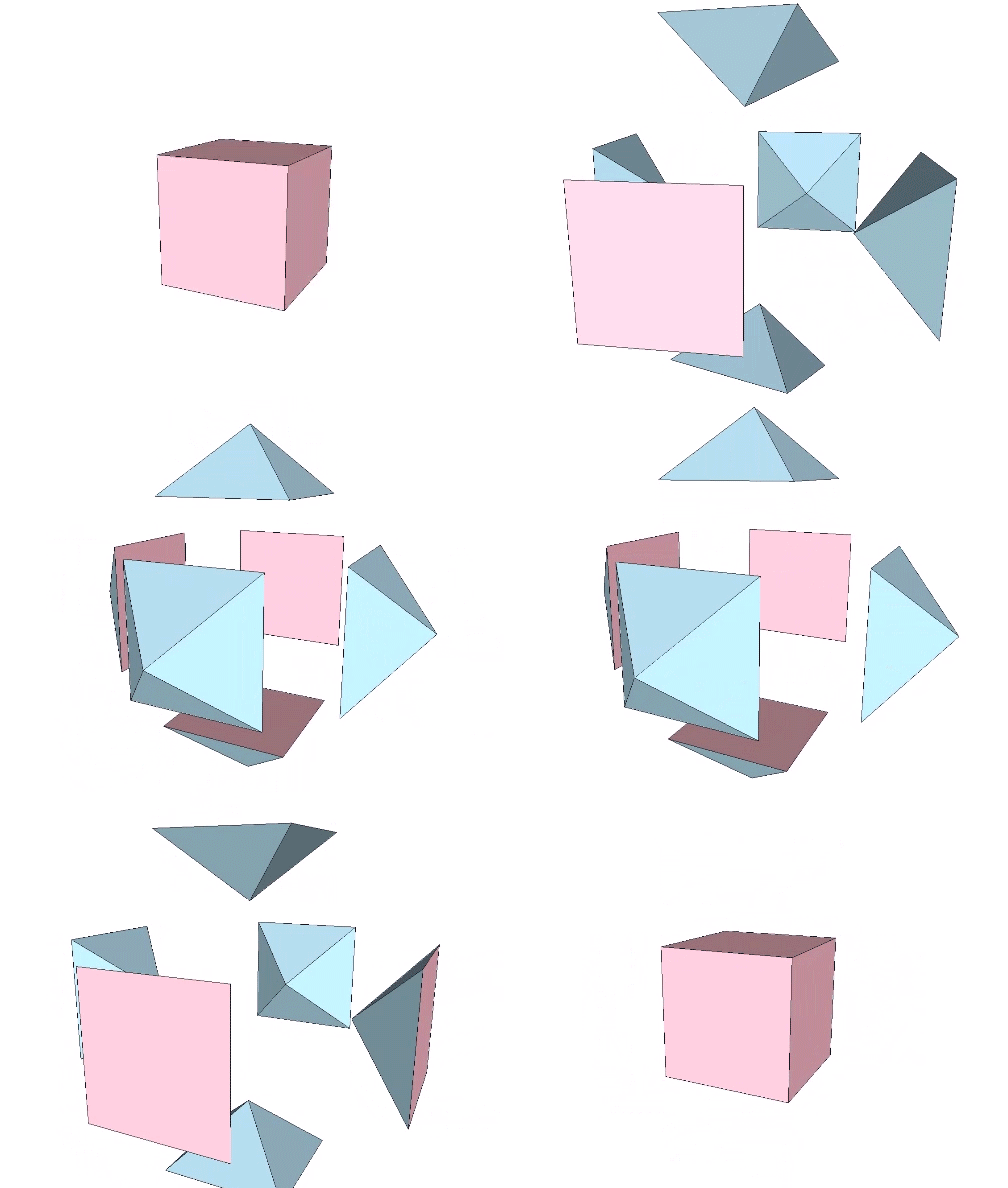
To underscore their energy characteristics, the A quanta modules are typically colored blue, and the B quanta modules are typically colored red. Blue signals energy-conserving, and red signals energy-dispersing. It is perhaps surprising that these characteristics often make intuitive sense when the quanta modules are combined into the shapes of the various polyhedra. For example, the tetrahedron, made entirely of blue A quanta modules, is stable, structural, and virtually indestructible. Whereas the cube, famously non-structural and unstable, is encased in red B quanta modules.
The regular tetrahedron (left) tends to hold rather than release energy, which is reflected its being composed entirely of A quanta modules (blue). The cube (right) is a shape that is famously unstable, which is reflected in its being encased in energy-dispersing B quanta modules.
“The rhombic dodecahedra symmetrically fill allspace in symmetric consort with the isotropic vector matrix. Each rhombic dodecahedron defines exactly the unique and omnisimilar domain of every radiantly alternate vertex of the isotropic vector matrix as well as the unique and omnisimilar domains of each and every interior-exterior vertex of any aggregate of closest-packed, uniradius spheres whose respective centers will always be congruent with every radiantly alternate vertex of the isotropic vector matrix, with the corresponding set of alternate vertexes always occuring at all the intertangency points of the closest-packed spheres.” —R. Buckminster Fuller, Synergetics, 426.20
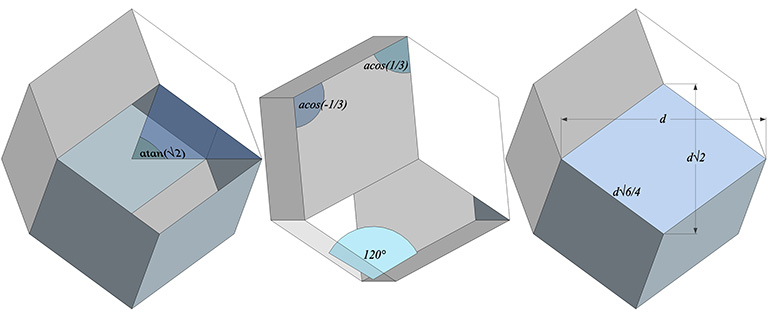
The rhombic dodecahedron with unit long face diagonal, d:
12 rhomboid faces, 14 vertices, 24 edges
Face Angles: atan(2√2) ≈ 109.471221°, and 2×atan(√2) ≈ 70.528779°
Dihedral Angle: 120°
Central Angle: atan(√2) ≈ 54.735610°
Edge Length; d√6/4
Volume (in tetrahedra): 6d³
Volume (in cubes): d³2√2
A quanta modules: 96
B quanta modules: 48
Surface area (in equilateral triangles) = d²×4√6
Surface area (in squares): d²×3√2
In-sphere radius: d/2
Mid-sphere radius: d√3/3
Circum-sphere radius (to vertices of long diagonal): d√2/2
Circum-sphere radius (to vertices of short diagonal): d√6/4
Rhombic Dodecahedron Dimensions
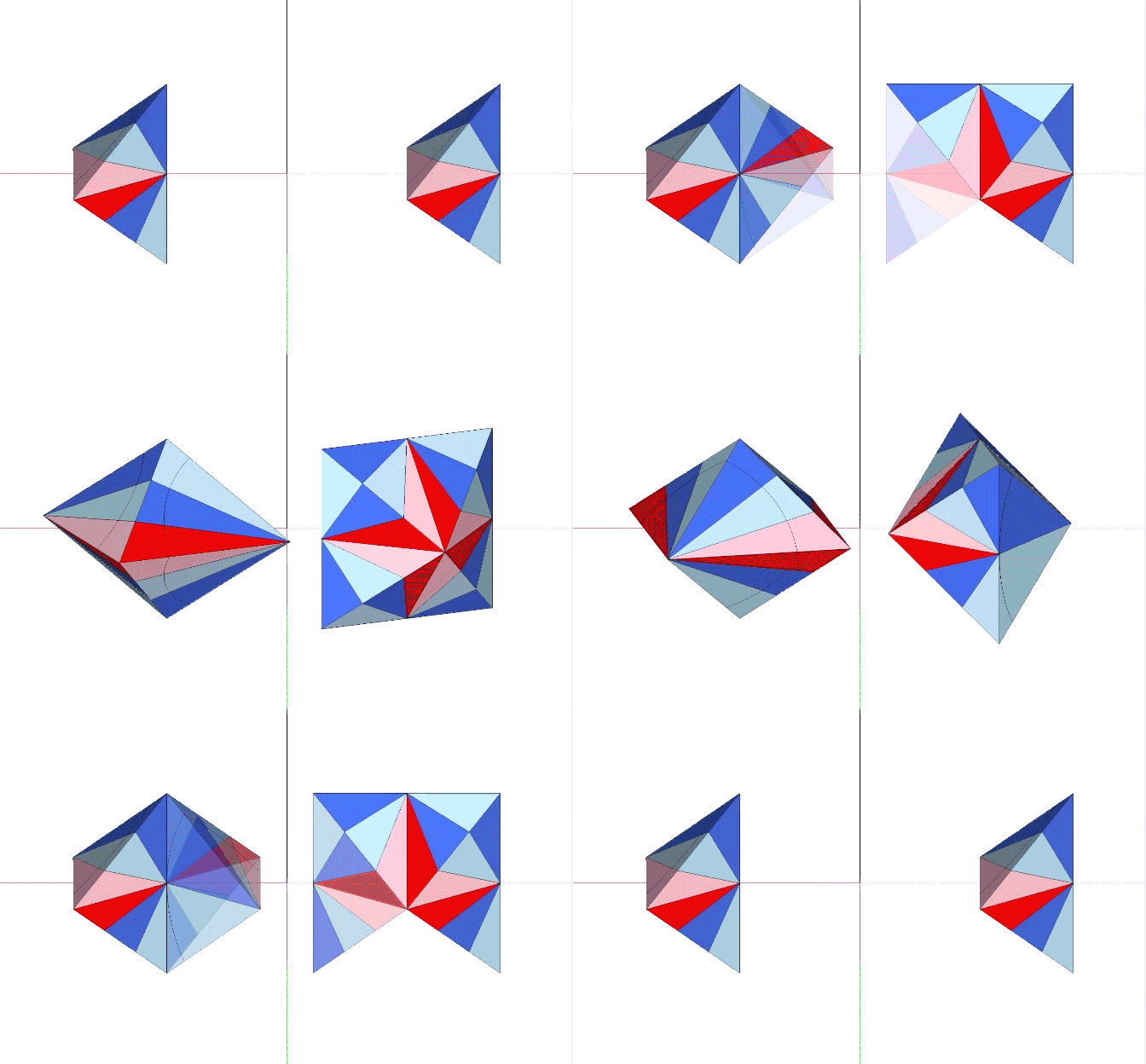
The rhombic dodecahedron may be constructed from a single paper strip.
Eleven sequential folds of 60° each produce the the regular rhombic dodecahedron.
The in-sphere diameter describes a sphere that is fully enclosed by the rhombic dodecahedron, and is equal to the length of the long diagonal, d, of its rhomboid face. If d is taken to be unity, the tetrahedral volume of the rhombic dodecahedron is exactly 6, and defines the polyhedral domain of the radially close-packed spheres of the isotropic vector matrix.
The in-sphere diameter of the rhombic dodecahedron is the same as the length of the long diagonal, d, of its rhomboid face.
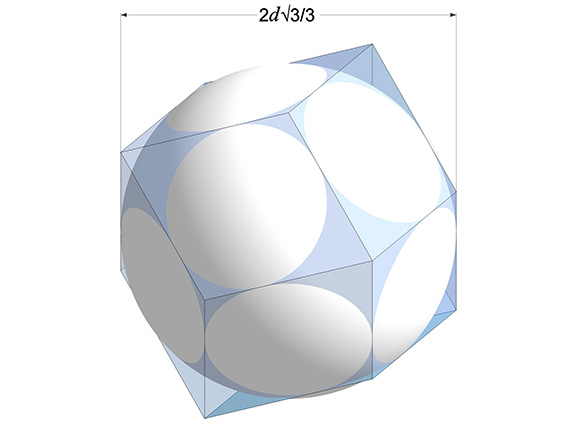
The mid-sphere diameter defines the sphere whose radii intersect the edges of the rhombic dodecahedron at right angles. Its length is 2d√3/3.
The mid-sphere diameter of the rhombic dodecahedron is 2d√3/3. The radii intersect the rhombic dodecahedron at right angles to its edges.
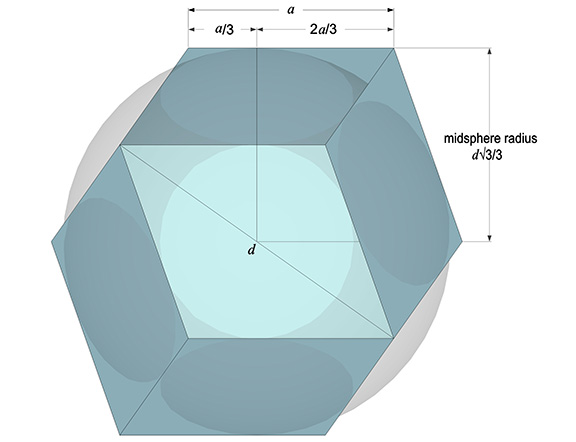
Note the mid-sphere radius does not intersect the edges at their mid-point, as might be expected. Rather, the intersect divides the edge length, a, into 1/3 and 2/3 segments, as illustrated below.
The mid-sphere radius of the rhombic dodecahedron intersects its edges at a right angle, and divides the edge into unequal lengths of 1/3 and 2/3 the edge length.
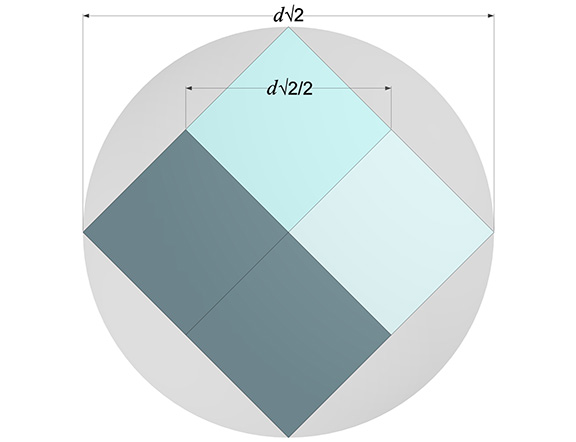
The circum-sphere diameter defines the sphere that fully encloses the rhombic dodecahedron. Its length is d√2. The radius, i.e., one half of the diameter, is identical with the length of the short diagonal, i.e., the shorter of the two widths of its rhomboid face: d√2/2.
The circum-sphere radius of the rhombic dodecahedron is equal to the length of the short diagonal of its rhomboid face, d√2/2.
The circum-sphere radii intersect the rhombic dodecahedron at the vertices of its long diagonal, i.e., the longer dimension of its rhomboid face. The radius of the sphere that intersects the vertices of its short diagonal, i.e., the shorter dimension of its rhomboid face, is d√6/4, which, curiously, is identical with the edge length. The diameter of this sphere is, naturally, two times that length, or d√6/2.
The radius of the sphere that intersects the rhombic dodecahedron at the vertices of the short diagonal of its rhomboid face has a length identical with the edge length, d√6/4.
Rhombic dodecahedra close pack to fill all space in exactly the same way that unit-radius spheres close pack around a central nucleus, as vector equilibria (VEs) of increasing frequency. That is, the polyhedral domain of each sphere in a cluster of radially close-packed spheres is a rhombic dodecahedron whose in-sphere radius is the radius of the sphere. (See Formation and Distribution of Nuclei in Radial Close-Packing of Spheres.)
Rhombic dodecahedra describe the domains of spheres close packed around a central nucleus. (Click on image to view animation in new tab.)
The rhombic dodecahedron can be constructed by adding quarter tetrahedra to each of the eight faces of a regular octahedron.
Rhombic dodecahedron constructed by adding quarter-tetrahedra to each of the eight faces of a regular octahedron.
Alternatively, the rhombic dodecahedron can also be constructed by subdividing the cube into six identical pyramids whose apexes converge at its center of volume. These are then added to the faces of another cube, or simply rotated 180° to expose their internal faces. The construction can also be thought of as turning the cube inside out.
Rhombic dodecahedron created by subdividing a cube into six identical pyramids and rotating them 180° so that their apexes point outward. (Click on image to view animation in new tab.)
The long and short diagonals of the rhomboid faces define a regular octahedron and cube respectively. The ratio of the long diagonal over the short diagonal is exactly √2.
Lines connecting opposite vertices of the rhomboid faces of the rhombic dodecahedron describe the octahedron and cube.
The lines along which the the cube and the octahedron intersect are equal to the in-sphere radius of the rhombic dodecahedron and describe vector equilibrium (VE).
The lines along which the the cube and the octahedron intersect with describe the VE.
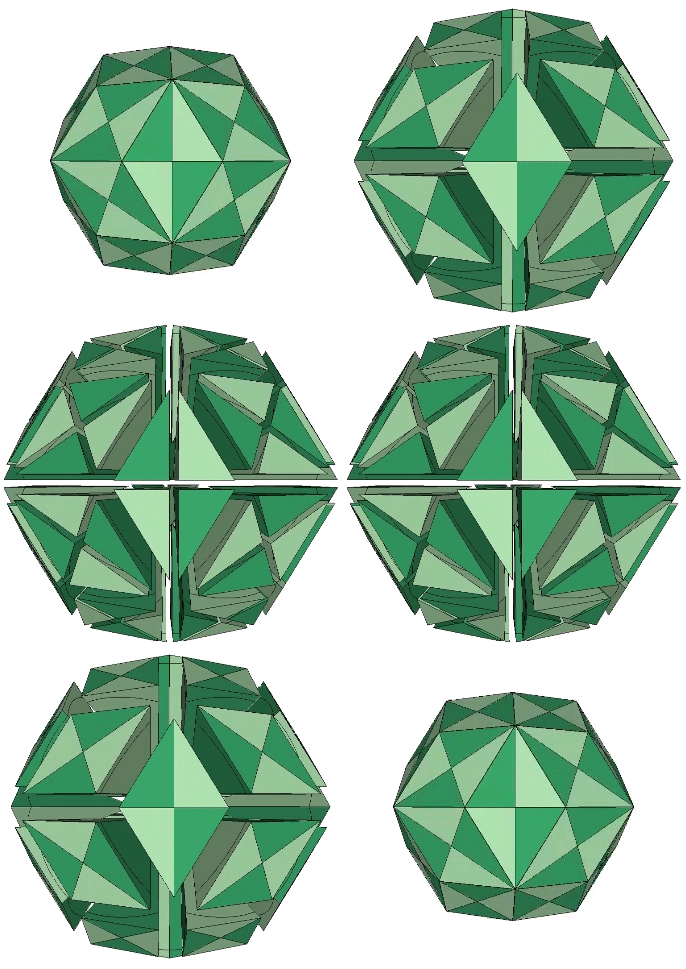
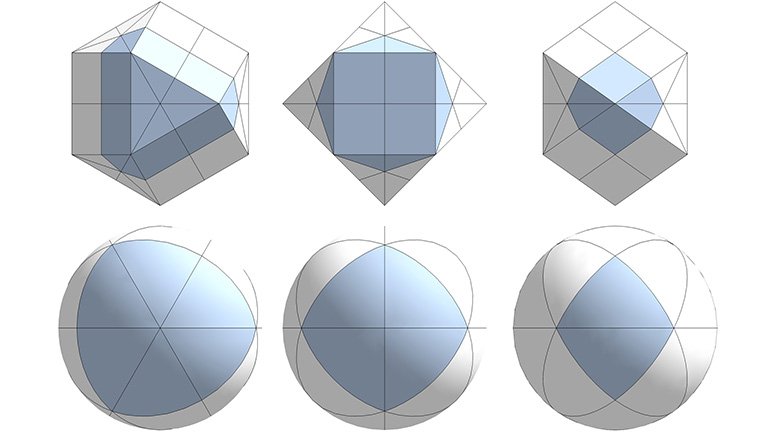
The set of 6 great circles in the VE, formed from the six axes connecting opposite vertices, disclose the spherical rhombic dodecahedron (right), as well as the spherical tetrahedron (left) and spherical cube (middle).
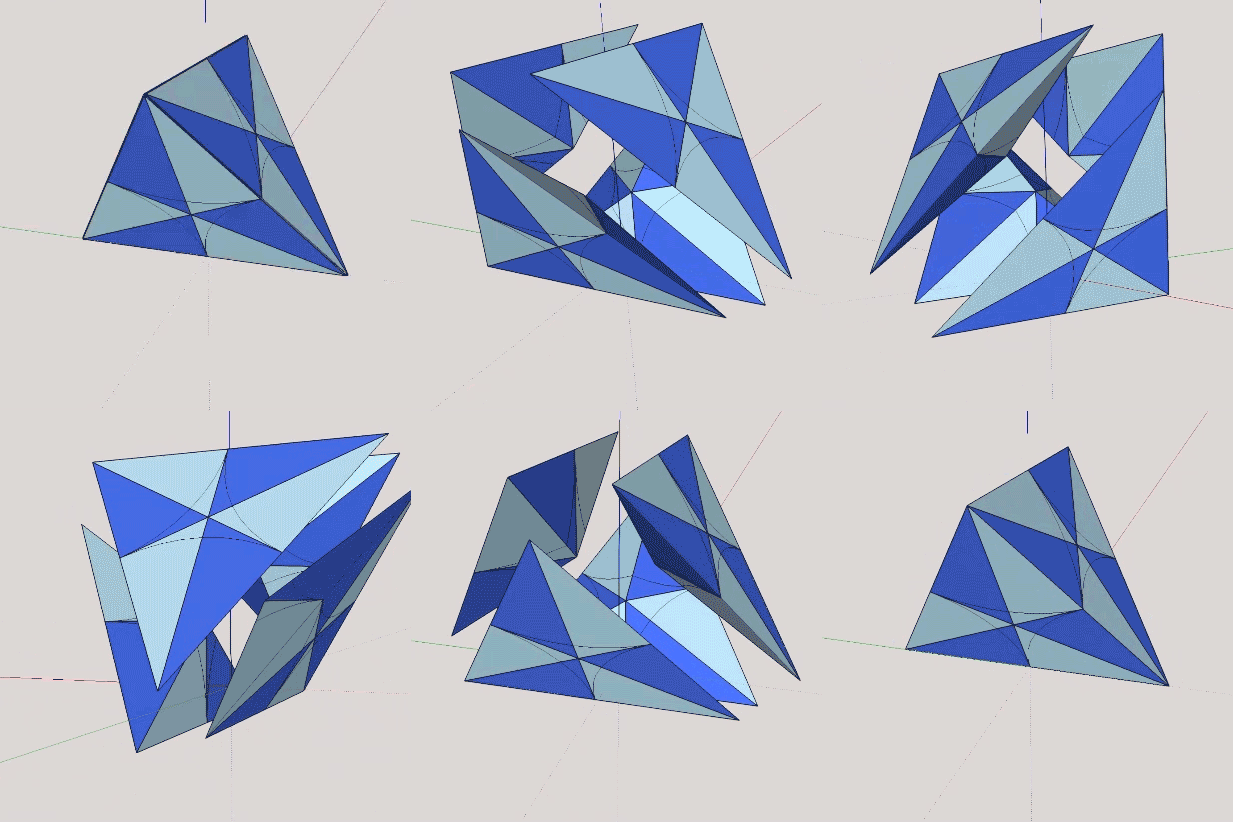
All the great circle sets may be modeled as disks which can then be folded into “bow ties” along their lines of intersection and reassembled. The bow-tie model of the set six great circles of the VE is illustrated below. For more information, see Great Circle Bow-Ties of the VE.
The set of 6 great circles of the VE modeled as bow-ties folded from great circle disks.
The vertices of the rhombic dodecahedron correspond to the distribution of unique nuclei in the isotropic vector matrix.
The distribution of unique nuclei in a rhomboid matrix coexistent with the isotropic vector matrix.
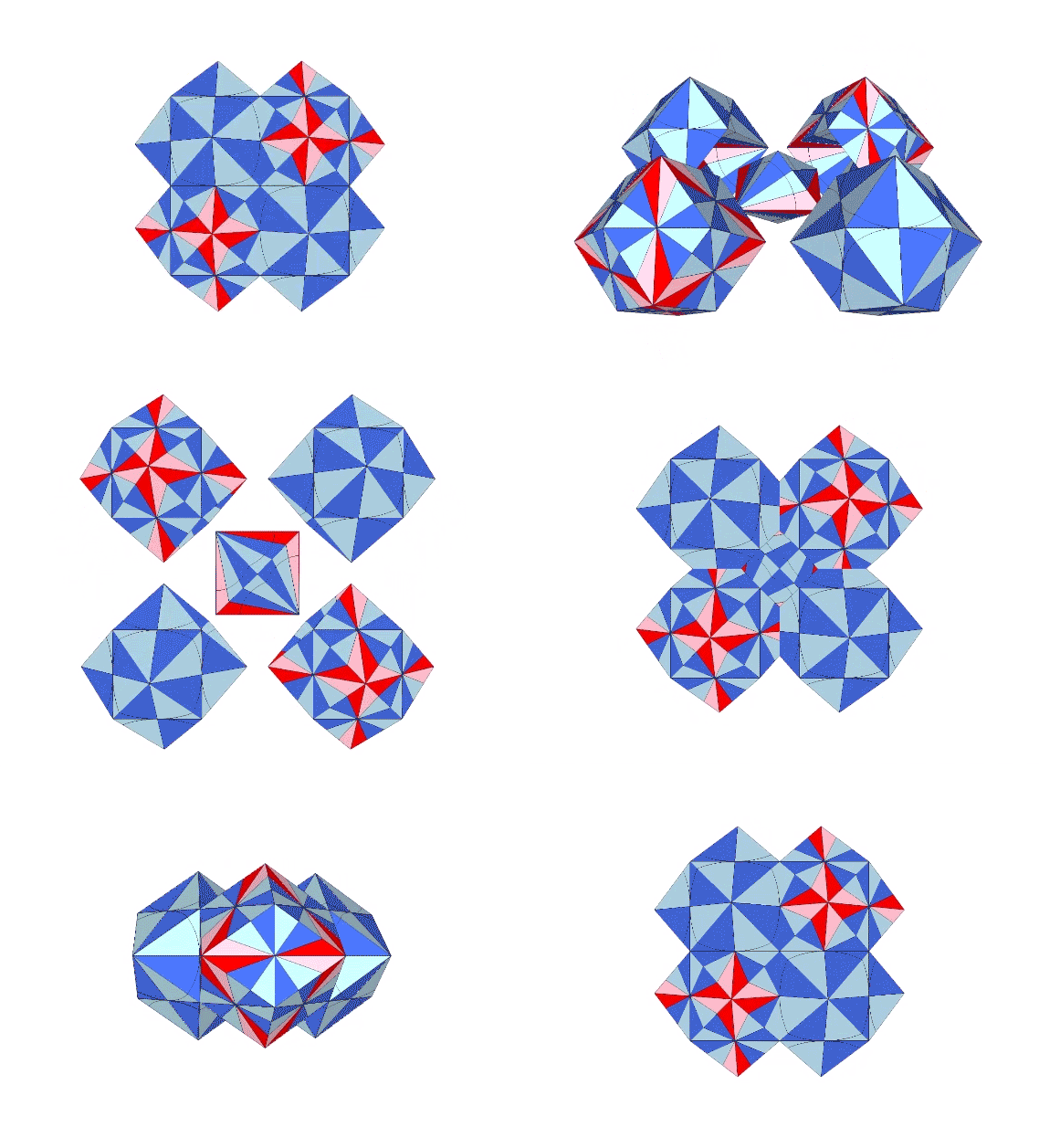
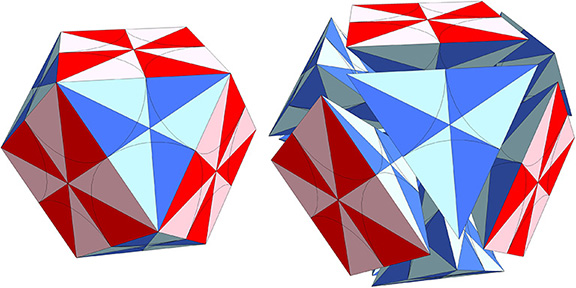
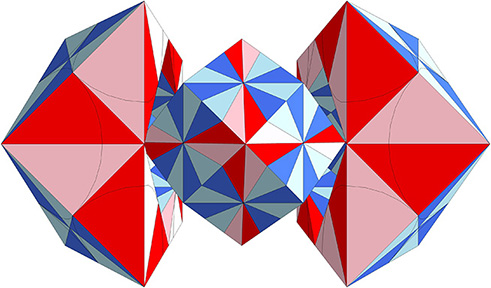
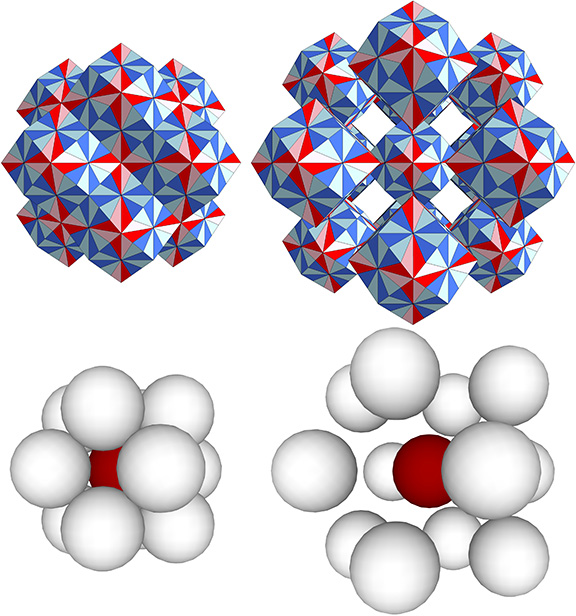
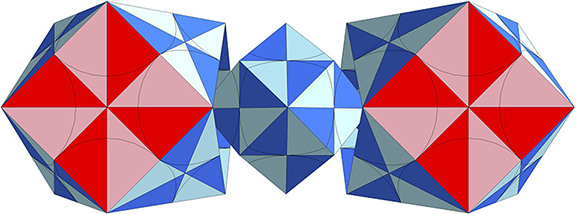
In the quantum model of the isotropic vector matrix (see A and B Quanta Modules) there are two different constructions of the rhombic dodecahedron—one occupying the position of the spheres, and the other occupying the position of the spaces (concave VEs) between the spheres.
In the quanta model of the isotropic vector matrix, there are two constructions of the rhombic dodecahedron, one representing the sphere (top), and the other the space between spheres (bottom).
The one identified with the sphere has all of its constituent quanta modules exposed on the surface, a construction which conveys energy dispersal, or radial pressure:
Spheres: This quanta-module construction of the rhombic dodecahedron suggests an energy-dispersing event.
The one identified with the spaces between the spheres is the outside-in version of the sphere. Its energy-dispersing B quanta modules are fully contained inside a wrapper of energy-conserving A quanta modules, conveying energy-conserving circumferential tension:
Spaces: This quanta module construction of the rhombic dodecahedron suggests an energy conserving event.
“The rhombic dodecahedron’s 144 modules may be reoriented within it to be either radiantly disposed from the contained sphere’s center of volume or circumferentially arrayed to serve as the interconnective pattern of six 1/6th spheres, with six of the dodecahedron’s 14 vertexes congruent with the centers of the six individual 1/6th spheres that it interconnects. The six 1/6th spheres are completed when 12 additional rhombic dodecahedra are close-packed around it. The fact that the rhombic dodecahedron can have its 144 modules oriented as either introvert-extrovert or as three-way circumferential provides its valvability between broadcasting-transceiving and noninterference relaying. The first radio tuning crystal must have been a rhombic dodecahedron.” — R. Buckminster Fuller, Synergetics, 426.41-42
The isotropic vector matrix modeled as A and B quanta modules discloses two rhombic dodecahedra, one occupying the positions of the spheres, and the other the space between the spheres. The two constructions can be shown to exchange places during the jitterbug transformation, which to me is strong validation of the models. See also: Spheres and Spaces.
The close-packing of spheres around a central nucleus form successive shells of cuboctahedra, and defines the polyhedron that Fuller called the vector equilibrium (VE ). We can construct the VE in A and B quanta modules by joining around a common center the quanta module constructions of eight regular tetrahedra and six half-octahedra.
Quanta module constructions of eight tetrahedra and six half-octahedra combined around a common center for the quanta module construction of the VE.
At the center of this construction we have inadvertently constructed a rhombic dodecahedron, which elegantly corresponds to the nuclear sphere of the close-packed array.
At the center of the quanta module construction of the VE is a rhombic dodecahedron.
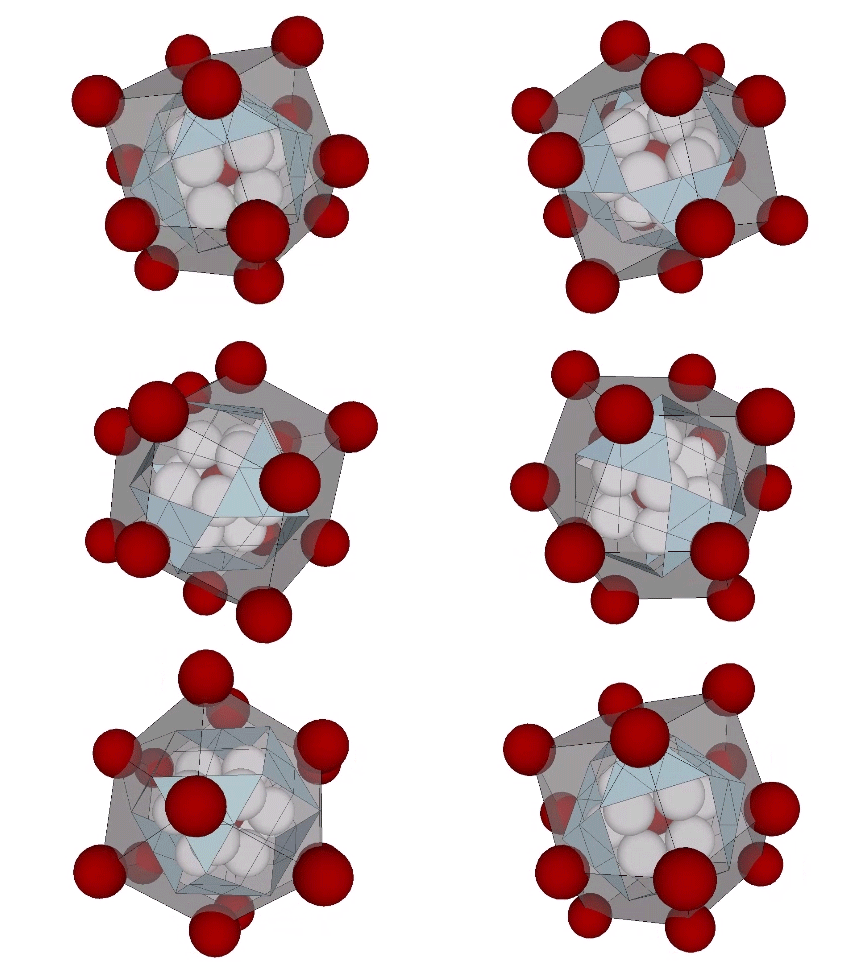
In the quanta module construction of the isotropic vector matrix, it can be shown operationally that the same rhombic dodecahedron occurs at each of the vector equilibrium’s twelve exterior vertices, coinciding with the twelve spheres in the first shell of spheres radially close-packed around a central nucleus.
In the quanta module models of the isotropic vector matrix, twelve rhombic dodecahedra close pack around the rhombic dodecahedron at the center of the VE, just as spheres close pack around a nucleus.
Curiously, another rhombic dodecahedron occurs between vector equilibria in the matrix, that is, in the spaces between the spheres.
An alternate quanta module construction of the rhombic dodecahedron occurs between the rhombic dodecahedra associated with spheres in the isotropic vector matrix. This construction is identified with spaces.
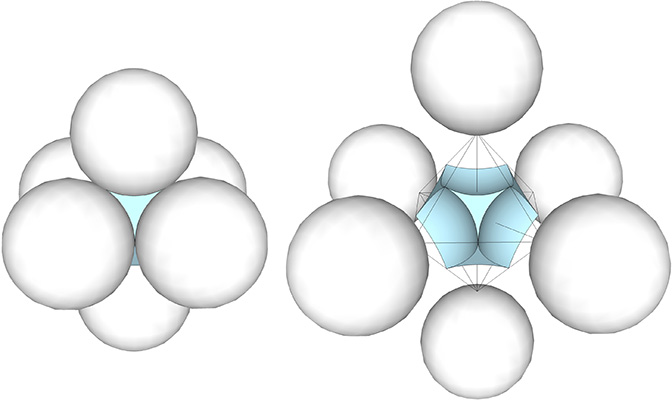
In the interstitial model of the isotropic vector matrix, the space between spheres is disclosed to be a concave vector equilibrium at the centers of the octahedra.
Spaces in the isotropic vector matrix are occupied by the concave vector equilibria at the centers of octahedra.
Because spaces in the isotropic vector matrix are occupied by concave vector equilibria, Fuller conceived of spheres as convex vector equilibria (see Spheres and Spaces). During the jitterbug transformation, these two rhombic dodecahedra exchange places, i.e., the spaces become spheres and the spheres become spaces. Fuller imagined the spaces to be spheres turned inside-out; the concave VE discloses the sphere’s interior (concave) surface. This conception of the jitterbug transformation is reinforced in the two quanta module constructions of the rhombic dodecahedron, as the following illustration should make clear.
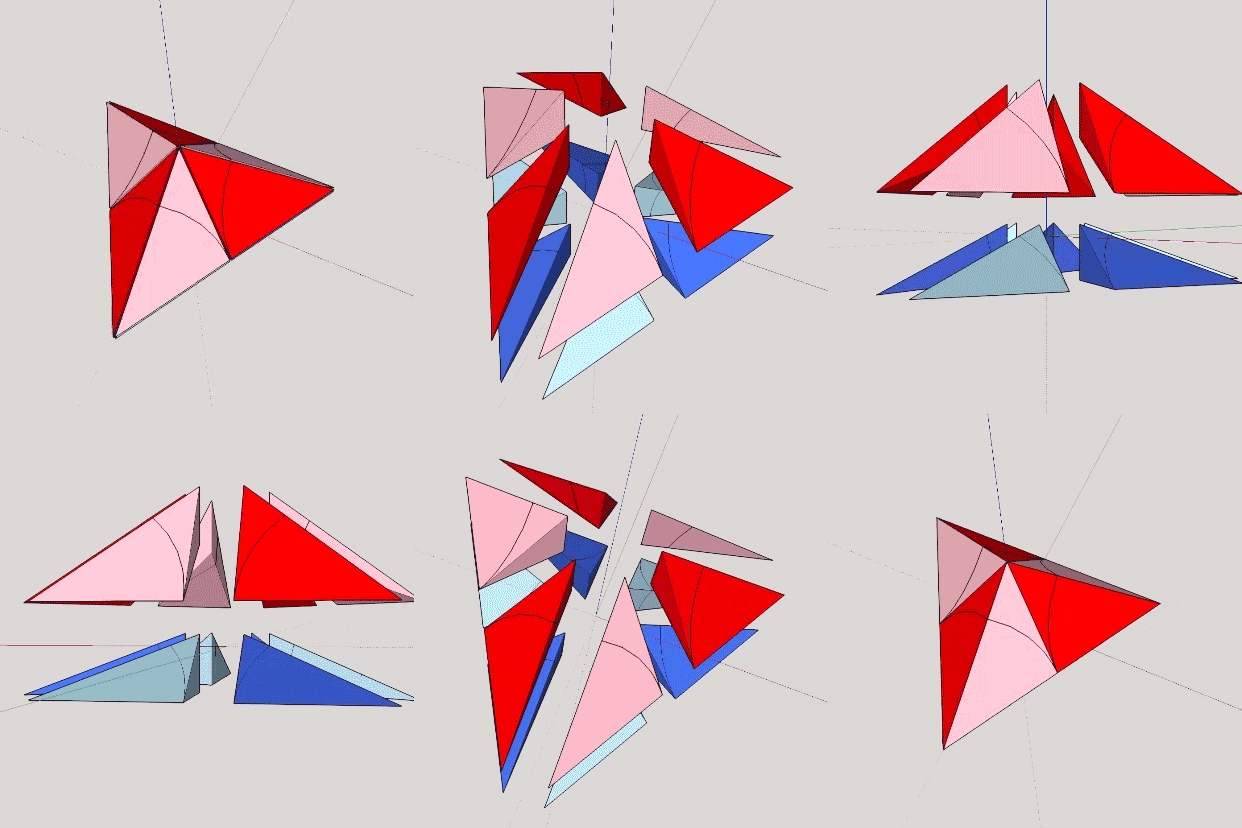
Each of the two quanta module constructions of the rhombic dodecahedra is the inside out version of the other.
We can turn one quanta module construction of the rhombic dodecahedron into the other by dividing it into six irregular octahedra and then flipping them 180° so that the center becomes the surface (or vice versa). See also: Anatomy of a Sphere; and Spheres and Spaces.
Jitterbugging into and out of its ground state, the isotropic vector matrix seems to reach maximum disequilibrium (i.e. maximum expansion) when the contracting vector equilibria (VEs) and expanding octahedra both describe regular icosahedra. It can be shown, however, that the contracting VEs and expanding octahedra cannot pass through their icosahedral phases simultaneously. While one has expanded or contracted into a regular icosahedron, the other describes an irregular icosahedron that complements the other to maintain an unbroken array of face-bonded polyhedra.
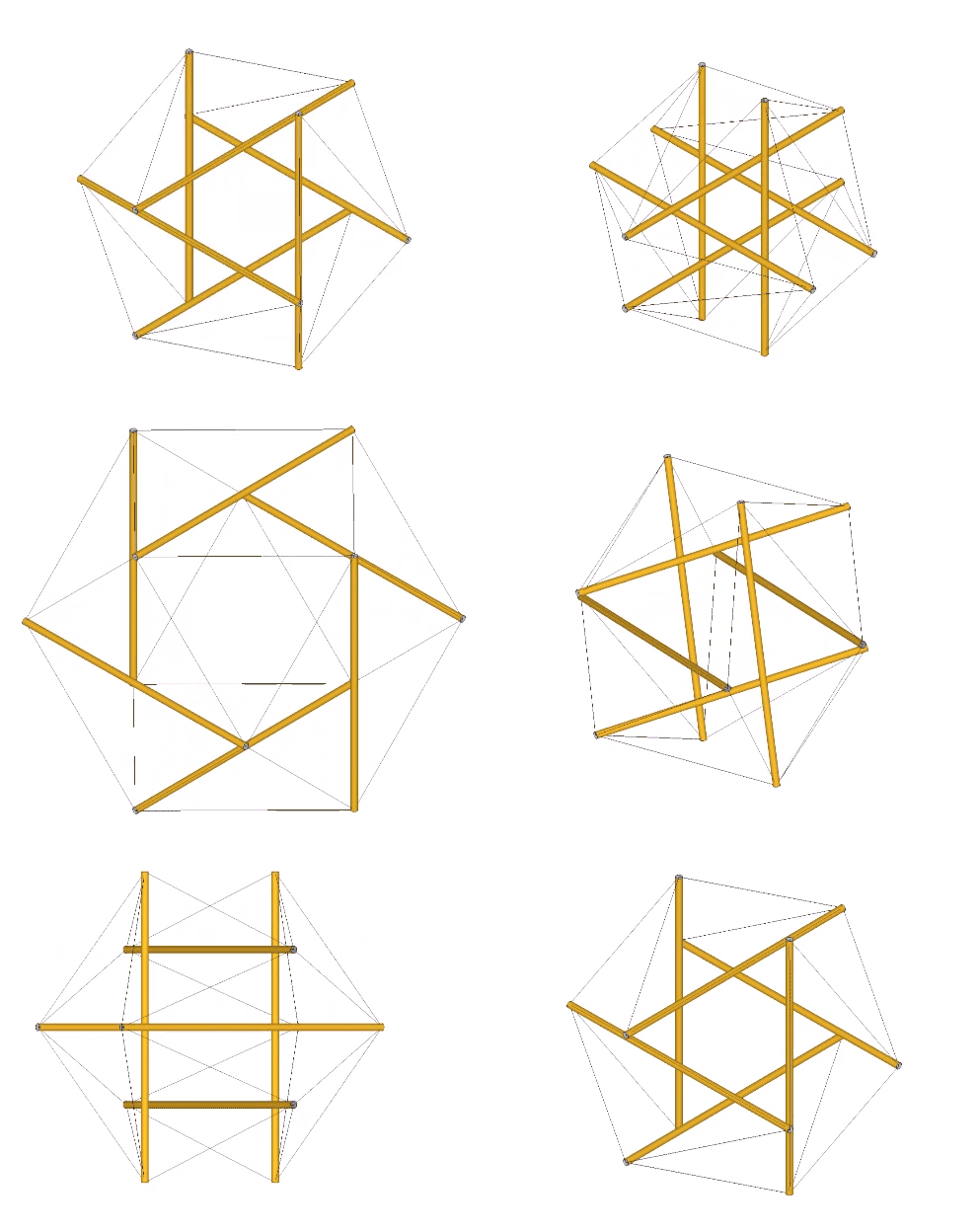
Precisely midway through the jitterbug, both the collapsing VEs and the expanding octahedra describe an irregular icosahedron identical with the six-strut tensegrity sphere which, when combined to fill all-space, forms the tensegrity model of the isotropic vector matrix. See also: Tensegrity. The polyhedron associated with the six-strut tensegrity sphere is now more commonly known as the Jessen orthogonal icosahedron, but in Fuller’s geometry it is more accurately described as the spherical form of the tensegrity tetrahedron. This phase seems to be the true equilibrium phase of the jitterbug, or what I’m now calling the tensegrity, or tensor equilibrium phase—the vector equilibrium phases, i.e., the VE and octahedron phases, being the extremes. See: Tensegrity Equilibrium and Vector Equilibrium.
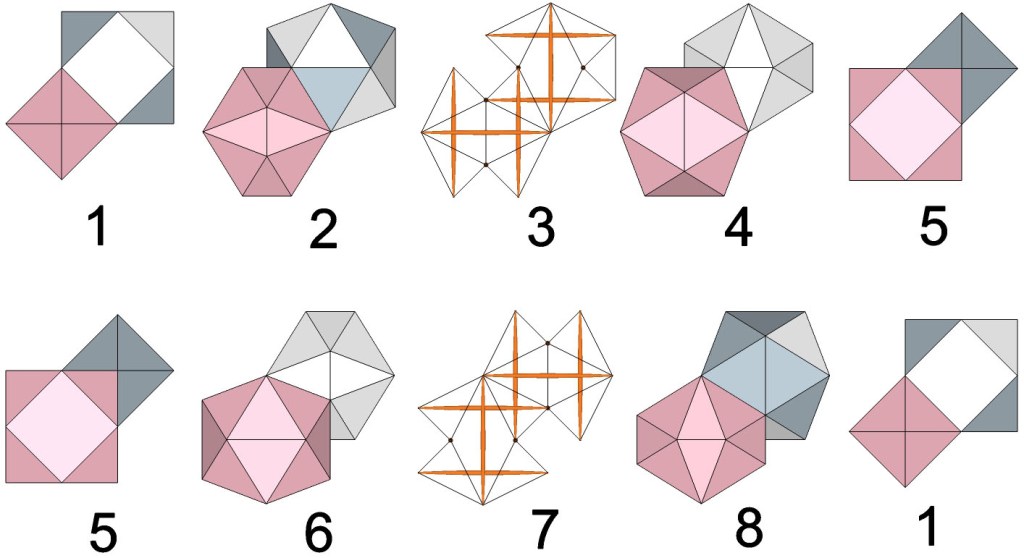
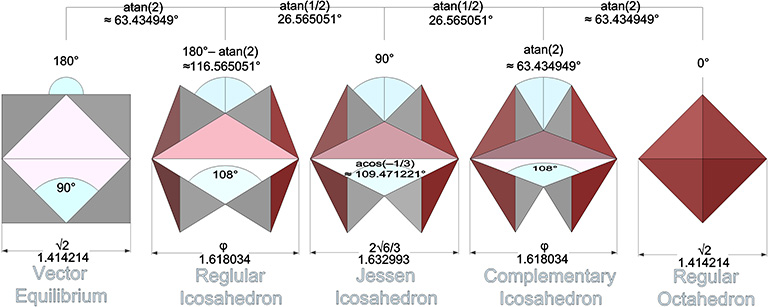
Phases of the Jitterbug Transformation: Phases 1 and 5 are the base states, alternating between VEs and octahedra; at phases 3 and 7 (the midway point) the octahedra and the VEs have both transformed into polyhedra whose dimensions are identical with the six-strut tensegrity sphere; at phases 2, 4, 6, and 8, the regular icosahedra are complemented by irregular icosahedra with rational, even-numbered face angles.
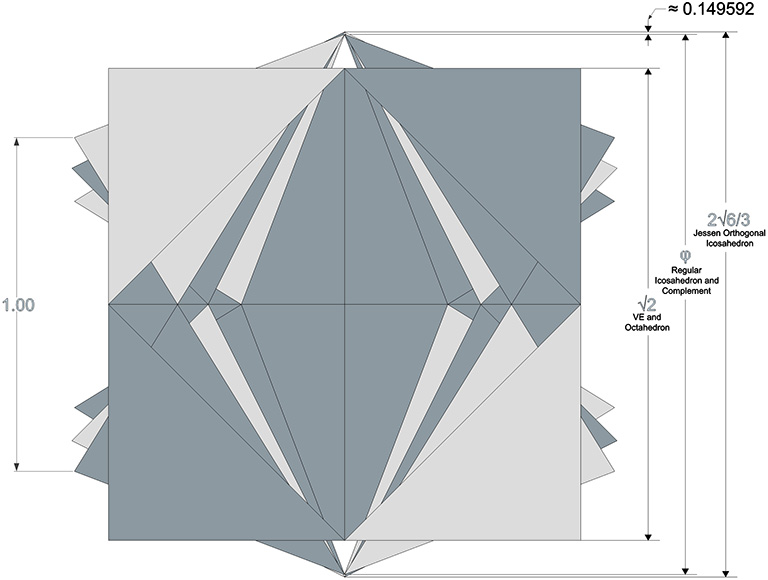
The six-strut tensegrity sphere describes an irregular icosahedron whose cubic domain is less than 1% larger than that of the the regular icosahedron and its complement. With unit edge lengths, the cubic domain of the jitterbugging VE increases from φ (the golden ratio, (√5+1)/2) at the phases of the regular icosahedron and its complement, to 2√6/3, a difference of only about 0.149592.
Linear dimension of cubic domains at each phase of the jitterbug. The VE expands and contracts from √2 at the VE and octahedron phases, through (√5+1)/2 or φ at the regular icosahedron and complement phases, to a maximum of 2√6/3 at the midpoint of the transformation when the jitterbug describes the Jessen orthogonal icosahedron or six-strut tensegrity sphere.
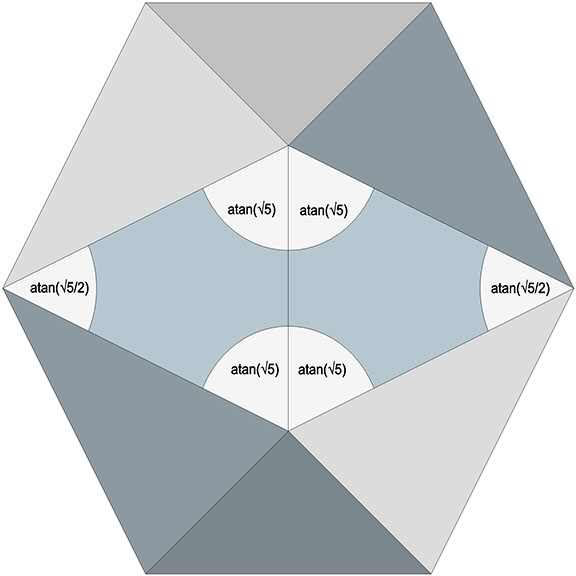
Represented as a convex polyhedron, eight of the twenty faces of the Jessen orthogonal icosahedron remain equilateral triangles (all angles 60°), while the remaining twelve, corresponding to the six open square faces of the VE, are isosceles triangles whose angles are atan(√5/2) and atan(√5), approximately 48.189685°, and 65.905157°.
Jessen icosahedron represented as a convex polyhedron.
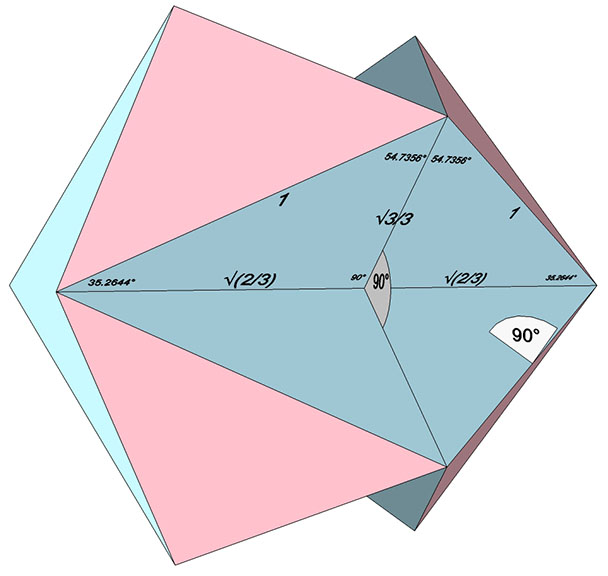
The polyhedron that most closely resembles the six-strut tensegrity sphere draws the vector along the long diagonal (rather than the short diagonal) of the skewed square. This construction forms the concave polyhedron identified as the Jessen Orthogonal Icosahedron, so named because its dihedral (face-to-face) angles are all 90°. Curiously, the angles of the its concave faces, atan(√2/2) and atan(√2) (approx. 35.2644° and 54.7356°) are also found in the tetrahedron and A quanta module, which suggest that that the Jessen may have a rational volume in tetrahedra.
In fact, if the long edge of the Jessen’s concave face is held at √2 (as shown below for the jitterbugging of the 6-strut tensegrity sphere) its tetrahedral volume is precisely 7.5. If the Jessen’s concavities are filled in, its volume is exactly 10.5 unit tetrahedra. The concavities alone have a volume of 3. The same tetrahedral volume as the unit-diagonal cube.
The Jessen orthogonal icosahedron is the polyhedral form of the six-strut tensegrity sphere. All dihedral angles are 90°. The surface angles of its concave faces, arctan(√2) and arctan (√2/2) are found in the regular tetrahedron and the A quanta module.
The jitterbug transformation may be modeled by alternately squeezing the struts of the six-strut tensegrity inward to form the octahedron, and pulling the struts outward to form the VE.
A tensegrity model of the jitterbug transformation. The struts of the six-strut tensegrity sphere are alternately squeezed inward and pulled outward, stretching the tendons into the shapes of the VE and the octahedron.
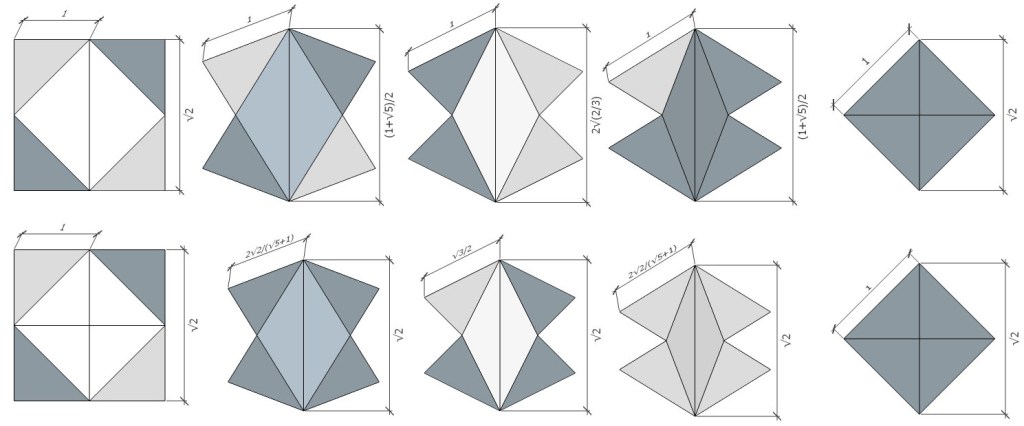
If we allow the tendons of the six-strut tensegrity sphere to stretch while the struts maintain their length of √2 at vector equilibrium, we find that the tendon length increases from √3/2 (approximately 0.866) at tensegrity equilibrium to 1.0 at vector equilibrium. Between tensegrity and vector equilibrium, the icosahedron and its complement have a tendon-edge length of 2√2/(√5+1), or √2/φ, approximately 0.874032.
Top Row: If the tendon length is held constant at 1.0, the strut length decreases from 2√(2/3) (approximately 1.633) at tensegrity equilibrium to √2 (approximately 1.414) at vector equilibrium. Bottom Row: If the strut length is constant, the tendons stretch from √3/2 (approximately 0.866) at tensegrity equilibrium to 1.0 at vector equilibrium.
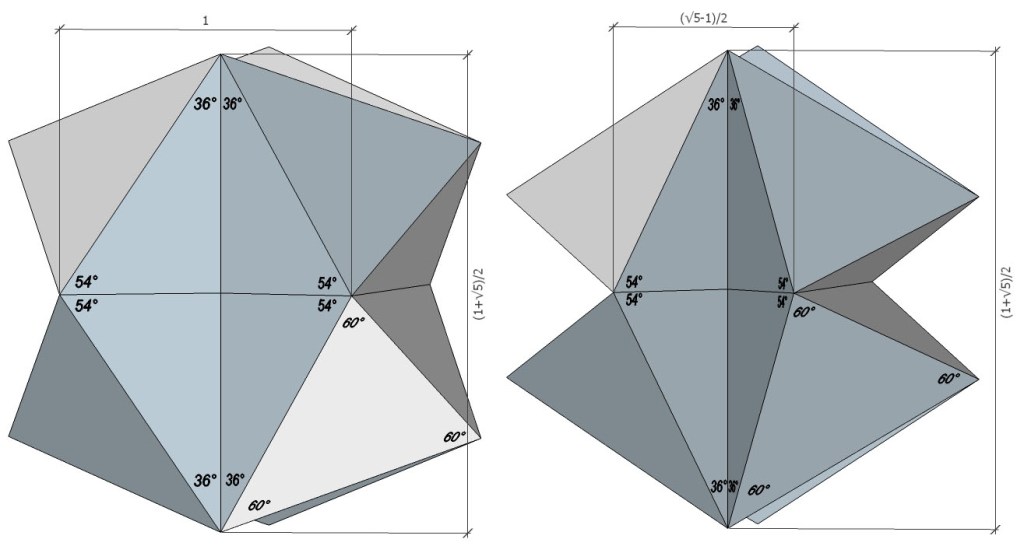
The concave forms of the regular icosahedron and its complement have, despite their different shapes, identical face angles: eight equilateral triangles (60°, 60°, 60°) and twelve isosceles triangles of 36°, 36°, 54°.
Represented as the concave polyhedra, the regular icosahedron (left) and its complement (right) have, despite appearances, identical surface angles and cubic domains.
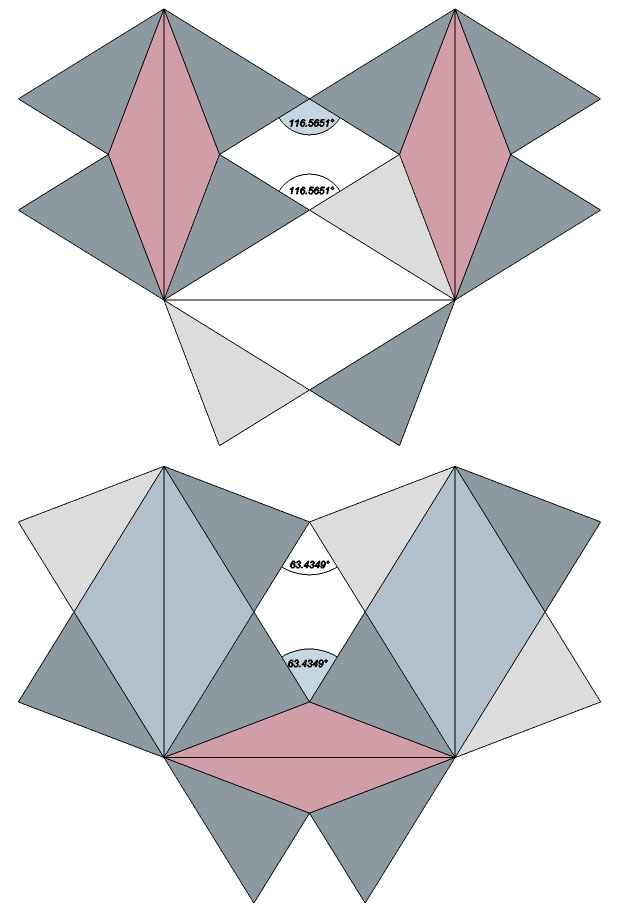
The dihedral angles of the concave polyhedra oscillate between 0° and 180°, passing through: arccos(-√5/5) ≈ 116.5605° at the regular icosahedron phase; 90° at the Jessen phase; and arctan(2) ≈ 63.4349° at the complementary icosahedron phase. The reduction or increase of the angles between phases follows the pattern: arctan(2); arctan(1/2); arctan(1/2); arctan(2); arctan(1/2), etc.
The face angles of the concave polyhedra oscillate between 0° and 180°, passing through: 36° and 108° at the regular icosahedron and its complement phases; and arctan(√2/2) ≈ 35.3644° and arccos(-1/3) ≈ 109.4712° at the Jessen phase.
Icosahedron phases of the jitterbug as concave polyhedra.
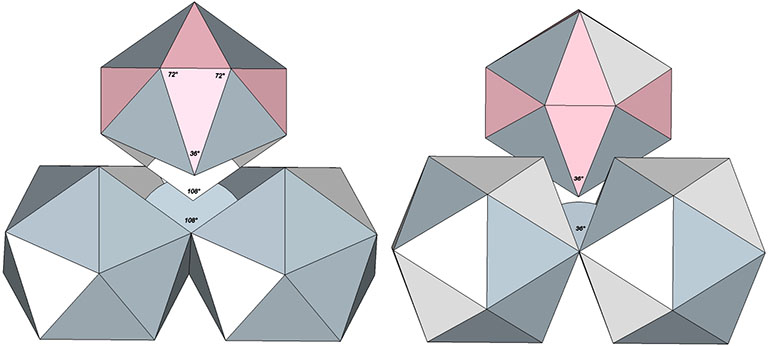
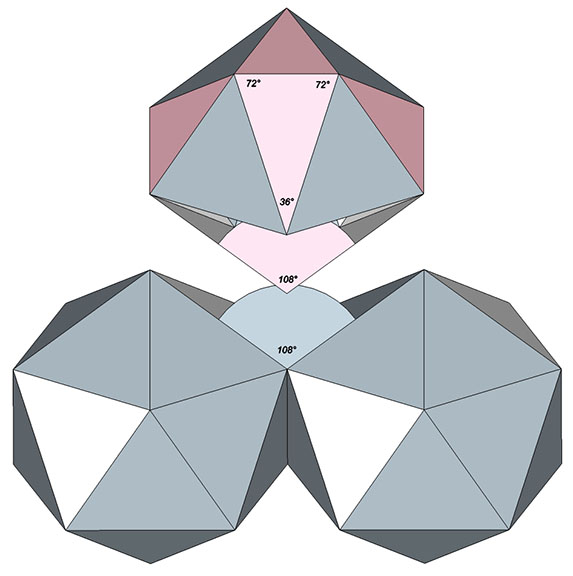
The space-filling complement to the regular icosahedron when represented as a convex polyhedron has rational, whole-number face angles of 36°, 72°, and 72°, the same angles that constitute the golden triangle. Its internal edge-to-edge angles of 108° (3/10 of 360°) match the inter-edge angles of close packed convex regular icosahedra so that one nests transversely between the others.
The space-filling complement to the icosahedron (top, pink) nests between two regular icosahedra.
The concave faces of the regular icosahedron and its complement form symmetrical “holes” that tunnel perpendicularly through the matrix with angles of 2×atan(φ) and 2×atan(1/φ) or atan(2), approximately 116.56505° and 63.43495° respectively.
The concave faces of the regular icosahedron and its complement form holes that tunnel transversely through the matrix.
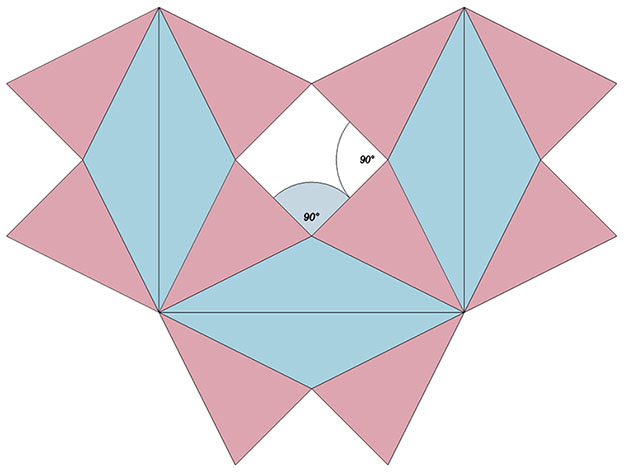
At tensegrity equilibrium the dihedral angles approach 90° and the transverse “holes” are orthogonal.
The concave faces of the Jessen orthogonal icosahedron form square holes that tunnel transversely through the matrix.
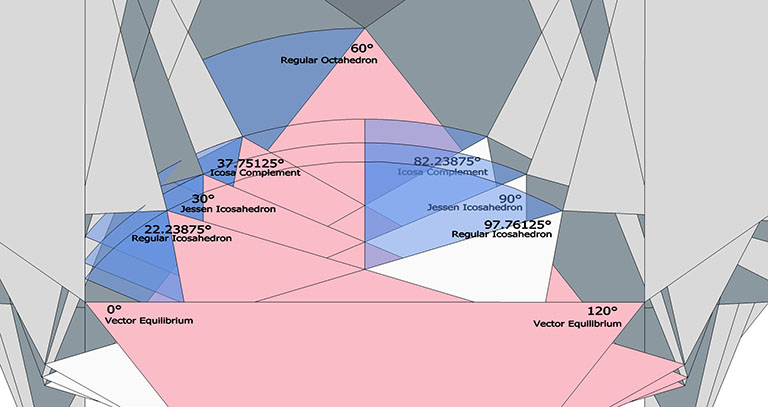
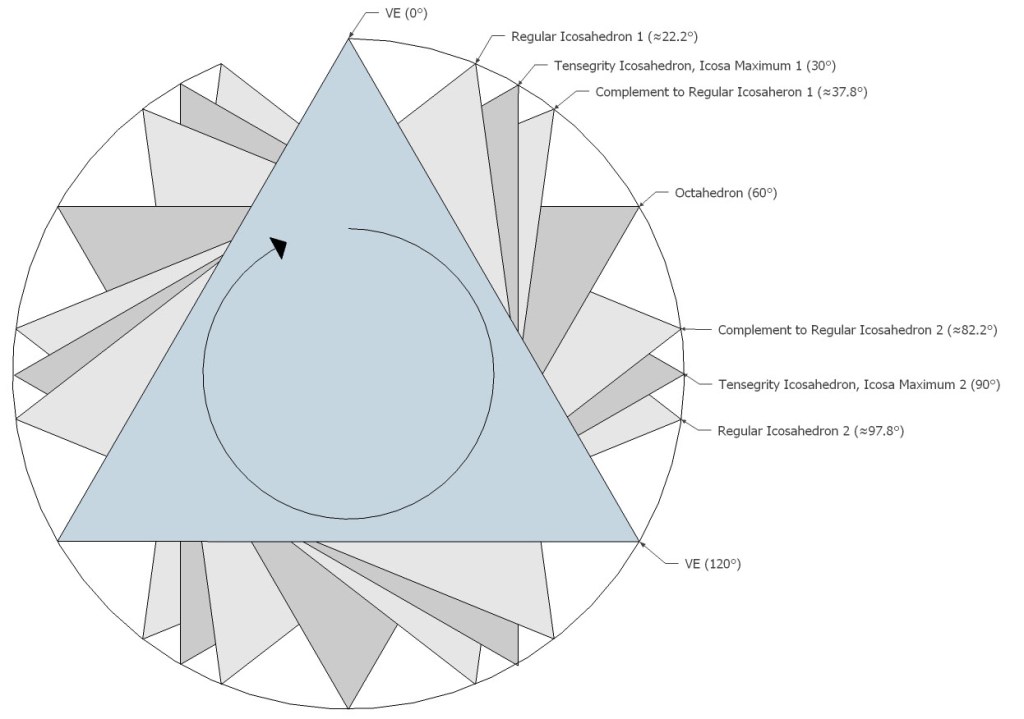
In the following illustration, the sequence of polyhedral transformations is shown in relation to the the angular rotation of the equilateral triangles in the vector model of the jitterbug.
From the vector equilibrium (VE) phase, a rotation of arctan(√(5/3))-30° (approximately 22.23875°) produces the regular icosahedron. Additional rotations of arctan(√(3/5))-30° (approximately 7.76125°) produce the Jessen icosahedron at 30°, and the space-filling complement to the regular icosahedron at arctan(√(3/5)) (approximately 37.76125°). Another rotation of 22.23875° produces the Octahedron at 60°. From the octahedron phase the rotation can reverse direction or continue to produce the complement to the regular icosahedron at arctan(√(5/3))+30° (approximately 82.23875°), the Jessen icosahedron at 90°, the regular icosahedron at arctan(√(3/5))+60° (approximately 97.76125°), and the VE again at 120°.
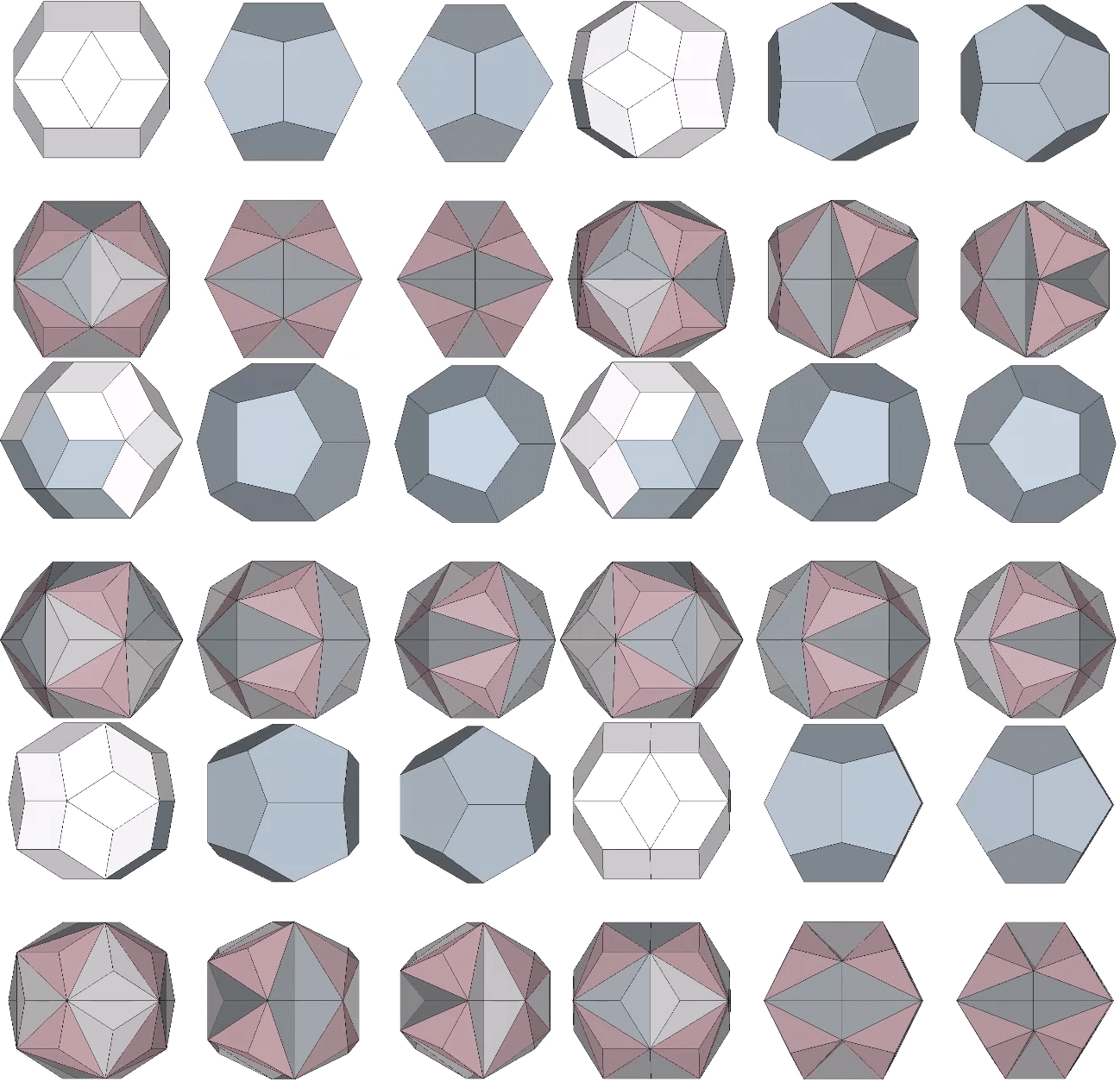
The regular icosahedron, the Jessen icosahedron, and the space-filling complement to the regular icosahedron, are truncations of the rhombic tricontahedron (top left), pyritohedron (top middle), and pentagonal dodecahedron (top right), respectively.




















 The Geometry of Thinking