I’ve updated this topic with better illustrations here: The 31 Great Circles of the Icosahedron (new illustrations).
The 31 great circles of the icosahedron disclose the following spherical polyhedra: the octahedron; icosahedron; pentagonal dodecahedon; icosidodecahedron; tricontahedron; and VE.
Octahedron
The two octahedra, the icosahedron, the pentagonal dodecahedron, and the tricontahedron, as well as the basic disequilibrium LCD triangle, are all disclosed in the 15 great circles defined by the icosahedron’s 15 edge-to-edge axes of spin. Each face of spherical octahedron contains 15 of the 120 LCD triangles.

Octahedron (with Inscribed Icosahedron)
The inscribed face of the regular icosahedron contains 6 of the 120 LCD triangles.

Pentagonal Dodecahedron
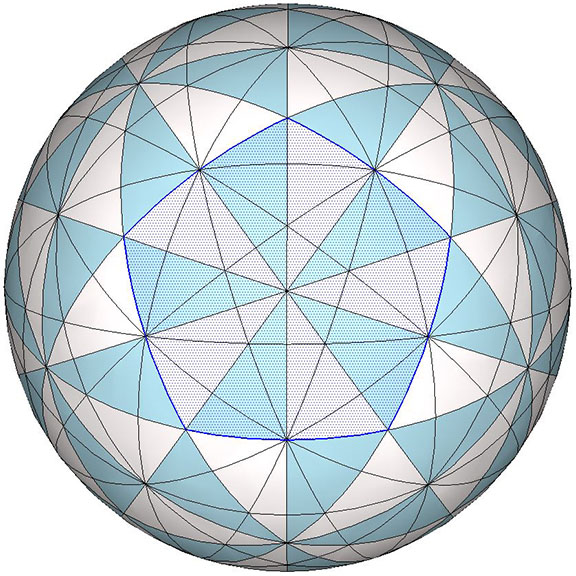
Each face of the pentagonal dodecahedron contains 10 of the 120 LCD triangles.
Triacontahedron
Each face of the triacontahedron contains 4 of the 120 LCD triangles

Icosidodecahedron
The icosidodecahedron is disclosed in the set of 6 great circles defined the icosahedron’s 6 vertex-to-vertex axes of spin. Both the triangular and pentagonal faces of the icosidodecahedron contain only partial LCD triangles.

Vector Equilibrium (VE or Cuboctahedron)
The vector equilibrium (VE) is disclosed in the 10 great circles defined by the icosahedron’s 10 face-to-face axes of spin. Both the triangular and square faces of the spherical vector equilibrium contain only partial LCD triangles.

 The Geometry of Thinking