The regular icosahedron can be nested inside the regular octahedron so that eight of its faces are coincident with the eight faces of the enclosing octahedron.
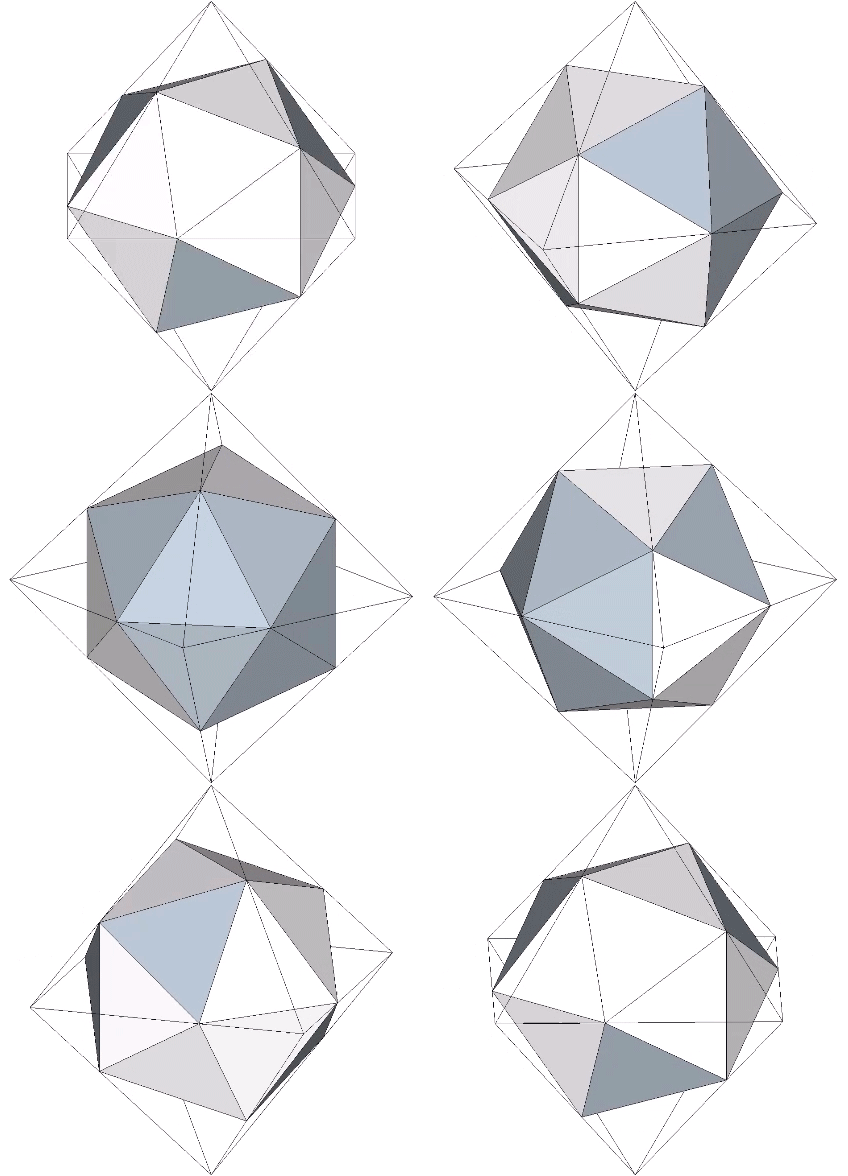
The icosahedron’s face is skewed at an angle of 37.76125° (arctan(√(3/5)) from the face of the octahedron and divides its edges into lengths corresponding to golden ratio (Φ).

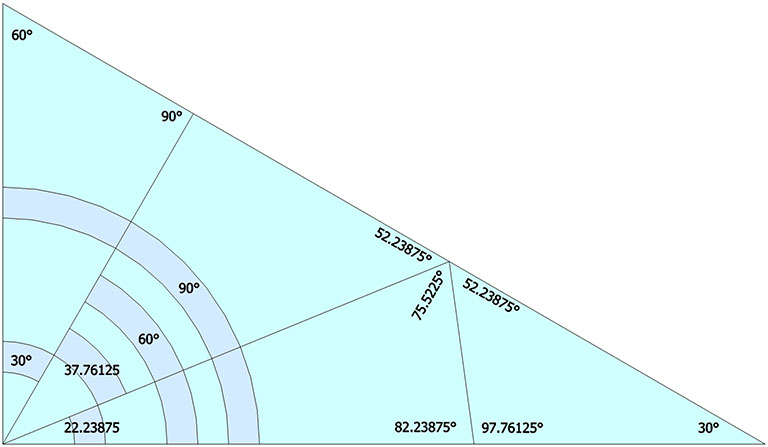
The same relationship is disclosed in the 31 great circles of the icosahedron. The faces of both the spherical octahedron and the spherical icosahedron are divisible by whole numbers of the Basic Disequilibrium LCD Triangle.

The projection of the Basic Disequilibrium LCD Triangle onto the regular icosahedron discloses the same angles at which the icosahedron’s face is skewed from the face of its enclosing octahedron: 37.76125° (arctan(√(3/5)) and 82.23875° (arctan(√(5/3)+30°).
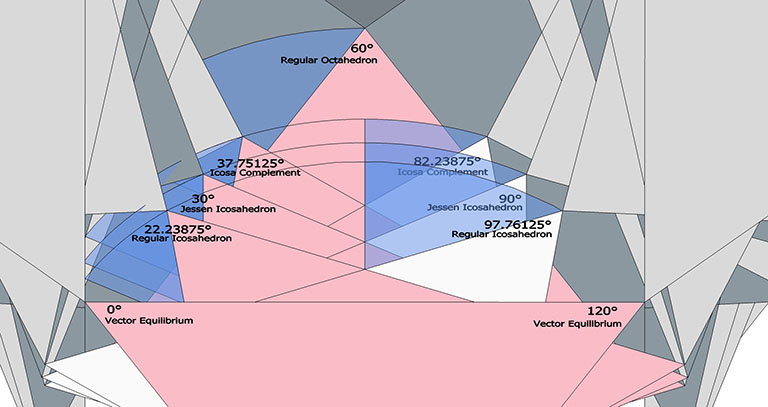
The angles at which the icosahedron’s face is skewed from the face of the enclosing octahedron are identical with the angles of rotation in the jitterbug corresponding to the space-filling complement to the regular icosahedron. See: Icosahedron Phases of the Jitterbug.
Note further that all of the surface angles in the icosahedron projection of the spherical LCD triangle are identical with the rotations in the jitterbug: the regular icosahedron at 22.23875° (arctan(√(5/3)-30°) and 97.76125° (arctan(√(3/5)+60°); the Jessen icosahedron or tensegrity equilibrium at 30° and 90°; the space-filling complement to the regular icosahedron at 37.76125° (arctan(√(3/5)) and 82.23875° (arctan(√(5/3)+30°), and the regular octahedron at 60°.
 The Geometry of Thinking